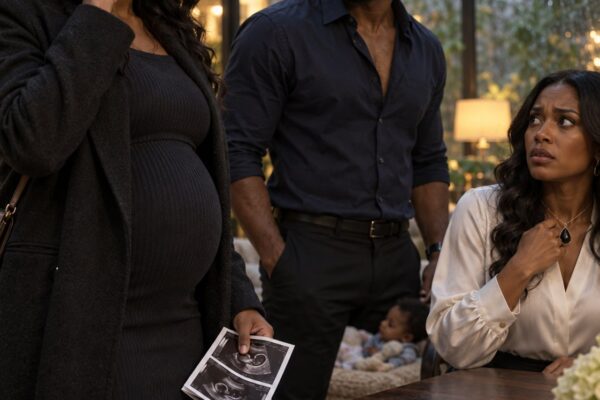
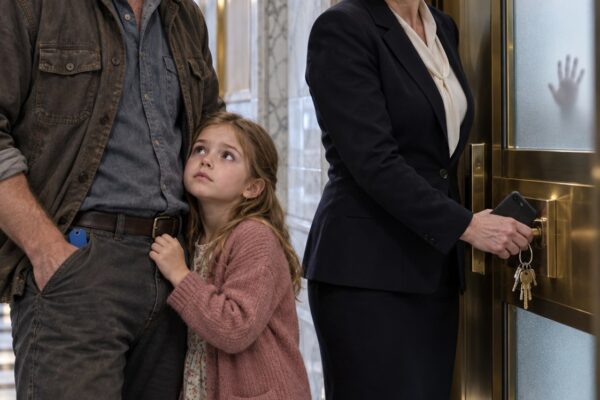
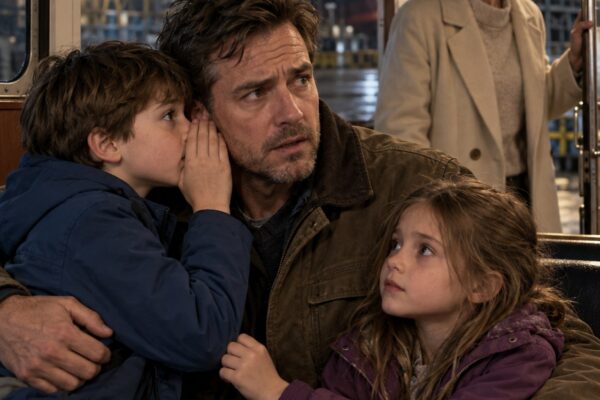
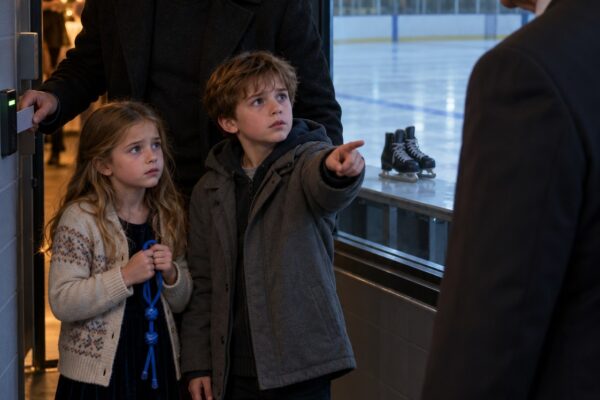
My Daughter Found a Shivering Girl Under Our Kitchen Table—and the Papers in Her Pencil Pouch Named Me as Her Father
Chapter 2: What the Papers Held
Celia knocked again.
The girl moved behind my legs.
Brooke’s phone shook in her hand.
June stood by the sink, still holding a spoon.
“Take June upstairs,” I said.
“I want to stay,” June whispered.
“I know.”
Brooke put an arm around her.
Celia tried the handle.
It was locked.
“Nathan,” she called. “Let me explain.”
“Explain from there.”
“The child needs to come with me.”
“What’s her name?”
Nobody answered.
I looked down.
“Can you tell me?”
“Kit.”
“Kit what?”
“Ingrid says Kit Mercer.”
Celia tapped the glass.
“That’s what her guardian calls her.”
Brooke closed her eyes.
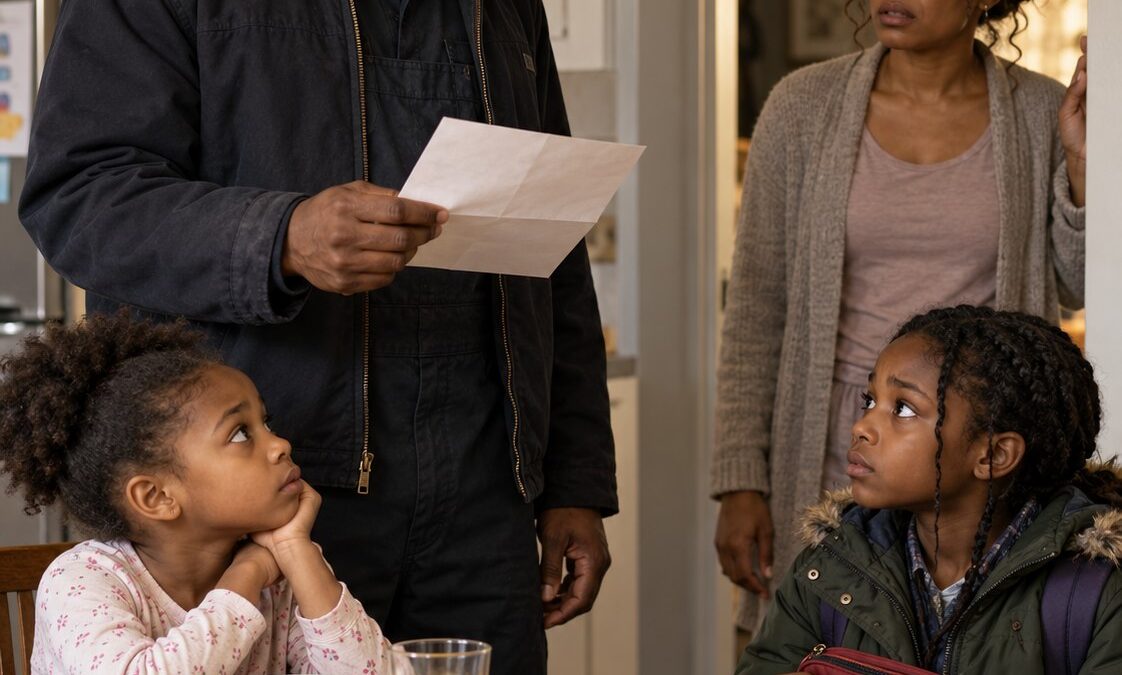
I kept the birth paper in my hand.
The page bore a county seal and a date I remembered.
It was the date Tess had called me crying.
She had said there was no baby anymore.
I had sat on the floor of my old apartment until dawn.
“Nathan,” Celia said, “that paper proves nothing.”
“Then why did you come for it?”
Her face appeared beside the kitchen door.
Even through rain-streaked glass, her expression looked composed.
Celia ran the largest private adoption agency in our county for twenty-two years.
She knew judges, donors, and half the people at city hall.
Last spring, the mayor had thanked her for building families.
“I came because Ingrid Mercer called me,” she said.
Kit grabbed my jeans.
“She was scared,” Kit whispered.
“Who was scared?”
“My mom.”
A siren sounded several streets away.
Celia looked toward it.
“Open this door before someone gets hurt.”
I called the police myself.
I gave the dispatcher our address.
Then I said an eight-year-old had arrived frightened and cold.
I said an adult outside was demanding custody without showing me an order.
Celia heard every word.
Brooke led June to the living room.
She came back alone with a blanket.
Kit took it after I nodded.
For one second, Brooke and I looked at each other.
“You knew,” I said.
“Yes.”
“Did you tell Tess?”
Brooke’s mouth opened.
“No.”
The officer arrived six minutes later.
Celia greeted him by name.
I showed him the paper.
He asked Kit whether she knew Celia.
“Yes,” Kit said.
“Do you want to go with her?”
Kit shook her head.
The officer crouched to her height.
“Is Ingrid Mercer your mom?”
“Yes.”
“She’s at St. Anne’s?”
Kit nodded.
He called the hospital.
Celia stood in our kitchen doorway while he spoke.
She did not come inside.
Ingrid was conscious.
She had been admitted after a fall.
She had told a nurse that Kit was with a neighbor.
That neighbor was looking for her now.
Kit looked at the floor.
“I left a note.”
“You walked here alone?” I asked.
“Mom gave me the address.”
Celia’s gaze snapped to the pouch.
Brooke saw it too.
“What’s in there?” she asked.
Kit held it against the blanket.
“My mom said only Nathan.”
I knelt.
“I’m Nathan.”
She studied my face.
Then she gave me the pouch.
Inside were two more pages.
One was an agency receipt.
The other was a copy of a letter addressed to Tess.
Across the bottom, in block capitals, someone had written that I had declined to be contacted.
The signature beneath those words was supposed to be mine.
I had never seen that letter.
I had never signed it.
* * *
The officer asked Celia to wait outside.
He did not accuse her of anything.
He wrote down the names on the papers and photographed each page.
He asked Kit how she had reached our house.
She pointed toward the street.
“Mom told me which bus.”
I pictured her alone at the stop in the rain.
My work boots were still damp from the depot.
“I’ll get her dry socks,” I said.
Kit watched me leave the kitchen.
When I returned, she had finished the oatmeal June had poured.
June sat across from her.
Neither girl spoke.
Brooke stood at the stove, holding the pot with both hands.
The officer found Ingrid’s neighbor by phone.
The woman had reported Kit missing twenty minutes earlier.
She came to our house with a hospital social worker.
Celia said Ingrid had given Kit false information.
The social worker asked Celia to make that statement at the station.
Celia said she would bring her attorney.
Kit went to the hospital with the neighbor.
Before she left, she touched the pouch in my hand.
“Keep it safe.”
“I will.”
“Will you come?”
“Yes.”
Brooke offered me her car keys.
I took them.
That was all we said until the girls were gone.
At St. Anne’s, Ingrid Mercer sat upright in bed with her left wrist wrapped.
She was a school librarian in her fifties.
Her face softened when Kit ran to her.
“You found him,” Ingrid said.
Kit climbed carefully onto the bed.
Ingrid looked at me.
“I’m sorry she had to come this way.”
“Why did she?”
“Celia came to my house yesterday.”
Ingrid had requested Kit’s original birth information months earlier.
Kit wanted to know where she had been born.
The agency sent records with two different dates.
Ingrid asked for a corrected copy.
Celia called within an hour.
“She said records from that period were unreliable,” Ingrid told me.
“Then she offered to collect them herself.”
Ingrid had kept the papers.
That morning, she fell on her porch steps.
While the ambulance crew helped her, she gave Kit the pouch.
She told the neighbor where Kit would be staying.
“She was meant to bring it here,” Ingrid said.
“Kit heard Celia’s name and panicked.”
Kit hid her face against Ingrid’s sleeve.
Ingrid kissed her hair.
“I should have explained better.”
The social worker gave us time alone.
I spread the papers across the tray.
The birth record named Tess Bellamy as Kit’s mother.
Tess and I had dated for three years.
Nine years ago, she became pregnant.
We were young, broke, and frightened.
We were making plans anyway.
Then Tess called to say she had lost the baby.
A week later, she moved to her aunt’s place in another state.
We spoke twice more.
Both calls ended badly.
“I thought she wanted me gone,” I said.
Ingrid looked at the letter.
“She was told the same thing about you.”
“Who told her?”
“Celia.”
Ingrid had spoken to Tess the previous night.
She reached for her phone.
Tess answered on the third ring.
Her voice came through thin and strained.
“Nate?”
I gripped the bed rail.
“Tess.”
“I didn’t know where Kit was.”
“She’s safe.”
The line went quiet.
Then Tess said, “I’m coming.”
I looked at Brooke’s handwriting on the envelope inside the pouch.
I knew her writing from grocery lists and birthday cards.
She had labeled that envelope six years ago.
Brooke had known before June was born.
* * *
Brooke was waiting in our kitchen when I returned.
June was asleep upstairs.
Her third bowl remained on the table.
Brooke had washed the spoon but left the place set.
“Kit’s safe,” I said.
“Thank God.”
I set the pouch beside the bowl.
“When did you find out?”
“Three months after our wedding.”
“How?”
“I was closing old agency accounts for my mother.”
Brooke had worked for Celia before we met.
After we married, she helped part-time during tax season.
One file contained Tess’s name.
Another contained mine.
Brooke recognized both.
“She said it had been handled legally,” Brooke said.
“You saw my signature.”
“I saw a copy.”
“You knew it wasn’t mine.”
“I asked her.”
“And?”
“She said there was a signed original.”
Brooke pulled out a chair.
She did not sit.
“I wanted to believe her.”
“What did Tess know?”
“Celia told Tess you had signed away your rights.”
“And Tess believed it?”
“She was nineteen.”
So was I.
I had been working twelve-hour shifts and sleeping on a friend’s couch.
Tess had no family nearby.
Celia had offered her help through a counselor at the clinic.
The help came with papers.
I looked toward the stairs.
“Why didn’t you tell me?”
“By then we were married.”
“That isn’t an answer.”
“I thought you would leave.”
She said it plainly.
I had waited six years for an answer she could say in six words.
Brooke pressed her fingers against the chair back.
“Every year made it harder.”
“Every year Kit got older.”
“I know.”
A car passed outside.
June coughed in her sleep.
Brooke started toward the stairs.
I caught myself watching her.
She had checked on June every night since our daughter was born.
She had also passed Kit’s file across a desk and gone home to me.
“Celia came here before the police,” I said.
“She called me from the hospital.”
“How did she know Kit had the papers?”
“Ingrid told her she’d given them to someone.”
Brooke glanced at the pouch.
“I told her Kit was here.”
“Why?”
“I thought she could calm this down.”
I took a step away from her.
Brooke did not follow.
“She said she had a court order,” Brooke said.
“Did you see it?”
“No.”
The next afternoon, someone left a large envelope at the bus depot.
My supervisor brought it to me.
Inside was a letter from Celia’s attorney.
It said the birth papers were private records.
It demanded their return.
It also said I had caused distress to a minor child by claiming to be her father.
My supervisor had read the envelope’s return address.
He asked whether I needed time off.
I asked for two days.
He gave me three.
I took the letter to a lawyer recommended by Ingrid’s social worker.
Her name was Denise Park.
She read it once.
“Do you have the originals?”
“Ingrid does.”
“Good.”
Denise explained what we could establish quickly.
The county could provide certified birth records.
The agency records might require a court order.
A parentage test could answer the biological question.
None of those steps would decide where Kit lived that week.
“Ingrid is her mother in every daily sense,” Denise said.
“She raised her.”
“I know.”
“You need to hear it anyway.”
I did.
Tess arrived that evening.
We met in a hospital conference room.
She had gray at her temples now.
I wondered whether she saw the scar across my knuckle.
I had got it fixing a crib we never used.
She stopped three feet from me.
“They told me you wouldn’t come,” she said.
“They told me there was no one to come for.”
Tess sat down.
She had placed Kit with Ingrid herself.
That part was true.
She had believed I had refused the baby and signed the papers.
She could not care for a newborn alone.
Ingrid had sent Tess photographs over the years.
They had met a few times when Kit was younger.
Tess now worked as a medical receptionist and lived four hours away.
“I thought I’d done what she needed,” Tess said.
“You did what you could.”
“I should have called you.”
“I should have called you too.”
Neither of us pretended one call would have solved everything.
Denise joined us.
She showed Tess the copied signature.
Tess stared at it.
“That’s the page Celia showed me.”
“Did you see Nate sign?”
“No.”
Celia had said she was carrying it from him.
Denise asked about the day Tess signed.
Tess remembered a counselor and a stack of forms.
She remembered being told I had already made my choice.
She remembered wanting to go home.
The clinic counselor had retired.
Denise took her name.
When we left, my phone rang.
It was Ingrid.
Someone had come to her house while the neighbor was collecting Kit’s clothes.
The back door was open.
Nothing valuable appeared missing.
The drawer where Ingrid kept adoption papers had been emptied.
Ingrid’s voice stayed steady.
“Kit isn’t here,” she said.
“She’s with me.”
I thanked her for saying that first.
Denise called the detective assigned to our report.
We drove to the station.
I gave him the letter from Celia’s attorney.
I told him about the emptied drawer.
He asked us to keep every message and avoid confronting anyone.
Then he showed us a photograph Ingrid’s neighbor had taken.
A blue agency van had parked across from the house that morning.
Its registration belonged to Celia Voss’s agency.
* * *
The detective did not call Celia a thief.
He said the van gave him a lead.
He asked Ingrid’s neighbor to send the original photograph.
He asked the agency for its vehicle log.
Celia’s attorney said the van had been there for a scheduled welfare visit.
Ingrid had no appointment.
Denise obtained written confirmation from her.
The court set a hearing about preserving the adoption records.
Celia arrived with two attorneys and a folder thick enough to hide behind.
Her agency’s accountant arrived carrying another.
I sat beside Tess and Ingrid.
Brooke sat at the end of our row.
Kit stayed at Ingrid’s sister’s house with June.
June had asked whether Kit could have the red bowl.
I had told her yes.
Celia’s attorney spoke first.
He said we were reopening a settled adoption because an old relationship had left painful feelings.
He said documents had been copied without context.
He said Kit needed calm.
On that point, I agreed with him.
He turned toward Ingrid.
He praised her care.
Then he said Celia’s agency had protected her family for eight years.
Ingrid folded her hands.
Celia took the stand.
She spoke about frightened young parents and difficult choices.
She remembered Tess as overwhelmed.
She remembered me as unavailable.
“I relied on the signatures presented to me,” she said.
Denise asked who presented mine.
Celia said she could not recall.
“Was it Tess?”
“I don’t believe so.”
“Was it Brooke?”
Brooke looked up.
Celia’s expression did not change.
“My daughter was a junior employee.”
“That wasn’t the question.”
The judge asked Celia to answer.
“No.”
Denise placed the red pencil pouch on the table.
I had carried it from the hospital in a sealed evidence bag.
Ingrid had kept it since Kit’s first school year.
Inside, she had stored every paper the agency sent.
The receipt was a carbon copy.
It showed a payment labeled “administrative transfer.”
It also showed the account that received it.
Celia’s agency had listed the payment as a grant.
Ingrid had paid it from money left by her parents.
She had believed it covered legal and medical costs.
The accountant had brought the agency’s ledger.
Denise asked him to find that grant.
He turned pages.
He stopped.
The amount matched.
The date matched.
The account number did not match the agency’s grant account.
It matched a separate account Celia controlled.
Celia leaned toward her attorney.
The judge asked for a recess.
Nobody moved until she stood.
In the hallway, Brooke came to me.
“I signed off on that account,” she said.
“Did you know what it was?”
“No.”
“Are you sure?”
“I can show them every entry I made.”
Denise heard her.
She gave Brooke the detective’s number.
“Call him before this hearing resumes.”
Brooke went outside to do it.
I watched the elevator doors close behind her.
Tess sat beside me.
“I used to think you’d changed your mind,” she said.
“I used to think you had.”
We looked at the floor.
Ingrid came from the restroom with a paper cup of water.
She offered it to Tess.
Tess took it.
That small exchange hurt more than the attorneys had.
These two women had found ways to care for Kit while I knew nothing of her.
After the recess, the accountant testified again.
He had checked archived bank records during lunch.
The payment went into a company owned by Celia.
He had not known about it.
He supplied the account statements.
Denise then called the retired clinic counselor.
She had been reached that morning.
The counselor remembered Tess.
She also remembered Celia bringing papers already marked with my name.
“She said the father had signed elsewhere,” the counselor testified.
“I had no reason then to doubt her.”
Celia’s attorney objected to what Celia had said.
The judge allowed the counselor to describe her own actions.
The detective sat behind us.
He wrote steadily.
Celia took the stand again.
She argued that an old billing error proved nothing about a signature.
She said her agency had completed hundreds of lawful adoptions.
She said removing Kit from Ingrid’s care would be cruel.
I had not asked for that.
Neither had Tess.
Denise made that clear.
We wanted the record preserved and the facts investigated.
Kit would stay with Ingrid while the adults followed the law.
Celia turned to me.
“You will unsettle that child just to be called her father.”
My hands tightened under the table.
I looked at Ingrid.
She gave one small nod.
“I want her to know who told the truth,” I said.
“And I want her home safe tonight.”
Celia looked away.
The judge ordered the agency to preserve its records.
She directed the parties to provide certified copies to the proper authorities.
She made no ruling about a crime.
She made no change to Kit’s home.
Outside, the detective asked Celia to speak with him.
Her attorney answered for her.
Months passed before charges were filed.
Investigators compared the signature with known samples.
They traced the payment.
They reviewed agency emails and interviewed former employees.
The prosecutor charged Celia with forgery, fraud, and records offenses.
At a later hearing, she admitted falsifying my consent.
She said she had been short of money and believed Ingrid would give Kit a stable home.
The judge accepted her plea after the required process.
Celia was barred from working in adoptions.
She received a sentence that included restitution and supervision.
The agency closed.
Brooke gave investigators her old account records.
They showed she had discovered the suspicious file years later.
They also showed she had done nothing with it.
No charge came from her silence.
That did not make it harmless.
* * *
At the depot, I went back to repairing buses.
A bus did not start one cold morning.
I found a loose wire, fixed it, and clocked out on time.
For the first time in months, I came home before June’s bedtime.
She and Kit were at the kitchen table with Ingrid.
They were building a paper city.
Every building had too many windows.
Kit had named the library.
June had named the bakery after herself.
They had invited me to run the bus route.
I drove a wooden block through their streets.
Kit corrected my turns.
She had memorized the whole map.
The parentage test had confirmed what the birth record said.
The result did not tell us what to call each other.
Ingrid remained Kit’s legal mother.
Tess came to visit twice a month.
I visited on Sundays and called on Wednesdays.
Some days Kit wanted to talk.
Some days she handed the phone to Ingrid and returned to her books.
I learned to accept both.
Brooke and I lived separately.
She stayed in a small apartment near June’s school.
June spent time with each of us under a schedule we made with help.
Brooke asked to speak to me after the paper city was packed away.
We stood on the porch.
“I told Celia Kit was at our house,” she said.
“I know.”
“I kept thinking she would fix what she’d done.”
I waited.
“She couldn’t.”
“No.”
Brooke rubbed her thumb along the porch rail.
“I’m sorry I kept it from you.”
“You should have told me the day you found the file.”
“I should have.”
“We’ll keep raising June together.”
“I know.”
“I can’t promise more than that.”
She nodded.
It was the first conversation we’d had in months that ended where the truth was.
Celia’s attorney later sent an offer.
A family trust would pay for Kit’s education if I signed a statement saying Celia had acted with good intentions.
Denise read it with me.
I declined.
Restitution from the case went through the court.
Ingrid put the money assigned to Kit into an account for her.
I added what I could each payday.
At first, that was twenty dollars.
Then my supervisor gave me the training shift I had applied for.
I began adding thirty-five.
Tess sent Kit postcards from every place she traveled for work.
Most were ordinary conference hotels.
Kit liked the postcards anyway.
She pinned them above her desk.
Ingrid invited Tess to Kit’s school concert.
Tess asked me whether she should come.
“She invited you,” I said.
“She might change her mind.”
“Then we’ll listen.”
Kit did change her mind about sitting with us.
She wanted Ingrid in the front row.
Tess and I sat behind her.
That was fine.
After the concert, Kit came over wearing a cardboard star on her sweater.
“I saw you both,” she said.
“We saw you.”
“I missed one note.”
“Only one?” I asked.
She smiled.
Ingrid produced the red pencil pouch from her bag.
Kit had asked to have it back.
She no longer kept papers inside.
There were three colored pencils and a ticket from the concert.
She held it out to me.
“Can you keep this until Sunday?”
“The pouch?”
“Yes.”
“Of course.”
She hesitated.
“Can I call you Nate at school?”
“You can call me Nate anywhere.”
“And something else later?”
“If you want.”
She took a pencil from the pouch.
“Okay.”
Then she ran to show June the cardboard star.
I watched them compare it with the ones June had drawn.
The question she had asked was small enough to fit in a school hallway.
I was glad I had answered only that question.
* * *
Three years later, June still set an extra bowl at our kitchen table.
She was eight now.
She knew exactly how many people were coming to breakfast.
She set it there because Kit always arrived hungry after the early bus.
Kit was eleven.
Ingrid brought her every other Saturday.
Tess joined us when her work allowed.
Brooke picked June up afterward.
None of us called the arrangement simple.
We had kept it.
That morning, Kit sat beneath the table, searching for a lost pencil.
I looked down and saw the red pouch beside her shoe.
For a moment, I remembered the wet coat.
The shaking hands.
The page with my name.
Kit found the pencil and stood.
“You look worried,” she said.
“I’m not.”
“Good.”
She slid into the chair beside June.
Ingrid poured orange juice.
June pushed over the red bowl.
Brooke knocked at the back door with a bag of muffins.
Tess came in behind her, carrying Kit’s forgotten jacket.
The kitchen filled slowly.
With plates.
With ordinary voices.
With people who knew what had happened and still chose to come.
Kit opened the pouch for her homework pencil.
Inside was the concert ticket, folded soft at the edges.
She had kept it all this time.
“Dad,” she said, “can you help me with this?”
I pulled out a chair.
“Yes,” I said.
THE END