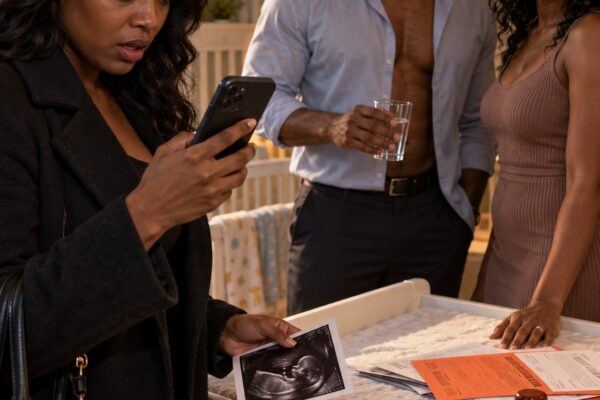
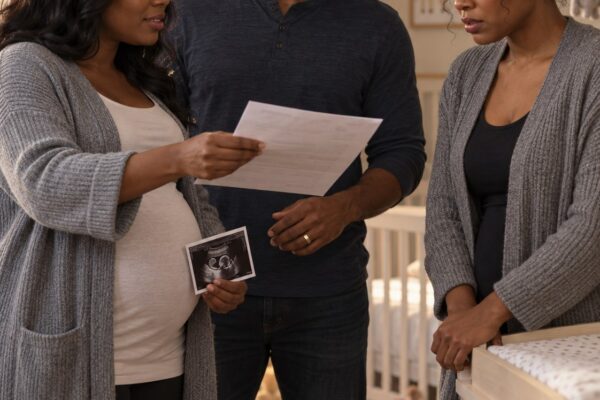
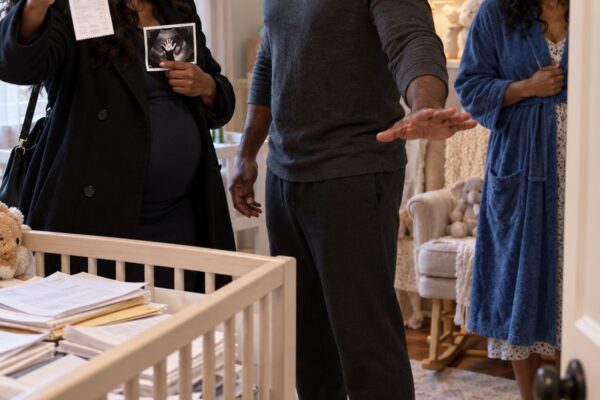
I Came Home From Our Baby’s Anatomy Scan and Found My Husband Clasping My Mother’s Pendant Around My Best Friend’s Neck
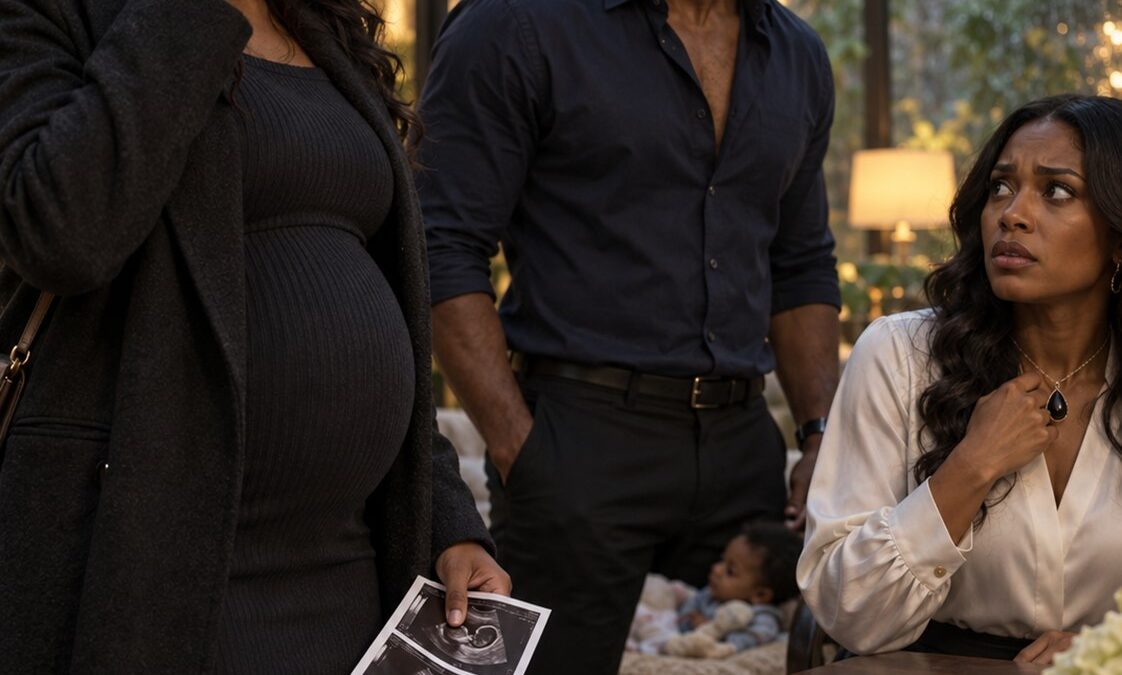
Chapter 2: The Missing Ridge
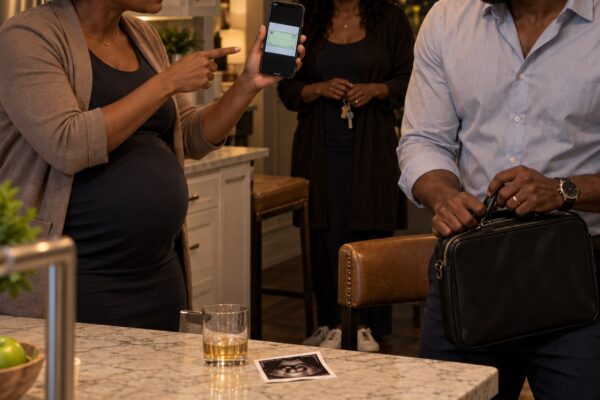
Tessa stared at my phone.
Evan stared at the claim.
I stared at the clasp.
“Why Mara?” Tessa asked.
“Because she signed the inventory.”
“You don’t need your lawyer,” Evan said.
“Mara is my accountant.”
He looked surprised.
Tessa did not.
Rain clicked against the roof.
The pendant lay between us.
I had imagined this room filled with plants when we bought the house.
Evan preferred it bare.
He said the light made everything look expensive.
“Who wrote tomorrow’s date?” I asked.
Evan put a hand on the table.
“We were going to call it in.”
“I gathered that.”
“No claim was filed.”
“Who wrote it?”
He looked at Tessa.
She folded her arms.
“The date was a placeholder.”
“For a burglary?”
“For a discussion.”
I turned the sleeve over.
There was a draft claim, a photograph checklist, and a printed description of the pendant.
The form said the original had been taken from our home safe.
It listed an estimated value of eight hundred thousand dollars.
My mother had paid twelve thousand for it forty years earlier.
Insurance values changed.
Memories did not.
“Who signed my name?” I asked.
Evan’s hand slid off the table.
Tessa said, “We copied a signature for the draft.”
“From where?”
“The appraisal paperwork.”
I had signed that paperwork while my mother was still alive.
Tessa had brought it to the hospital cafeteria.
She had said the insurance company needed a clean file.
Evan reached for me.
I moved the scan pictures out of his path.
“You should sit down,” he said.
“I’m standing comfortably.”
“You’re pregnant.”
“Yes.”
He lowered his hand.
I took a second photograph of the form.
Then I photographed its reverse.
A faint impression crossed the blank page beneath the signature.
Somebody had pressed hard with a pen.
Tessa noticed.
She reached for her phone.
“Leave it there,” I said.
“It’s mine.”
“You can use it.”
I stepped aside so she could reach it.
I had no right to seize her property.
I also wanted to see whom she called.
She slipped the phone into her pocket and kept her hands there.
Evan looked from her to me.
“I borrowed the pendant last week,” he said.
Tessa’s jaw tightened.
“That isn’t what you said.”
“It’s what happened.”
“From the safe?”
“Yes.”
“Why?”
He swallowed.
“Because Tessa said the appraisal needed updating.”
Tessa gave a thin shake of her head.
“You told me she knew.”
“I said she would.”
I remembered the safe standing open three nights earlier.
Evan had said he was looking for his passport.
I had been tired from a long day at the office.
I had told him the passport was in his desk.
He had closed the safe before I crossed the bedroom.
“How long has that necklace been gone?” I asked.
Evan looked at the black stone.
“I don’t know.”
Tessa answered first.
“Six months.”
The roof gave a soft crack as the heat came on.
Six months ago, Tessa had taken the pendant for its annual appraisal.
She had returned it in a gray velvet box.
I had put the box in the safe without opening it.
I had trusted her hands because they had held mine.
I leaned over the pendant.
The hinge was smooth.
My mother’s clasp had a ridge.
The pendant on the table was a copy.
* * *
Mara arrived forty minutes later.
By then, Evan had buttoned his shirt.
Tessa had asked three times whether she could leave.
“You can,” I told her each time.
Each time, she stayed.
Perhaps she feared being alone with her phone.
Perhaps she hoped to hear what I knew.
Mara came through the conservatory with a flat black portfolio.
She was fifty-eight, precise, and impatient with speculation.
She had handled my mother’s taxes for twenty-three years.
I had asked her to bring the estate inventory because she kept a signed copy at my office.
The original stayed with the estate attorney.
She set the portfolio on the dry end of the table.
“What happened?” she asked.
I showed her the necklace.
Then the claim form.
She read without speaking.
“Who prepared this?” she asked.
“Neither of them has answered.”
Evan said, “It was never submitted.”
“I can see that,” Mara said.
She opened the portfolio.
Inside were photographs taken after my mother’s funeral.
Each object had a number.
Each photograph had a date.
Mara found the pendant on page nine.
The black opal sat in a plain gold setting.
At the back of the clasp, the repair ridge caught a narrow stripe of light.
Mara put the estate photograph beside the necklace.
Evan leaned closer.
Tessa remained by the door.
“What does that prove?” she asked.
“That this clasp is different,” Mara said.
“Clasp repairs happen.”
“Yes,” I said. “My mother had one.”
I pointed to the photograph.
“This one.”
Mara examined the pendant beneath the conservatory lamp.
“The setting is different, too.”
Tessa came back to the table.
“A photograph can distort metal.”
“Of course,” Mara said.
“We’ll have a jeweler examine it.”
Tessa’s eyes flicked to me.
I knew why.
An appraisal by a qualified jeweler would take her opinion out of the room.
I asked Mara to call the estate attorney.
I called the police nonemergency line.
The officer who arrived listened, photographed the room, and took our names.
He did not arrest anyone.
He explained that the necklace’s ownership and the timing of any substitution needed to be established.
He gave me a report number.
I gave him copies of my photographs.
Evan offered to hand over the draft claim.
The officer took it in an evidence sleeve.
Tessa said very little.
By evening, the three of us had given separate accounts.
Evan went to his brother’s apartment.
I changed the safe code and slept badly in the guest room.
The next morning, Mara met me at the jeweler my mother had used.
Mr. Bell had repaired the original clasp himself.
He remembered my mother insisting that the hinge be strong enough to wear.
He remembered her watching through the workshop window.
His records showed the date and a photograph of the repair.
Then he examined Tessa’s necklace.
“The stone is synthetic,” he said.
I had expected that.
Hearing it still hurt.
“The setting is recent,” he added.
He turned the chain beneath a small light.
“The clasp was made to resemble ours.”
Mara asked whether he could put that in writing.
He said he could describe his findings and his own repair.
He would not claim to know who made the copy.
That restraint made me trust him.
Outside his shop, I called the insurer.
I spoke to the fraud department, not the claims desk.
I told them the original might have been stolen during an appraisal.
I told them a draft claim had been prepared using my signature.
They took a report and asked for the police number.
No one promised a quick answer.
I did not ask for one.
At my office, Mara laid out the chain of custody.
My mother’s estate inventory.
The jeweler’s repair record.
The annual appraisal appointment six months ago.
The gray box returned to me afterward.
“Do you have the receipt?” she asked.
“I kept the calendar invitation.”
Tessa had scheduled the appointment through her work address.
She had sent a confirmation afterward.
It said the pendant had been examined and returned.
I found both messages in my email.
I had kept them because I kept business records.
That habit had once annoyed Evan.
Now it gave us dates.
Mara called the appraisal firm listed in Tessa’s signature.
A manager confirmed that Tessa had resigned four months earlier.
The firm would review its records.
They would speak to police.
They would not discuss her clients with us.
That was fair.
I looked again at the confirmation Tessa had sent me.
Its attached report described a natural black opal.
The photograph showed the repaired clasp.
I enlarged the image.
Under the report number sat a shipping reference.
I had skimmed past it months ago.
Mara checked it against the courier receipt Tessa had included.
The receipt showed a pickup from the appraisal office.
Its destination was not our house.
It was a storage suite across town.
The account holder was a small company.
Mara recognized the name from my mother’s old client files.
She searched the state business registry.
Tessa was its sole manager.
The necklace had gone to Tessa’s own storage suite.
* * *
Evan called that afternoon.
“I want to tell you what I know.”
“Tell the detective.”
“I did.”
“Then send me his name.”
He paused.
“I deserve that.”
I sat at my office window.
Below, people crossed the square under bright umbrellas.
Two floors down, our company’s staff were preparing drawings for a library renovation.
My workday had continued without asking permission.
The ordinary sound of it steadied me.
“What do you want, Evan?”
“To make sure you’re safe.”
“I am.”
“Tessa knows your schedule.”
“So do many people.”
“She planned to meet someone tomorrow.”
“Who?”
“She wouldn’t tell me.”
“Tell the detective.”
“I will.”
He waited for more.
I had nothing to give him.
He said, “I’m sorry about the scan.”
“You missed it because you chose to.”
“I know.”
After we hung up, I sent his message to the detective.
I did not follow Tessa.
I did not call the storage facility and invent a reason to enter.
I wanted the original pendant returned.
I wanted its path documented.
At six, my obstetrician’s office called about the scan.
The measurements looked normal.
The nurse asked whether I had questions.
I looked at the little profile on my desk.
My daughter’s nose was a pale mark against a dark field.
For the first time all day, I asked one.
“Is there anything I should change?”
The nurse said to keep my next appointment and call if I felt unwell.
I thanked her.
That was the whole medical conversation.
It helped more than Evan’s promise.
Mara brought soup from a place near the office.
She sat opposite me while I ate.
“My mother trusted Tessa,” I said.
“Your mother trusted people until they gave her reason to stop.”
“She warned me about Evan’s spending.”
“She did.”
“Did she warn you about Tessa?”
Mara folded her napkin.
“No.”
That answer mattered.
I had spent twenty-four hours trying to turn every happy memory into a clue.
Mara would not let me invent a past that had not happened.
The next morning, the detective called.
The storage company had preserved its access records after receiving a request.
Its manager had provided camera footage through the proper process.
Tessa had visited the suite on the day of the appraisal.
She carried a gray jewelry box.
That did not prove what was inside.
The detective was waiting on a warrant for the suite.
He also had Evan’s interview.
Evan had described Tessa’s proposal.
She told him my insurance would pay if the necklace disappeared.
She said the policy covered theft from the home.
She had shown him a draft claim and asked him to help stage an empty safe.
He admitted giving her the code.
He admitted copying my signature from an old document.
He said he believed she had the real pendant ready to return if they changed their minds.
“Do you believe him?” I asked the detective.
“I’m checking what I can.”
That was fair, too.
Evan had been losing money on his restaurant for a year.
He had told me the business was stable.
I had seen the loan payments, but he had said he could manage them.
I had allowed him space to fail privately.
He had used that space to lie.
That night, someone left a plain envelope at my office reception.
Inside was a copy of my mother’s last letter to me.
One line had been highlighted.
Take care of the things I loved.
There was no note.
I gave the envelope to the detective.
The letter itself was in my desk at home.
Tessa had seen it after the funeral.
She knew which sentence would hurt.
I went home with Mara and my building’s security manager.
We did not expect an intruder.
I wanted a witness while I collected documents for my attorney.
In the hall, I passed the empty conservatory.
The table had been cleared.
The rain had stopped.
I could still picture Tessa’s throat above my mother’s chain.
I put my hand against my stomach.
My daughter moved.
It was small and unmistakable.
“Do you need a minute?” Mara asked.
“I have one.”
We stood together until she moved again.
The following day, the detective called with a name.
The company that owned Tessa’s storage suite also held Evan’s restaurant debt.
Tessa had bought it through that company three months earlier.
Evan did not know his creditor was Tessa.
She had made herself his lender before she made him her accomplice.
* * *
The detective asked me to come to the station.
My attorney came with me.
So did Mara.
The storage suite had been searched under a warrant.
The original pendant was not there.
Investigators found its appraisal box, packing material, and a sale agreement.
The buyer was a private collector who had placed the pendant with a licensed auction house.
The auction house had suspended the sale after the detective contacted it.
Its records showed the seller as Tessa’s company.
Its photographs showed my mother’s repaired clasp.
The pendant was secured while ownership was reviewed.
I looked at the photograph for a long time.
The stone was darker than I remembered.
Then the light caught its green edge.
There it was.
My mother’s.
The detective had also obtained the storage company’s entry logs.
Tessa had visited the suite several times after the appraisal.
The auction house had accepted the pendant two months later.
She had been selling it while she came to dinner at my house.
I asked whether I could see her.
My attorney looked at me.
“What would that accomplish?”
“I want her to say it in front of Evan.”
The detective said he could not arrange a confrontation for my benefit.
He did tell me that the auction house would hold a meeting with the parties’ lawyers about the ownership claim.
Tessa’s attorney had asked to attend.
Evan’s attorney would be there.
So would an insurer representative.
I could attend with counsel.
The meeting took place the following week in a conference room at the auction house.
The pendant stayed in secure storage.
A photograph of it lay on the table.
Tessa arrived in a charcoal suit.
She had worn one much like it to my mother’s funeral.
Evan came separately.
He looked at me once.
I looked at the photograph.
The auction house’s lawyer opened the meeting.
The purpose was narrow.
They wanted to establish who owned the pendant and how it reached them.
The insurer wanted to understand the draft claim.
The lawyers reminded everyone that the police investigation continued.
Tessa spoke first.
She said my mother had promised her the pendant.
She claimed the appraisal was part of a private sale we had discussed.
I had authorized her to place it, she said.
The money was meant to support Evan’s restaurant.
She had delayed telling me because I was pregnant and under stress.
It was a careful account.
It explained my silence.
It turned my trust into consent.
Evan’s face changed as she spoke.
“You told me she’d lent it to you,” he said.
“I told you there was an arrangement.”
“That isn’t what you said.”
Tessa ignored him.
She turned to me.
“You asked me what your mother would have wanted.”
“I did.”
“She loved you enough to let you use what she left.”
My hands stayed flat on the table.
“My mother is dead,” I said.
“You don’t get to borrow her voice.”
Tessa’s attorney intervened.
He asked whether I had written proof that no sale was authorized.
My attorney slid the estate inventory across the table.
It showed the pendant passing to me after probate.
That established ownership at the time.
It did not answer every claim Tessa had made.
Tessa knew it.
She leaned forward.
“She could have changed her mind.”
“I could have,” I said.
“I didn’t.”
She gave a small, sorrowful smile.
For a moment, I saw how easily she had persuaded Evan.
She could make greed sound like concern.
The auction house’s lawyer asked about the sale agreement.
Tessa had signed as an authorized agent.
She said the authorization had been verbal.
My attorney showed the email from the appraisal day.
Tessa had written: Your pendant is back in its box and ready for your safe.
Tessa said she had meant the replacement.
“You called it my pendant,” I said.
“It was a temporary copy.”
“Why didn’t you tell me?”
“You were difficult to reach.”
I thought of every dinner she had attended since then.
She had helped choose a name for my daughter.
She had borrowed my coat.
She had kissed my cheek at the door.
“You reached me often.”
Tessa looked down.
Then she said, “You never noticed.”
Evan flinched.
She had meant it as an indictment.
For me, it was an admission.
My attorney did not smile.
She asked the auction house to note the statement.
The insurer representative asked about the claim form.
Tessa said Evan had prepared it without her knowledge.
Evan spoke at once.
“She typed it.”
“Can you prove that?” she asked.
He went quiet.
He had trusted her with the computer.
He had trusted her with his debt.
Now she offered him all of it.
Mara opened her portfolio.
She had brought the conservatory photograph I took when Tessa removed the necklace.
In it, the copied pendant lay beside the claim.
The photograph alone did not show who typed the form.
It showed the object they planned to report stolen.
Then Mara placed Mr. Bell’s repair photograph beside it.
The copied clasp was smooth.
The original, in the auction house photograph, had his repair ridge.
Two pendants.
One prepared claim.
A sale agreement signed by Tessa.
The auction house’s lawyer studied both images.
The insurer representative asked for copies.
Tessa’s attorney requested a break.
Before anyone stood, the auction house’s lawyer checked a note from the file.
Their intake video had recorded Tessa presenting the original pendant.
In the recording, she identified herself as its owner.
The lawyer said the video and intake documents would be made available to investigators.
Tessa looked at him.
Then she looked at me.
“You’ll destroy Evan over a necklace?”
I answered quietly.
“Evan made his choices.”
“And our friendship?”
“You made yours.”
The meeting ended.
No one was led away in handcuffs.
The auction house kept the pendant secured.
The insurer closed the unfiled claim inquiry without paying anything.
The police continued gathering records.
Months passed before the legal outcome.
Tessa pleaded guilty to offenses arising from the theft and attempted fraudulent sale.
Evan pleaded guilty to his part in the attempted insurance fraud and the forged signature.
Their sentences included restitution and probation under separate agreements.
The court records were public.
That had consequences for Tessa’s career and Evan’s restaurant.
I did not arrange those consequences.
I gave truthful evidence and let the process reach them.
When the pendant was finally released, Mr. Bell checked its setting.
He cleaned the chain.
He left the ridge alone.
* * *
By then, I was seven months pregnant.
My attorney had begun the divorce.
Evan did not contest that the house and my mother’s estate property were mine.
We worked through the remaining finances with lawyers.
His restaurant closed.
I heard about it from him, not from a notice in the paper.
He asked to meet at a café near my office.
I agreed to one hour.
He arrived early.
He did not ask to touch my stomach.
I appreciated that.
“I’m sorry,” he said.
I waited.
“I used your trust to cover my debt.”
“Yes.”
“I let her convince me the claim would fix everything.”
“You signed my name.”
“Yes.”
He looked at the table.
“I knew it was wrong when I did it.”
That was the first useful thing he had said.
He told me he had started meeting with a financial counselor.
He was working in another restaurant kitchen.
I hoped he would keep both appointments.
Neither fact changed what he had done.
“Our daughter deserves an honest father,” I said.
“I want to be one.”
“You can start by respecting the custody process.”
“I will.”
“We’ll communicate through the family app our lawyers recommended.”
He nodded.
“And if you need something from me?”
“I’ll ask through it.”
He looked disappointed.
I let him.
Before we left, he asked whether he could have a copy of the scan.
I thought about the four pictures on my desk.
I had held them while he reached for a fraudulent claim.
He had also asked about the baby before he knew what I had seen.
Both things were true.
“I’ll send you one,” I said.
“Thank you.”
I went back to work.
My company had won the library project.
The drawings covered a long table in my office.
We argued about window heights, reading lamps, and where to put the stroller ramp.
The last question made my staff laugh.
I laughed with them.
In August, my daughter was born.
I named her June, after my mother’s favorite month.
The birth was ordinary in the best way.
She was loud.
She was warm.
She wanted milk and then more milk.
Mara arrived with a blanket she had knitted badly.
One corner was longer than the others.
“It has character,” she said.
June slept under it anyway.
The recovered pendant stayed in its box.
I did not wear it to the hospital.
I did not put it in a vault to prove a point.
It was mine to decide about later.
Several people suggested selling it.
Eight hundred thousand dollars could do real work.
They were right.
I considered what my mother would say.
She had bought the pendant after her first profitable concert tour.
She loved fine things.
She also paid for lessons for children who could not afford them.
In September, I met with the director of the music school she had supported.
We reviewed its accounts and a plan for more scholarships.
I contributed money from my own earnings.
I kept the pendant.
My mother had left me both the means and the choice.
One afternoon, Mara found me working with June asleep against my shoulder.
“The school called,” she said.
“They chose the first students.”
“How many?”
“Six.”
I looked at June.
She made a small, furious sound in her sleep.
“Tell them my mother would have wanted to hear them play.”
Mara smiled.
“I already did.”
Evan met June under the visitation arrangements.
At first, a supervisor was present.
Later, as he complied with the plan, the visits changed.
He learned how she liked her bottle warmed.
He learned that singing made her stare at him.
When he asked to take her to the park for the first time, he asked in writing.
I read the request.
I checked the arrangements.
Then I said yes.
Forgiveness was not the price of letting him be her father.
Care was a practice he had to keep showing.
June would judge him by the years ahead.
I would watch closely.
That winter, I wore the pendant to the music school’s first student concert.
Mr. Bell’s repaired clasp held against my neck.
Mara noticed.
“Are you sure?”
“Yes.”
The youngest pianist missed her opening note.
She stopped, looked at the audience, and began again.
When she finished, everyone applauded.
I applauded until my hands hurt.
* * *
Five years later, June stood in the conservatory beneath the glass roof.
Rain moved over us in silver lines.
The room was full of plants now.
She had insisted on a lemon tree.
It had produced one hard little fruit.
June called it our harvest.
I wore my mother’s pendant for the school concert that evening.
June watched me fasten it in the window’s reflection.
“Can I try?” she asked.
“The clasp is tricky.”
“I know.”
I knelt.
Her small fingers found the hinge.
She worked carefully.
The chain settled against my neck.
“There,” she said.
I looked at our reflections.
Mine.
Hers.
No one hiding behind either of us.
The conservatory table held June’s drawing of the lemon tree.
Beside it lay a concert program.
Six scholarship students had become twenty-three.
Evan would meet us at the school.
He had kept his arrangements and his promises to June.
Mara had reserved seats near the front.
Mr. Bell had retired.
My attorney had become a friend I saw for dinner.
Tessa had served her sentence and moved away.
We had not spoken again.
June took my hand.
“Will Grandma’s necklace be mine?”
“When you’re grown,” I said.
“Why?”
“Because she loved it.”
June considered that.
“Do you love it?”
“I do.”
She touched the clasp.
“Then I’ll be careful.”
Outside, the rain slowed.
June pulled me toward the door, eager to hear the music.
I followed her into the light.
THE END