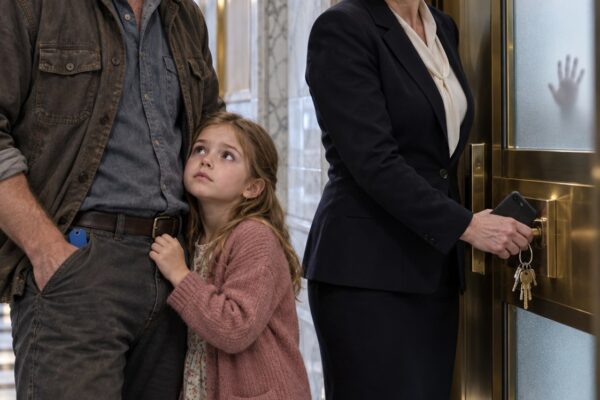
My Son Saw a Girl’s Handprint Inside Our Garage Window—Then My Wife Recognized the Star Around Her Neck
Chapter 2: The Name She Kept
The girl struggled to breathe.
I stepped around Beth and called 911.
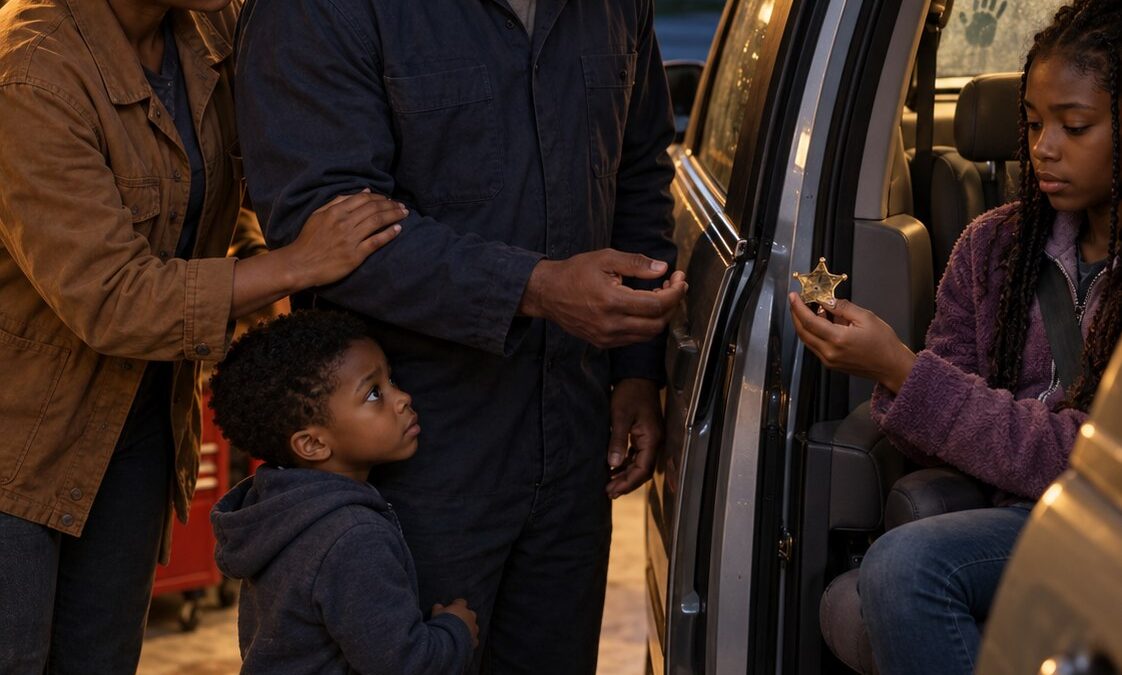
Our son, Miles, held the open minivan door while I helped the girl onto the garage floor.
She fought me until Beth knelt beside her.
“It’s all right, Junie.”
The girl recoiled.
“You said he knew.”
Beth shut her eyes.
“I know.”
“You said he didn’t want me.”
“I know what I said.”
A woman appeared in the driveway.
Beth’s mother wore a dark wool coat and carried Junie’s pink backpack.
At every school fundraiser I had attended with Beth, Celia Vale had been the person holding the microphone.
She stopped when she saw my phone.
“Tell them the child is with family,” Celia said.
“I did.”
“Then give me the phone.”
“No.”
Junie leaned against the tire.
Her breathing scraped in her chest.
“Her inhaler’s in here,” Celia said.
She held up the backpack.
“Set it down,” I told her.
Celia looked at Beth.
“This is how you thank me?”
Beth took the bag and found the inhaler.
Junie knew how to use it.
She took a careful breath, then another.
Miles watched from behind my shoulder.
“Is Grandma Celia mad at her?” he asked.
Celia’s expression changed.
“We had a misunderstanding, sweetheart.”
“Go inside, Miles,” I said.
He stayed where he was.
“I’ll take him,” Beth said.
Junie caught her sleeve.
“Don’t leave me with him.”
That landed harder than anything Celia had said.
Beth sat back down.
“I’m staying.”
The dispatcher kept me on the line.
Celia could hear every word.
“She’s eleven,” I told him.
“She has an inhaler.”
“She traveled here alone.”
Celia folded her arms.
“You have no idea what she did.”
Junie lifted her head.
“I took the bus.”
“After taking things that belong to me,” Celia said.
The brass star lay against Junie’s sweater.
I remembered making it at the machine shop during my last month of training.
Beth had laughed at its crooked point.
She had said a baby would never notice.
I had carried it in my pocket for weeks after she told me the pregnancy was over.
“Did you give her that?” I asked Beth.
“Yes.”
“When?”
“When she was born.”
Celia took one step toward the minivan.
I moved between them.
“Stay there.”
“You cannot keep my ward from me.”
“Then wait for the paramedics.”
Her gaze flicked to the phone.
For the first time, she seemed unsure of what I might say next.
The ambulance arrived with a police officer behind it.
Celia spoke first.
She said Junie had run away after an argument.
She said Beth was upset and I was confused.
One paramedic listened to Junie’s breathing.
The other asked Junie where she wanted Beth to stand.
“Here,” she said.
I stayed with Miles until my neighbor came across the driveway and offered to take him inside.
Miles hugged my waist.
“Will the girl be okay?”
“They’re helping her.”
He looked through the open garage door.
“She looked really cold.”
“I know.”
Beth rode with Junie.
I followed in my truck.
At the hospital, a nurse treated Junie while an officer took our names separately.
I gave him Celia’s name, the address of our house, and exactly what Beth had said.
Beth heard me.
She didn’t ask me to change it.
Near midnight, a doctor said Junie’s breathing had settled.
She could go home after observation, but the nurse had asked the hospital social worker to come in.
Junie was asleep when I entered her room.
Beth sat beside the bed.
The brass star rested in a plastic tray with Junie’s other things.
I picked it up.
The point still bore one thin file mark.
“I was at the plant when you called,” I said.
“I remember.”
“You said there wasn’t going to be a baby.”
Beth rubbed both hands over her face.
“I was frightened.”
“So was I.”
“I thought your leaving for that job meant you were already gone.”
“I was working nights for us.”
“I know that now.”
I set the star down.
“When did you know she was alive?”
Beth looked at Junie.
“When I heard her cry.”
The vending machine hummed beyond the door.
Neither of us spoke until the social worker arrived.
She introduced herself and explained that she needed to understand who had legal responsibility for Junie before anyone decided where she would spend the night.
Celia was her guardian, Beth said.
“Is that what you wanted?” I asked.
Beth’s answer took a long time.
“I signed papers.”
“That wasn’t my question.”
“No.”
Junie stirred beneath the blanket.
Beth lowered her voice.
“My mother told me you had signed them first.”
* * *
By morning, I had slept for forty minutes in a hospital chair.
Junie had eaten toast and asked for her backpack.
The social worker brought it from the nurses’ station.
A folded bus schedule fell out when Junie opened the front pocket.
She had marked the stop three blocks from our house.
“Where did you get our address?” I asked.
Junie touched the star.
“Mom wrote it on an envelope.”
Beth looked up.
“I gave you an envelope last Christmas.”
“I kept it.”
Celia had told Junie the address belonged to Beth’s husband, a man who did not want to meet her.
Junie had kept the envelope anyway.
Yesterday, Celia had announced that they were moving across the state before school ended.
Junie had taken a bus after school instead.
“I wanted to ask him myself,” she said.
I couldn’t answer her in that room.
The social worker asked Junie whether she felt safe returning to Celia’s house.
Junie said no.
She did not describe a blow or a locked door.
She said Celia had taken her phone whenever she asked about her father.
She said Celia had told her that Beth could visit only if Junie behaved.
The social worker wrote it down.
A temporary place with an approved relative was discussed while the agency checked the guardianship and our home.
Beth gave them the name of a cousin Junie trusted.
I drove home to shower and found Miles sitting at the kitchen counter.
Our neighbor had made pancakes.
He pushed one toward me.
“Did the girl get her medicine?”
“She did.”
“Good.”
He went back to cutting his pancake.
I went into the garage.
The handprint had dried from the window.
For a moment, I wished I had seen Junie arrive.
I wished I could have met her at the door.
Then I remembered how she had hidden when she heard my truck.
She had come a long way to ask one question and expected the answer to hurt.
I took the brass star from my coat pocket.
The nurse had given it to me when Junie asked me to keep it safe.
On its back, my old lettering remained:
FOR OUR NORTH STAR.
Beth and I had chosen those words together.
At the plant, I had used a hand stamp borrowed from the tool room.
One letter sat higher than the rest because I struck it twice.
I photographed the star and called an attorney whose name the social worker had given me.
Her name was Dana Pike.
She asked me to bring every record I had from the pregnancy.
I thought there would be nothing.
Then I remembered a blue folder in the file cabinet.
Beth had saved appointment cards, receipts, and a photograph of the first ultrasound.
She had also saved the hospital invoice.
I had never looked closely at it.
I had been too relieved when Beth came home.
She had said there had been complications and asked me not to make her tell the story twice.
At the time, I had listened.
The invoice carried a date three months after the day she said we lost the baby.
I called Beth.
“You kept the bill.”
“I couldn’t throw it away.”
“It says maternity care.”
“I know.”
“Why didn’t you tell me?”
“I tried once.”
“When?”
“The night you got home from the plant.”
I remembered that night.
I had brought soup.
Beth had asked whether I would still love her if she had made a terrible choice.
I had thought she meant ending the pregnancy.
I had said we could talk later, when she felt stronger.
Later never came.
Dana met us that afternoon.
She listened without interrupting.
Then she asked what, exactly, Beth had signed.
“A temporary guardianship petition,” Beth said.
“My mother said it would give Junie health coverage while we found an apartment.”
“Did you read it?”
“No.”
“Did Evan sign anything?”
Beth looked at me.
“She showed me a page with his signature.”
I shook my head.
Dana did not ask us to settle it by memory.
She requested the court file through the proper channel and told us the agency would obtain its own copies.
She also explained that a DNA test would need consent and proper handling if we wanted its result used in court.
“I do,” I said.
Beth nodded.
“You should.”
Junie spent that night with Beth’s cousin, Tessa, after the agency approved her home.
Tessa lived twenty minutes away.
She called when Junie woke from a nap.
“She wants to know if she left her star at the hospital.”
“I have it.”
“Can you tell her?”
Tessa put the phone on speaker.
“I kept it safe,” I said.
Junie didn’t speak at first.
Then she asked, “Did you really make it?”
“Yes.”
“It’s crooked.”
“I know.”
“I like that part.”
A court clerk sent Dana copies of the guardianship petition two days later.
Beth sat beside me as Dana laid the pages out.
Junie’s birth date was there.
Beth’s signature was there.
Under the space for father, someone had written my full name.
Below it sat a second signature.
Mine.
I leaned over it.
The letters looked close.
The last stroke of the E even curled the way mine did.
Then I saw the address beside it.
It was the apartment Beth and I moved into the following spring.
I had never lived there when the petition was signed.
Dana placed a finger beneath the date.
“Who filled this out?”
Beth’s voice came out thin.
“My mother.”
The lie was in our own file.
* * *
Celia called me that evening.
I put her on speaker with Dana present.
“Junie is frightened,” Celia said.
“She’s with Tessa.”
“Tessa cannot provide what she needs.”
“She has her medicine.”
“You think this is about an inhaler?”
I watched Dana open her notebook.
“What is it about?”
“Junie has a life.”
“She asked to meet me.”
“You could have written.”
“I thought she was dead.”
Celia was quiet.
Then she said, “Beth should have handled this years ago.”
“She should have.”
Across the table, Beth accepted that without looking away.
Celia heard the silence.
“She signed the petition,” Celia said.
“So it says.”
“You intend to accuse me of a crime because you missed your chance to be a father?”
Dana raised one hand.
I stopped before I answered the question Celia wanted me to answer.
“The records can speak for themselves.”
Celia ended the call.
The next morning, the agency worker told Tessa that Celia had requested Junie’s return.
An emergency hearing was scheduled.
Celia had also hired an attorney.
There was nothing unlawful about either step.
Junie heard about the hearing and refused breakfast.
Beth and I went to Tessa’s after school.
Junie sat at the dining table with a math worksheet.
She had erased a hole through one problem.
I stayed near the doorway.
“Can I sit here?” I asked.
She nodded.
For ten minutes, I helped her divide fractions.
I was rusty.
She corrected me twice.
Beth made grilled cheese with Tessa in the kitchen.
When the plates arrived, Junie asked if I was angry.
“At you?”
“At everybody.”
“I’m angry about what happened.”
“That’s a lot of people.”
“Yes.”
She considered her sandwich.
“I was angry when I thought you knew.”
“I would have been too.”
“I wanted you to say it.”
“Say what?”
“That you didn’t want me.”
I set down my pencil.
“I’m sorry you had to come here expecting that.”
She looked at the star in her palm.
“Mom said you made this before I was born.”
“Yes.”
“Were you excited?”
“Scared and excited.”
“Did you tell anybody?”
“My whole shift.”
She smiled into her plate.
Beth looked over from the kitchen.
Her eyes filled, but she let the moment belong to Junie.
That afternoon, a manila envelope arrived at my work.
Inside was a copy of the guardianship petition and a note typed on plain paper.
It said that upsetting Junie further would affect her health.
There was no demand and no signature.
I gave the envelope to Dana.
She told me to keep the original flat and said she would provide it to the agency and Celia’s attorney.
At the hearing, Celia’s lawyer argued that Junie had lived safely with her for eleven years.
He showed school reports and records of medical visits.
Those records mattered.
Whatever Celia had done, she had also been the adult listed on every form Junie’s teachers saw.
Dana did not dismiss that.
She asked the court to keep Junie with Tessa while the signatures and parentage were reviewed.
The judge continued the temporary arrangement.
Celia passed us in the hall.
“She won’t thank you for pulling apart her life,” she said.
Junie was not there to hear it.
“I’ll let her decide what she thinks,” I said.
Afterward, Beth took me to her car.
“There’s something else.”
I waited.
“My grandfather left money for his first great-grandchild.”
“How much?”
“Enough that my mother never worried about her business again.”
Beth said Celia had managed the trust since Junie’s birth.
It paid Junie’s expenses, but the rest was meant to remain for her as an adult.
A new trustee had recently asked Celia for an accounting.
“That’s why she wanted to move?” I asked.
“I think so.”
“Did you know about the money?”
“I knew it existed.”
“Did you know what she spent?”
“No.”
“You never asked?”
Beth gripped the steering wheel.
“I asked where Junie was.”
“And?”
“She let me see her twice a year.”
I thought of Junie waiting for those visits.
I thought of Beth returning home afterward and telling me she had seen a friend.
“You could have told me,” I said.
“Yes.”
There was nothing useful she could say after that.
Dana called before we left the parking lot.
The new trustee had contacted her.
He had found withdrawals marked as schooling and care that did not match Junie’s school or medical records.
Celia had used the trust to keep her business open.
* * *
Three weeks later, Junie sat between Tessa and the agency worker outside a courtroom.
She had chosen to wear her star beneath her sweater.
I had chosen a clean shirt from the back of my closet.
Beth kept smoothing a crease in her sleeve.
The DNA result had arrived through a lab arranged with the court’s approval.
It confirmed that I was Junie’s biological father.
It also confirmed Beth was her mother.
Neither result told us who had signed my name.
The petition’s notary had retired.
Dana had located her journal.
My supposed signature appeared beside an identification number that belonged to someone else.
The address was still wrong.
Dana had found more.
The petition said I had appeared before the notary at four in the afternoon.
My old plant supervisor had kept payroll records through a dispute over unpaid overtime.
His records placed me on an eight-hour shift that day, nearly ninety miles away.
He could testify to that.
A handwriting examiner had compared the petition with forms I had signed around the same time.
The examiner could not identify the writer of the false signature.
She could say it was not consistent with my samples.
Dana told me the court would consider all of it together.
Celia arrived with her lawyer.
She greeted Junie by name.
Junie held Tessa’s hand and said nothing.
Inside, Celia’s lawyer began with the life Junie had lived.
He described a stable home, familiar teachers, and years of care.
He said a frightened young mother had asked her own mother for help.
He said a father’s late arrival did not erase eleven years.
I felt the force of that argument.
Junie’s room at Celia’s house was real.
So were her friends.
No ruling would give her back a childhood without the lie.
Then Beth took the stand.
She said she had been twenty-two when Junie was born.
She said she had signed a temporary petition because Celia promised to help with rent and insurance.
She said Celia later told her I had agreed to make the arrangement permanent.
“Did you ask Evan?” Dana asked.
“No.”
“Why?”
Beth’s fingers tightened around the edge of the witness stand.
“My mother said he had already left us.”
That was not true.
Beth knew it now.
She had known it long before Junie came to our garage.
Dana asked when she first understood Celia had lied.
“Seven years ago.”
A sound escaped me before I could stop it.
Beth looked at me.
“I found a letter Evan wrote when I was pregnant.”
The judge asked her to continue.
Beth said Celia had taken the letter from our old apartment.
It had been in a box of baby things.
Beth found it among Junie’s belongings during a visit.
I remembered writing it at the plant on a lunch break.
I had filled two pages with things I wanted to teach our child.
How to swim.
How to change a tire.
How to tell when a person needed company more than advice.
“I should have told him then,” Beth said.
She did not offer an excuse.
Celia’s attorney asked why she had stayed silent.
“Because I had lied for four years,” Beth said.
“And every year made me more afraid of telling the truth.”
Junie stared at the floor.
Beth’s words could not lift that weight from her.
They could at least stop adding to it.
Celia testified after lunch.
She was composed.
Beth had been young, she said.
I had taken a distant job.
Celia believed Junie needed a steady home.
She said she had managed the trust carefully through a difficult period.
Her lawyer showed receipts.
Some were for Junie.
No one disputed that Celia had bought her food or paid a doctor.
Then Dana showed the petition.
“Did you prepare this form?”
“I helped my daughter.”
“Did Evan sign it in your presence?”
“I believe he did.”
“You remember him being there?”
“It was many years ago.”
Dana showed her the address.
“We didn’t live there yet,” I said when I was called to testify.
The judge looked at the date.
Dana showed my shift record and the notary’s journal.
Celia’s lawyer challenged the old payroll record.
He asked whether a timecard proved I had stayed at work every minute.
“It doesn’t,” I said.
My supervisor had also brought the emergency maintenance log.
A machine had stopped at 3:42.
I had signed the repair sheet at 4:18.
He had signed beneath me.
It was routine work.
That was why both men had kept the record.
Dana returned to the trust accounting.
The new trustee testified by video.
He identified payments to Celia’s business marked as Junie’s educational expenses.
They matched no bill from her school.
Several had been made after the business lost a major contract.
Celia said she had meant to replace the funds.
Her lawyer said the accounting belonged in a separate proceeding.
The judge agreed that the trust dispute needed its own review.
It did not make the petition true.
At the end, the judge spoke to Junie privately with the agency worker present.
We waited outside.
Celia sat at the far end of the hall.
When Junie emerged, she walked to Tessa.
The court kept Junie with Tessa while a plan for safe contact and possible placement with us was assessed.
The judge referred the petition to investigators.
The trust remained under the new trustee’s control.
Those decisions took minutes to say.
We lived inside them for months.
An investigator interviewed Beth, Celia, the retired notary, and my former supervisor.
The notary recognized Celia’s handwriting in her old journal.
She said Celia had brought papers to her office and claimed both parents had signed elsewhere.
The notary had broken the rules by completing the acknowledgment without us present.
She admitted it.
Celia later pleaded guilty to forgery and to misusing trust funds.
The court ordered restitution and imposed a sentence that included supervision.
Her business was sold.
The money recovered went back into Junie’s trust.
It could not buy her missing years.
After the hearing, before any of those outcomes, Celia had one last thing to say to me.
She waited until Dana was beside me.
“You were a stranger to her yesterday.”
“I was,” I said.
Junie came through the courtroom door carrying her backpack.
I watched her find Tessa.
“Today she knows why.”
* * *
Junie’s first visit to our house lasted two hours.
She asked to see the garage.
I showed her the minivan.
Miles showed her the toy trucks he stored on the shelf behind it.
“That one goes fastest,” he said.
“It has three wheels,” Junie observed.
“It still goes fastest.”
They tested it on the driveway.
Junie won three races because she pushed hers downhill.
Miles called that cheating.
He asked her to do it again.
Beth stayed near the open kitchen door.
The agency worker came for the first visits.
Later, Junie and I met at the library and at Tessa’s house.
We talked about books, her school, and the people she missed.
I learned that she loved maps.
I also learned she disliked being told she was brave.
“It’s what adults say when I don’t get a choice,” she told me.
I stopped saying it.
When the agency approved a trial placement, Junie helped decide when to come.
She chose a Friday after school.
She packed three bags.
Tessa delivered the fourth the next morning.
For weeks, Junie called our guest room “the room.”
Then she called it “my room” while asking where the clean sheets were.
No one pointed it out.
Beth and I had harder conversations after Junie went to bed.
I wanted an answer for every birthday I had missed.
Beth could tell me where Junie had been for some of them.
For others, she had no answer because Celia had refused a visit.
I did not excuse Beth’s silence.
I also saw her tell the truth when it cost her something.
One evening, Junie asked whether Beth had wanted Celia to raise her.
Beth put down a dish towel.
“For a little while, I thought she could help us.”
“That’s not what I asked.”
“No,” Beth said.
“I wanted to raise you.”
“Then why didn’t you come get me?”
“I let her tell me it was too late.”
Junie waited.
“I should have checked,” Beth said.
“I should have told Evan.”
Junie nodded once and went back to drying plates.
It was not forgiveness.
Beth did not ask for it.
I began meeting Beth with a counselor recommended by Dana.
We talked about the years before Miles was born.
Beth answered questions she had avoided at home.
I told her when an answer did not make sense.
Some days we left together.
Some days we drove home separately.
We kept going.
In spring, the new trustee asked whether I wanted to review Junie’s trust accounts.
As her father, I had a reason to know what remained.
I asked Dana to review them with me.
Celia’s lawyer later sent an offer: Celia would sign away any claim to future guardianship decisions if we stopped speaking about the trust publicly.
Dana declined it.
The court had already placed the trust with someone independent.
Junie’s money would be used for Junie.
I told the trustee to keep sending clear statements to Dana and, when she was old enough, to Junie herself.
That summer, I took Junie to the machine shop where I had made the star.
The owner still remembered me.
He had less hair and the same sign on the wall asking people to wear safety glasses.
Junie watched him guide a piece of brass through a machine.
“Could you fix the point?” she asked me.
“I could.”
She turned the star over.
“Don’t.”
“I won’t.”
On the way home, we stopped for ice cream.
She chose mint.
I chose chocolate.
We were halfway through before she asked the question she had been carrying.
“Can I call you Dad?”
I pulled into a parking space.
“You can call me anything you’re comfortable with.”
“I know your name.”
“You can keep using it.”
“I want to try Dad.”
I looked at her.
“Okay.”
She tried it once, quietly.
Then she asked if we could go home before her ice cream melted.
At home, Miles ran to the door.
“Dad, she took forever.”
Junie raised her cup.
“Dad drives slow.”
They both waited for me to argue.
I took my own melting cup from the holder.
“I drive carefully.”
“That’s what slow people say,” Junie told Miles.
He repeated it through dinner.
Later that night, Beth found me washing the cups.
“Thank you for letting her choose,” she said.
“It was hers to choose.”
Beth reached for a towel.
I handed her a cup.
“I’m still angry,” I told her.
“I know.”
“I want us to keep telling her the truth.”
“Yes.”
“And I need you to tell it to me, even when you’re afraid.”
“I will.”
I wanted to believe her.
That would take time too.
In August, the agency ended the trial placement.
Junie stayed.
Tessa kept a drawer ready for visits and made sure Junie knew it.
One Saturday, Junie asked Beth if she could invite Tessa to our family barbecue.
Beth said yes.
Then Junie asked if she could invite a school friend.
“Yes.”
“What about the neighbor who made pancakes?”
“Of course.”
Miles began inviting everyone he could name, including the mail carrier.
Junie stopped him before he reached his teacher.
At the barbecue, she moved between the people who had made room for her.
For once, nobody asked her to pick a side.
* * *
Five years later, Miles opened the garage door and found Junie beside the minivan.
She was sixteen and carrying a box of things for a school donation drive.
He was ten and still claimed he could outrun her.
The box was too heavy for one person.
He took the bottom.
They brought it inside together.
Junie set it on the workbench where I had once laid out the tools to make her star.
The chain had grown too short years ago.
She had threaded the star onto a longer one herself.
Its crooked point rested against her shirt.
“Do you remember this window?” she asked Miles.
“Of course.”
“You were tiny.”
“I found you.”
“You found a handprint.”
“I knew a person made it.”
“You thought I was a burglar.”
“I was five.”
He looked offended that she expected better.
Junie laughed.
I stood by the garage door and listened.
She caught me watching.
“You okay, Dad?”
I looked at the rear window.
There was no handprint on it now.
Miles kept the glass clean because he washed the minivan for spending money.
“I’m okay.”
Junie picked up the donation box.
She had kept the star.
She had kept Tessa.
She had learned which questions Beth could answer and asked them when she was ready.
Beth answered.
We had learned to wait when Junie needed room.
Celia’s name sometimes came up.
Junie knew the court had made its decision.
She knew the trust was hers to understand and use when she was older.
She could decide what contact, if any, she wanted with Celia.
Today she wanted us to help load the box.
Miles opened the side door.
Junie turned the star once between her fingers.
“It’s still crooked,” she said.
“I remember.”
She smiled and climbed into the front seat.
“Come on, Dad.”
I got in beside her, and Miles slid the donation box safely onto the floor behind us.
THE END