A Florist’s Assistant Knocked the Mafia King Away From a Glass Elevator — Then He Saw Who Had Cleared It
Chapter 2: The Other Side of the Card
The elevator stood open.
Its lights were dead.
Nolan Keene put his phone away.
Adrian held up his own.
“Who was waiting above?”
“No one,” Nolan said.
“Then why change the card?”
“I didn’t.”
“The manager says you did.”
“I asked him to update an inspection.”
“That isn’t his message.”
Nolan glanced toward the guests.
“We can discuss this privately.”
“We are.”
Rafe closed the nearest ballroom doors.
Celeste stayed beside Adrian.
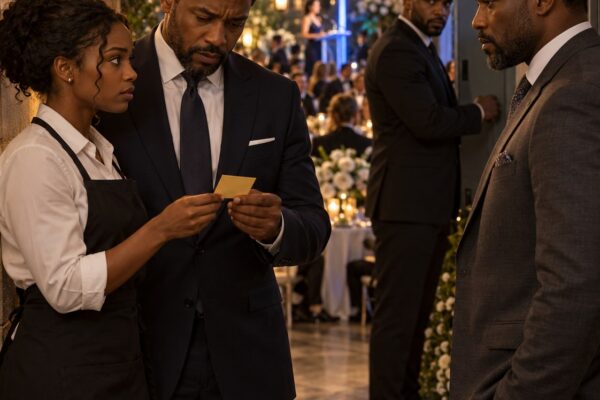
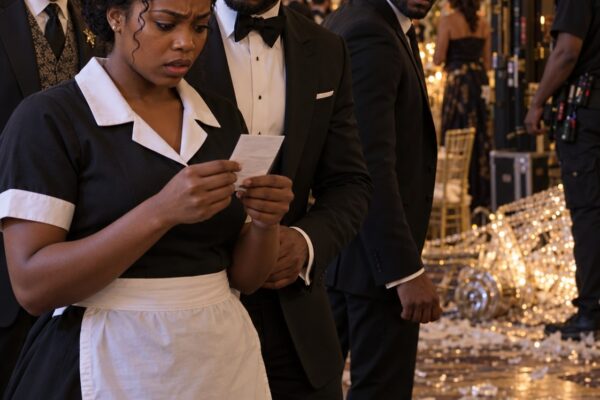
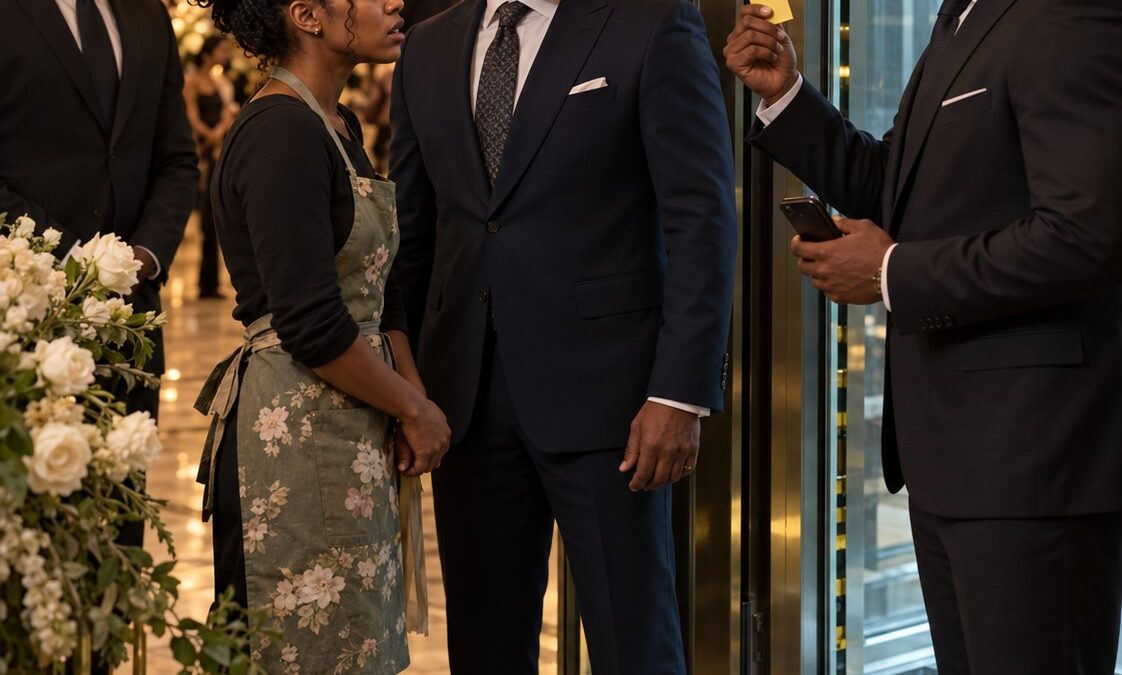
Tessa stayed by the brass card frame, the yellow paper pressed against her palm.
She could hear someone trying the doors from the other side.
Adrian looked at the loose hatch inside the lift.
“Rafe, call the police.”
Nolan’s expression remained composed.
“For a loose panel?”
“For whatever they find.”
Rafe made the call.
Tessa’s wrist had begun to swell.
She tucked it beneath her other arm.
Adrian noticed.
“Let me see.”
“I’m fine.”
“That wasn’t a request to Rafe.”
Rafe’s face tightened.
“I thought she had a blade.”
“She does,” Tessa said.
She laid the little florist’s knife on the marble table.
Celeste stared at it.
“It has rose sap on it.”
“I can see that,” Adrian said.
He turned to Tessa.
“I’m sorry he hurt you.”
Rafe said, “I’m sorry.”
Tessa nodded once.
She had expected the night to end with police questioning her.
It still might.
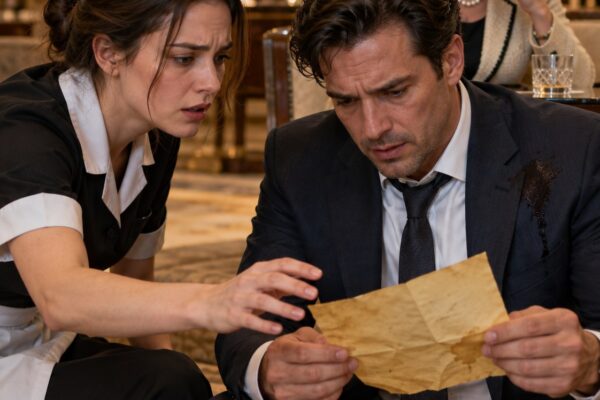
Adrian eased the yellow card from her cramped fingers.
“I remember your father,” he said.
“People usually remember the headline.”
“I remember his letter.”
She looked at him.
“What letter?”
“He wrote to me before the fire.”
The room seemed to narrow.
Evan had told Tessa he tried to warn the owners.
After the investigation, Adrian’s office said no warning had arrived.
“Your lawyers said you never got one.”
“I didn’t,” Adrian said.
“Nolan handled the building then.”
Nolan gave a small shake of his head.
“Careful.”
Adrian did not look away from Tessa.
“What did your father say?”
“He said someone signed off a repair he hadn’t finished.”
Adrian’s grip tightened on the card.
“The letter in my file said the repair was complete.”
Tessa stared at him.
Then she understood why her father had kept writing.
The letter Adrian read had never been her father’s.
* * *
The police arrived with an elevator mechanic from the city’s on-call inspection service.
Adrian gave them the card.
Tessa described where she had found it.
Rafe provided the building manager’s message and kept everyone out of the lift.
The mechanic opened the control cabinet with a police officer watching.
He found an emergency stop engaged behind a locked panel.
Someone had also loosened the ceiling hatch.
“The car itself is secure,” he said.
“But it shouldn’t have been carrying passengers.”
Adrian asked what might have happened.
“I can’t tell you without a full inspection.”
The officer wrote that down.
Tessa appreciated the answer.
It gave nobody a death scene to imagine.
It gave them a reason to keep the lift closed.
A detective named Priya Shah arrived before midnight.
She collected the card in a paper envelope.
Tessa showed her the green ink crossing the cut.
Shah photographed it under a portable lamp.
“The person who stamped this knew about the slash?” she asked.
“Probably,” Tessa said.
“Probably isn’t proof.”
“No.”
Shah nodded.
“We’ll ask them.”
Nolan offered to provide the building’s records in the morning.
Adrian said the manager could provide them tonight.
For the first time, Nolan looked tired.
Tessa gave Shah her contact details.
Her manager called while she was speaking to the detective.
Tessa stepped aside to answer.
“Tell me that wasn’t our arrangement,” her manager said.
“It was.”
“Did you hit him with it?”
“Yes.”
A long pause followed.
“Go home,” the manager said.
“We’ll talk tomorrow.”
Tessa returned the phone to her apron.
Adrian was waiting near the flowers.
“You’ve lost your job?”
“I don’t know.”
“I can speak to them.”
“Please don’t.”
He accepted that at once.
It surprised her.
“What would help?” he asked.
“I want to see my father’s letter.”
Adrian looked toward Nolan.
“So do I.”
By noon the next day, Shah had obtained the building’s electronic access log.
Nolan’s badge had opened the lift’s control cabinet at 5:48.
The manager’s badge had opened the inspection frame at 6:12.
The gala had begun at seven.
Nolan said the first entry was routine.
The manager said Nolan told him to replace a damaged card.
Neither claim explained the cut.
Tessa spent the morning in her apartment, with an ice pack around her wrist and her father’s old tool case at her feet.
She had opened it many times since his death.
Usually she closed it quickly.
The smell of machine oil still belonged to him.
This time, she lifted the shallow tray.
Beneath it lay folded work sheets, numbered in pencil.
Her father had kept duplicate copies when a repair involved a safety closure.
Tessa found the supper club.
Three entries.
The first recorded a failed fire door.
The second ordered replacement parts.
The third remained unsigned.
She photographed each page.
Then she called Shah.
At the station, a records technician compared the paper copies with the scans in the old investigation file.
The first two matched.
The third did not.
The scan showed Evan’s signature beneath a completed repair.
The copy from his case showed a blank signature line.
Tessa watched the technician enlarge both images.
A dark mark beside the printed date appeared on each.
It was a tiny nick from the same office printer.
The pages had started from the same batch.
Someone had filled one in afterward.
Shah asked where the tool case had been.
“In my closet.”
“Who had access?”
“Only me.”
“That helps, but we’ll still need independent records.”
“I know.”
Tessa did not want her father cleared by a daughter’s word alone.
She wanted the proof to survive anyone who challenged it.
Adrian arrived with his attorney, Ruth Heller.
Ruth brought the letter from his archived file.
It was on Evan Vale’s company letterhead.
It reported that the fire door had been repaired and the building was safe for use.
At the bottom was Evan’s signature.
Tessa laid her father’s unsigned work sheet beside it.
“He wrote his sevens with a bar,” she said.
Ruth looked closer.
The signature beneath the letter contained a date.
Its seven had no bar.
Shah called a document examiner.
Then she requested the old mailroom log from Adrian’s office.
Nolan had supervised the property division that year.
He had also controlled which complaints reached Adrian.
Adrian sat across from Tessa while they waited.
“I should have met your father,” he said.
“Yes.”
“I should have checked.”
“Yes.”
He did not offer an excuse.
That helped more than another apology would have.
Near evening, Shah returned with the mailroom record.
Evan’s original envelope had been signed for at Adrian’s office two days before the fire.
The recipient was Nolan Keene.
* * *
Tessa went back to work on Thursday.
Her manager handed her a fresh apron.
“I saw the video,” she said.
“It looked expensive.”
“The roses were insured.”
Tessa gave her a look.
“Your shifts are still yours.”
That was all.
It was enough.
By afternoon, her face had appeared on every local news feed.
Someone had called her brave.
Someone else had called her a liar.
One account claimed she had conspired with Adrian to embarrass Nolan.
She put her phone in a drawer and trimmed stems.
At four, a delivery driver asked for her by name.
He carried a box of white roses.
Tessa refused it until he showed her the sender.
No name.
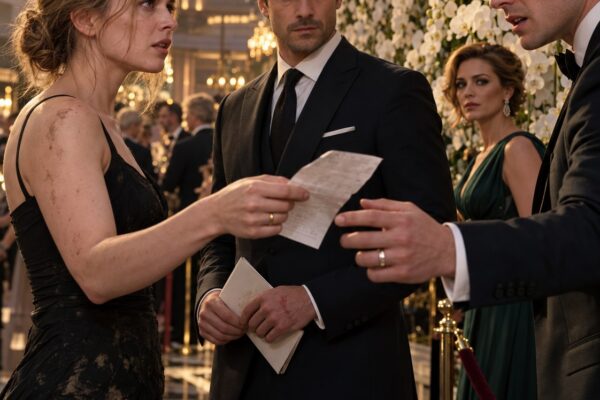
Inside the box, under the flowers, lay a copy of her father’s forged letter.
Across it, someone had written: LET THE DEAD REST.
The driver had picked up the box from a courier counter.
He had no idea who had sent it.
Tessa called Shah.
She did not touch the letter again.
The detective collected the box and asked about cameras at the counter.
“They have them,” the driver said.
“They’ll keep the footage.”
Tessa’s hands shook after he left.
Her manager set down a cup of tea.
“You can take the rest of the day.”
“I want to finish the wedding order.”
“You can.”
The manager stayed beside her until the next rack was done.
That evening, Adrian waited outside the shop with Rafe.
Rafe remained by the car.
Adrian stayed on the sidewalk.
“Shah called me,” he said.
“She called me too.”
“I brought someone.”
Celeste stepped out of the car.
She wore jeans and carried a thick envelope.
Tessa recognized her from the gala, though Celeste looked younger without the ivory gown.
“I handled the foundation’s old grants,” Celeste said.
“Nolan asked me to find records of waterfront repairs.”
“When?”
“Last month.”
Tessa went still.
Celeste held out the envelope.
“I thought it was for a property sale.”
Adrian did not take it from her.
Celeste gave it to Tessa.
Inside were copies of payments from a company that had worked on the supper club’s fire door.
The money had gone into a holding account connected to Nolan.
The payments continued for years after the fire.
“Why keep paying him?” Tessa asked.
“That’s what Ruth wants to know,” Adrian said.
Celeste met her eyes.
“I should have brought this sooner.”
“Why didn’t you?”
“Adrian and I were engaged.”
Tessa waited.
Celeste looked toward him.
“Nolan said these records would destroy him.”
“And you believed him?”
“I wanted to.”
That answer was honest enough to hurt.
Shah arranged for the originals to be obtained from the foundation and the bank.
She warned them that the copies were a lead, not yet a conclusion.
Adrian drove Tessa home.
Rafe took the front seat.
Tessa sat in the back with the envelope on her lap.
Her apartment window faced a brick wall.
Someone had left a small bunch of grocery-store daisies outside her door.
There was no card.
Her neighbor, an elderly woman who always complained about the stairwell light, opened her door.
“I saw the news,” she said.
“I thought you might like flowers you didn’t have to arrange.”
Tessa laughed.
It came out unevenly.
Inside, she put the daisies in a drinking glass.
Adrian stood near the doorway.
He had never been inside her apartment.
He seemed uncertain where to put his hands.
“My father used to bring me these,” Tessa said.
“Daisies?”
“The cheap mixed bunches.”
“Did he arrange them?”
“He said that was my department.”
Adrian smiled.
The smile faded when his phone rang.
Ruth had news from the company accountant.
She had compared Celeste’s records with Nolan’s recent requests.
Nolan was trying to move a waterfront warehouse into a creditor trust.
He needed Adrian’s signature at the charity dinner.
Adrian had delayed signing because the terms had changed.
The lift was supposed to take him upstairs to a private meeting with Nolan.
A lawyer was already waiting there with the papers.
“He wanted you frightened,” Tessa said.
“Or confused enough to sign,” Adrian said.
“And if I refused?”
Ruth answered through the phone.
“There’s more.”
The old contractor had kept invoices for work it never performed.
Those invoices were the basis for the creditor claim.
Nolan had been using the fire to build a debt that did not exist.
Then he had forged the record that blamed Evan for it.
* * *
Ruth asked Adrian to keep away from the warehouse.
Shah asked him to keep his staff from touching the records.
Adrian obeyed both.
He sent the original property files through counsel.
He gave Shah the names of everyone who had handled the gala meeting.
He did not call Nolan.
Nolan called him.
Adrian put the call on speaker in Ruth’s office, with Shah listening.
“You’ve made this public,” Nolan said.
“The card did.”
“You know what happens if your father’s properties are reopened.”
“They’ll be examined.”
“You say that as though you can bear it.”
“I can.”
A pause followed.
“I kept your name clean,” Nolan said.
Adrian looked at Tessa.
“No,” he said.
“You kept it useful.”
Nolan ended the call.
Ruth slid a document across the table.
It was the proposed transfer agreement.
At the top, the waterfront warehouse appeared as security for a debt.
Halfway down, a second clause would have given Nolan control of the property if Adrian missed a payment.
The due date was fourteen days after signing.
Adrian had never seen that clause.
“The copy Nolan gave me ended a page earlier,” he said.
Ruth held up the two versions.
Their final pages had different dates.
She had obtained hers from the lawyer Nolan brought to the gala.
That lawyer had already spoken to Shah.
He said Nolan instructed him to bring the longer version upstairs and present it as a correction.
“He may have thought the debt was real,” Ruth said.
“He says he did.”
Shah tapped the page.
“We can check who prepared it.”
Tessa watched Adrian read the clause again.
His anger showed in the stillness of his hands.
“What do you want to do?” he asked her.
She knew what he meant.
He could ruin Nolan by morning in ways Shah could not use as evidence.
“My father wanted people to read the right paper,” she said.
“Let them read it.”
Adrian nodded.
The decisive records arrived over the next week.
A bank produced the original account statements.
The old contractor’s former bookkeeper identified the invoices she had been told to prepare.
She had kept emails because she feared she would be blamed.
A document examiner found that Evan’s signature on the repair sheet had been copied from an unrelated payroll form.
The supposed letter to Adrian used the same copied image.
The courier counter footage showed Nolan’s assistant leaving the flower box.
Shah interviewed the assistant.
She said Nolan had told her it was a legal notice.
When she saw the writing inside, she asked for an attorney.
Nobody asked Tessa to forgive her.
Nobody asked her to guess what she knew.
On the second Friday after the gala, Ruth convened a meeting of the foundation board.
Its members controlled the grants Celeste had traced.
Two of them had approved the proposed warehouse transfer without seeing the longer agreement.
Shah and an assistant prosecutor attended at their request.
Nolan came with counsel.
Tessa was invited because the board had circulated statements about her father after the fire.
She wore the same black shoes she had worn at the gala.
She had cleaned rose dust from the seams.
Nolan spoke first.
He did it well.
The warehouse, he said, had been neglected.
The foundation had covered urgent repairs.
Adrian had relied on his judgment for years.
Evan Vale’s file was old, incomplete, and suddenly convenient to a daughter seeking a public victory.
Tessa felt her face warm.
Nolan did not look at her.
“That is unfair,” Celeste said.
“It is relevant,” Nolan replied.
One board member asked whether the current lift card had any bearing on the old fire.
“None,” Nolan said.
Shah placed a photograph on the table.
It showed the card before Tessa removed it.
The red slash was visible behind the brass frame.
“The building manager says you ordered him to replace it,” Shah said.
“He misunderstood me.”
“His phone recorded your instruction.”
Nolan’s attorney leaned toward him.
Shah did not play the recording.
She gave the board a transcript.
In it, Nolan told the manager to cover the slash and leave the card in place.
Nolan read the page.
“He was concerned about a delay,” his attorney said.
Shah set down a second photograph.
It showed the stamped card under magnification.
Green ink crossed the cut edge.
“The stamp came after the warning mark,” she said.
“Your assistant requested the stamp from the maintenance office at 5:31.”
Nolan turned to Adrian.
“You would put all of this on me?”
Adrian folded his hands.
“I’m listening to the records.”
“After everything I protected.”
“You can tell them what that means.”
Nolan looked at the board.
“His father bought buildings nobody else wanted.”
“Some needed more work than the family was willing to pay for.”
“I kept the doors open.”
A board member asked about the forged repair sheet.
Nolan said he had never seen it before the investigation.
Shah slid forward the mailroom log.
Then the examiner’s report.
Then the bookkeeper’s emails.
Nolan’s attorney asked for a break.
The board chair granted ten minutes.
Tessa went into the hallway.
Her hands hurt from gripping the arms of her chair.
Adrian came out behind her.
“You don’t have to go back in.”
“Yes, I do.”
“Nolan won’t get the last word.”
“That isn’t why.”
She looked through the glass at the table covered in paper.
“My dad sat in rooms like that.”
“Nobody believed him.”
Adrian’s face tightened.
“I know.”
“Today, they will.”
When the meeting resumed, the prosecutor told the board she could not announce charges on the spot.
The investigation was continuing.
She could, however, explain that the records had been preserved and witnesses interviewed.
The board voted to freeze the transfer.
It commissioned an outside review of the old fire file and its own statements about Evan.
Nolan’s counsel said his client would cooperate.
Nolan stood.
As he passed Tessa, he stopped.
“Your father made mistakes too.”
Tessa looked at him.
“I’m sure he did.”
Nolan seemed ready for a fight.
She gave him none.
“That’s why records have dates and signatures.”
He walked out.
Six months later, Nolan pleaded guilty to fraud and falsifying business records.
The prosecutor said the elevator investigation had not established that he intended to injure Adrian.
No one claimed that it had.
The forged repair approval was removed from Evan’s case file.
The city amended its findings to say his responsibility for the failed door had not been established.
The foundation published a correction and apologized to his family.
Tessa read it twice.
Then she took a copy to her father’s grave.
* * *
Winter arrived early.
Tessa worked through it with cold fingers and a stubborn plant in her apartment window.
Her manager promoted her to lead designer in January.
The raise paid her rent with room left for groceries.
She celebrated by buying a kettle that turned itself off.
“It’s extravagant,” her neighbor said.
“It has a light,” Tessa replied.
Adrian came to the shop every other Thursday.
At first he ordered flowers for his office.
Then he admitted the office already had too many.
He kept coming.
He and Celeste had ended their engagement.
Celeste remained on the foundation board long enough to finish its review, then left.
She sent Tessa a short letter.
It contained no request for forgiveness.
It said she had read Evan’s original reports and was sorry she had chosen comfort over checking them.
Tessa put the letter in the drawer beneath her worktable.
She did not answer immediately.
In March, the foundation offered Tessa a settlement for its false statements about her father.
Ruth explained every term with an independent lawyer Tessa had chosen.
The amount could have bought her a house.
Tessa accepted the correction and a smaller payment that covered her father’s old legal bills.
She directed the rest into a grant for trade workers who needed help obtaining independent safety inspections.
Adrian heard about it from Ruth.
“You could have kept it,” he said.
“I kept what I needed.”
“I’d like to contribute.”
“You can.”
Tessa handed him the grant rules.
“No names on the applicants’ files.”
He read them.
“No exceptions?”
“None.”
He smiled.
“You’ve met my lawyers.”
“They can read.”
Their visits grew easier.
Rafe once arrived with Adrian and stood outside the shop holding a tiny pot of basil.
Tessa opened the door.
“Is that for me?”
“It’s for him,” Rafe said.
Adrian took the pot.
“He says my apartment smells like money.”
“I said it smells empty.”
Tessa laughed so hard she had to sit down.
Rafe had apologized again for her wrist.
It had healed.
She told him once that she believed him.
When he tried a third time, she gave him a job carrying water buckets.
Adrian learned that Tessa’s favorite dinner was breakfast.
Tessa learned that Adrian burned toast while reading.
Neither fact changed the city.
Both changed their Thursdays.
In April, Adrian asked if she would walk with him after work.
They went down to the river.
The old waterfront buildings stood behind a new fence.
Ruth’s review had found repairs that still needed doing.
Adrian had closed the affected spaces until inspectors cleared them.
He told Tessa he wished he had listened sooner.
“You didn’t know me then,” she said.
“I knew your father had written.”
“You knew what someone said he wrote.”
“I accepted it because it was easier.”
They stopped beside the railing.
He did not reach for her.
“I’m sorry,” he said.
Tessa watched a ferry cross the gray water.
“I believe you.”
“I don’t expect that to fix anything.”
“It doesn’t.”
She turned to him.
“If you ever put someone between me and the truth again, I leave.”
“I understand.”
“And you ask before you try to fix my job.”
“I learned that one.”
She almost smiled.
Adrian waited.
“May I see you on Sunday?” he asked.
“Outside the flower shop?”
“Anywhere you choose.”
Tessa thought of her father, who had always insisted that a door should open from both sides.
She took Adrian’s hand.
“Sunday,” she said.
* * *
Four years later, the Bellwether Exchange hosted a dinner for the inspection grant.
Its glass elevator had been rebuilt and certified.
Tessa had checked the current card herself when she arrived.
It sat plainly behind the brass frame.
No folded corners.
No hidden marks.
She placed white roses beside it.
This time, they stood in a low bowl.
Nothing blocked the doors.
Rafe arrived carrying his daughter’s pink coat over one arm.
He asked whether Tessa needed help moving the flowers.
“I trust you with the water buckets,” she said.
“That’s progress.”
Celeste came later.
She shook Tessa’s hand.
They spoke about the grant’s first apprentices.
There were nine.
One had already reported a faulty school stair rail and been thanked for it.
Tessa thought her father would have liked that detail.
Adrian found her by the elevator.
He wore black again.
A loose rose petal rested on his shoulder.
“You missed one,” she said.
“I was hoping you’d notice.”
In the glass beside them, Tessa could see the room filling.
Her manager.
Her neighbor.
The document examiner.
Shah, now off duty and eating an entire plate of appetizers before the speeches.
There were people who had known Evan.
There were people who had only known the headline.
The foundation had printed his name correctly in the program.
The grant had paid for inspections.
The old file had been corrected.
The doors worked.
Adrian held out his hand.
“May I?”
Tessa looked once more at the yellow card in its frame.
A warning had once been hidden behind a false approval.
Now the card could be read by anyone.
She took his hand.
“Let’s go,” she said.
Together, they walked past the elevator and into the warm, crowded room.
THE END