The Station Attendant Held Open a Billionaire’s Private Elevator for Her Brother, and the Old Lunch Tin at Her Feet Changed Everything
Chapter 2: What the Tin Held
The elevator stood still.
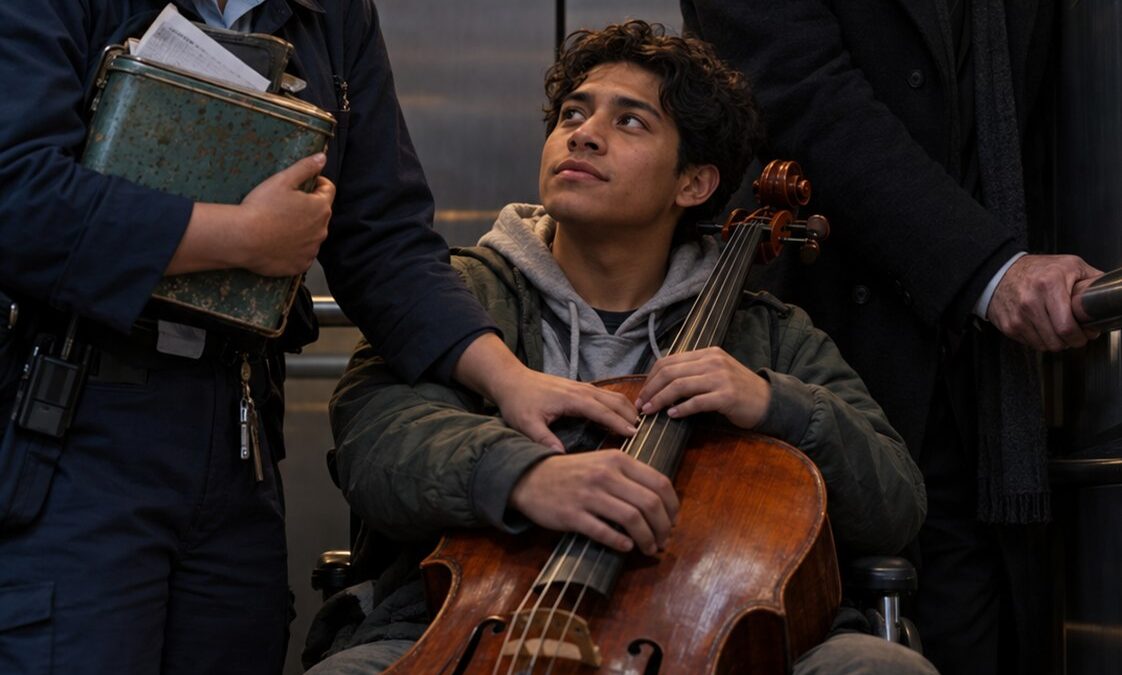
Adrian’s cello slid against his chair.
Inez caught it before it fell.
A dim emergency light came on above the doors.
Gideon pressed the call button.
A voice answered through the speaker.
“Control room.”
“Car three,” Gideon said.
“We stopped between floors.”
“We see it.”
“Is anyone hurt?”
“No,” Inez said.
Adrian adjusted his cello.
“Just my pride.”
The controller said a technician was coming.
Gideon took out his phone.
There was no signal.
Inez had expected him to curse at someone.
He put the phone away.
“Are you comfortable?” he asked Adrian.
“I’ve been in slower elevators.”
“Adrian.”
“What?”
“You don’t have to entertain him.”
“I was entertaining myself.”
Gideon looked at the tin in Inez’s hands.
She held it against her chest.
“Show me the report.”
“You can see it later.”
“You heard what I said upstairs.”
“Yes.”
“I was wrong.”
She turned toward him.
The emergency light made his face look tired.
“My father filed that report,” she said.
“He had a hearing.”
“I know about the hearing.”
“He was fired.”
“I know that too.”
“Then you know enough.”
The controller spoke again.
The technician needed a few minutes.
Adrian checked his watch.
“I’ll make the audition,” he said.
Inez knew he was trying to calm her.
She also knew he might be right.
The train still had to reach their platform, and the conservatory was two blocks from the far station.
“Does the train stop?” Gideon asked.
“Not for us,” Inez said.
“I meant the scheduled service.”
“It leaves at six-oh-two.”
“What time is it?”
“Five-fifty-eight.”
He pressed the call button again.
“Can dispatch hold the eastbound train until this car opens?”
The controller hesitated.
“I can ask.”
“Please ask.”
Inez watched him release the button.
“That’s a public train,” she said.
“Yes.”
“You don’t get to decide who waits.”
“I asked dispatch.”
It was a small distinction.
She wanted to ignore it.
Adrian wanted her to open the tin.
He had been asking for months to see the papers their father kept there.
She always said later.
Later had been easier.
Their father, Matias Calder, repaired station lifts for twenty-three years.
Twelve years earlier, a failed inspection became a public scandal.
The city said he had approved repairs that were never performed.
A contractor kept the money.
Matias lost his license, his job, and the easy way he once said his own name.
Afterward, he took apart broken clocks at their kitchen table.
He rarely finished one.
The tin had been on that table since Inez was nineteen.
She opened it.
There was no lunch.
There were two folded sheets, a photograph, and a paper sleeve of spare screws.
Gideon did not reach inside.
“What is the top sheet?” he asked.
“A copy of his report.”
“May I?”
She gave him the first page.
He held it beneath the emergency light.
Inez had read those lines so often that she could see them without looking.
The elevator’s emergency brake had failed its test.
The replacement assembly billed to the city had not been installed.
Three inspection stickers carried the same serial number.
At the bottom, Matias had written the date and time he delivered the report.
There was also a name.
Gideon read it twice.
“Who is D. Mercer?”
“The compliance officer,” Inez said.
“He testified that my father never raised a concern.”
Gideon looked at the second sheet.
Inez unfolded it herself.
It was a receipt, pressed thin from years in the tin.
A stamp showed it had entered the redevelopment company’s office.
A signature crossed the line marked RECEIVED.
Gideon brought the page closer.
“No one showed this at the hearing?”
“My father did.”
“The city’s copy?”
“Vanished.”
“And this one?”
“They said the stamp could have been made anywhere.”
The elevator jolted.
Adrian put one hand on his cello.
Gideon steadied the chair with his foot, then moved it away once Adrian had the wheel.
The car began to rise.
“Why did you keep the screws?” Gideon asked.
“They’re from the assembly my father took out.”
“He saved them?”
“He thought the new part would be fitted that week.”
The doors opened onto the platform.
The eastbound train waited with its doors open.
A dispatcher stood beside the cab.
Adrian looked between them.
“Go,” Inez said.
“Are you coming?”
“I’ll take the next one.”
He saw the report in Gideon’s hand.
“No,” Adrian said.
“That’s Dad’s.”
“It is,” she told him.
“I’ll bring it home.”
Gideon handed the page back at once.
The dispatcher helped Adrian board.
His chair cleared the gap.
His cello followed.
The doors closed.
Inez stayed on the platform until the train moved.
Then she found Gideon still beside the elevator.
He was studying the receipt in her hand.
“D. Mercer worked for your company,” she said.
“Yes.”
“Your people called my father a liar.”
Gideon looked toward the departing train.
“Someone did.”
“That sounds convenient.”
“It isn’t.”
She folded the receipt.
Gideon spoke before she put it away.
“My aunt chaired the office that received his report.”
* * *
By seven-thirty, Adrian had reached the conservatory.
He sent a photograph of his cello outside the audition room.
Inez looked at it in a break room Gideon had asked the station manager to open.
Her supervisor stood by the door.
“The guard reported that you obstructed a lift,” he said.
“I did.”
“You also challenged a guest.”
“I did.”
Gideon stood up.
“The lift should have been available to passengers.”
The supervisor looked at him.
“I can review that.”
“Please review who ordered it locked.”
Inez set her phone on the table.
“Don’t make my job a favor,” she said.
Gideon sat down.
“All right.”
The supervisor left with his radio.
Neither of them spoke until its crackle faded down the hall.
Gideon had called a lawyer named Naomi Price.
She arrived carrying a canvas folder and a paper notebook.
She worked outside his company.
Her first question was for Inez.
“Do you want me here?”
“I want someone to tell me what those papers can prove.”
“Then I’ll tell you what I know.”
Naomi asked permission before she touched the tin.
She photographed each item where it lay.
She wrote down who had held it that morning.
Inez told her about the twelve years it spent in their kitchen.
“And before that?” Naomi asked.
“With my father.”
“Does he know you have it?”
“He gave it to me when I moved out.”
“Why?”
“He said I was the only person who still read what he wrote.”
Gideon looked down.
Naomi did not.
She turned the receipt over.
A small blue mark showed through the paper.
“Was there another page attached?”
“I don’t know.”
“We can ask him.”
“He won’t enjoy it.”
“He can refuse.”
That made Inez like her.
The photograph in the tin showed an old elevator machine room.
Matias stood beside an open cabinet.
He had one hand on a metal plate inside it.
A date had been printed on the back at a pharmacy kiosk.
The image was grainy.
Naomi asked if there was an original file.
“No,” Inez said.
“My father used a disposable camera.”
“Where are the other pictures?”
“He gave the envelope to his lawyer.”
“Who was that?”
Inez gave her the name.
Naomi called the lawyer’s office.
He had retired.
His daughter now ran the practice and said the case file remained in storage.
She could arrange a visit that afternoon.
Gideon offered to send a car.
Inez shook her head.
“I know the bus.”
He accepted that.
At eight, Gideon’s own assistant called.
Inez heard only his side of the conversation.
“No press statement.”
“No, I haven’t spoken to Vera.”
“Tell the station team the lift is open.”
He ended the call.
“Vera is your aunt?” Inez asked.
“Yes.”
“What does she do?”
“She chairs the family’s holding company.”
“What did she do twelve years ago?”
“She oversaw contracts for the station redevelopment.”
Inez had heard the name Voss since she was a child.
She knew the company built terminals and freight yards.
She knew Gideon had inherited control after his father’s death.
She did not know how many decisions belonged to him.
“How old were you then?” she asked.
“Twenty-nine.”
“Old enough to read a report.”
“I was in another division.”
“That’s an answer.”
“It isn’t a defense.”
Naomi closed her notebook.
“I’d like to speak with your father first,” she told Inez.
“And I’d like the case file.”
Gideon stood.
“You can use our records.”
“I’ll request them,” Naomi said.
“I don’t work for you.”
For the first time that morning, Gideon almost smiled.
Inez took the tin home.
Matias lived in the second-floor apartment above a tailor’s shop.
The lift there had been repaired twice that year.
Inez found him at the kitchen table, holding a clock spring with tweezers.
He looked at the tin.
“Did Adrian leave it at your place?”
“I brought it.”
“Why?”
She told him about the elevator.
He put down the tweezers when she reached Gideon’s name.
“He saw the receipt?”
“Yes.”
“Did he say it was fake?”
“No.”
Matias stared at the table.
“That would be new.”
Naomi sat across from him.
She explained what she hoped to check.
Matias listened without moving.
When she asked about the missing attachment, he took the receipt and held it near the window.
“Blue carbon,” he said.
“It came from a bound delivery book.”
“Who kept the book?”
“The front desk.”
“Do you remember the clerk?”
“Mrs. Bell.”
He looked at Inez.
“You used to wait with her when school got out.”
Inez remembered a woman who gave her peppermint candies.
She remembered a glass window and a stool too tall for her legs.
She had forgotten the woman’s name.
Naomi wrote it down.
Matias turned to the photograph.
“That plate has the replacement serial number.”
“Can we read it?” Gideon asked.
“Not from this print.”
“Would another record show it?”
“The supplier’s invoice.”
Matias set the picture down.
“That’s how they said the repair was done.”
“Who said?” Inez asked.
“The compliance officer.”
“Mercer.”
“Yes.”
Matias looked at Gideon.
“Your aunt came to my hearing.”
“She did?”
“She sat behind him.”
Gideon knew she had approved the station accounts.
He had not known she attended the hearing.
Matias went back to the receipt.
“I watched Mrs. Bell stamp it.”
“Could she testify?” Naomi asked.
“If she’s alive.”
Inez watched his hands.
They had been steady all morning.
Now his thumb worried the softened corner of the paper.
“You never told me she saw you,” Inez said.
“I told my lawyer.”
“The city said you had nobody.”
“My lawyer said Mrs. Bell had left the job.”
“Did anyone find her?”
“He tried.”
Naomi said she would try again.
She called the retired lawyer’s daughter.
By three, they stood in a room filled with closed file boxes.
The daughter laid Matias’s case file on a table.
It held hearing notices, invoices, witness statements, and copies of his appeal.
Naomi read the index first.
Inez searched the pages for her father’s handwriting.
Gideon searched for his aunt’s name.
A letter had been filed two weeks before the hearing.
The city attorney had requested the original delivery log from Voss Holdings.
The response said the log was lost during an office move.
Its signer was Vera Voss.
Gideon made a quiet sound.
Naomi placed that letter beside the tin’s receipt.
“Keep going,” she said.
There was more.
The supplier invoice listed a replacement brake assembly.
Its serial number matched the inspection forms in the file.
The photograph showed a different plate on the machine room cabinet.
Matias had circled it in red pencil.
“It could be the old unit,” Naomi said.
“It was,” Inez replied.
“That still needs independent confirmation.”
They found it in a service call record attached to a later appeal.
Six months after Matias was fired, another technician reported the same failed brake test.
The city had closed the elevator for three weeks.
The record named the component he replaced.
It carried the old serial number from Matias’s photograph.
Gideon read the record.
“Why didn’t the appeal succeed?”
Naomi checked the decision.
“The board said the later failure did not establish what was installed on the earlier date.”
Matias had argued that it did.
He had not been able to prove who took the repair payment.
Naomi marked the two invoices.
One belonged to a parts supplier.
The other belonged to a consulting company called Harrow Technical Review.
Inez had never heard of it.
Gideon had.
“Harrow signed off on the work,” he said.
“And billed us for that review.”
Naomi opened a directory on her phone.
The company had dissolved nine years earlier.
Its registered address had been a small office across town.
The file gave the name of its manager.
D. Mercer.
Inez leaned over the page.
“He received my father’s report.”
“He also approved the repair,” Naomi said.
Gideon turned another invoice over.
A handwritten note authorized payment despite a missing installation certificate.
He knew the handwriting.
He had seen it on birthday cards, company memos, and the deed to his first apartment.
“Vera approved Harrow’s invoice,” he said.
* * *
The station took Inez off the schedule the next morning.
The supervisor called it paid administrative leave.
He would not say who ordered it.
By noon, a statement appeared online from Voss Holdings.
It said the company was reviewing an old personnel matter.
It asked the public to respect the privacy of former employees.
Matias read it on Inez’s phone.
“Former employees,” he said.
“They still can’t say my name.”
Inez took the phone back.
“Do you want them to?”
“I want them to say what happened.”
Gideon arrived an hour later.
He stood in the hallway until Inez let him in.
Naomi came with him.
Vera had called Gideon twice.
He had answered once.
“She says the papers in the tin are incomplete,” he told them.
“She remembers the hearing differently.”
“What else?” Inez asked.
“She says you can keep your job if we handle this inside the company.”
Inez moved aside so he could see her father.
“Ask him if that’s enough.”
Gideon did.
Matias shook his head.
“No.”
Gideon nodded.
“I told her the same.”
Naomi had spoken to Mrs. Bell that morning.
Her name was Ruth Bell.
She lived with her daughter forty minutes away.
She remembered Matias.
She remembered the report because he had insisted she stamp both his copy and the office copy.
She could not recall who collected the office copy afterward.
“But she kept something,” Naomi said.
“A diary?”
“A staff notebook.”
Mrs. Bell had written down unusual deliveries at the front desk.
Her entry for Matias’s visit listed his report and the time.
A second entry, later that day, recorded an instruction to send the bound delivery book upstairs.
The instruction came from Vera’s office.
“Will she talk to investigators?” Matias asked.
“She said yes.”
Gideon had brought a folder of records from his company.
Naomi had requested them through its records manager.
Gideon did not open the folder.
He slid it to her.
“I haven’t read these yet,” he said.
“You can read with us.”
The folder held payment approvals for the station lift project.
Harrow Technical Review had been paid for inspecting the replacement assembly.
A repair contractor had been paid for installing it.
Both payments came from a city accessibility grant administered by Voss Holdings.
The contractor still existed.
Naomi called its current office.
An administrator located the old job number.
There was no matching work order.
She promised a written response after checking archived records.
Inez watched Gideon’s hands as Naomi made notes.
He kept them flat on the table.
He looked like a man trying to stay still while a floor shifted beneath him.
“Is the grant public money?” Inez asked.
“Yes,” Naomi said.
“And the city can investigate?”
“Yes.”
“Then send it to the city.”
“I’d also send it to the state’s investigators.”
Gideon looked at her.
“Do that.”
Naomi explained that they had evidence of a false account, but no proof yet of who moved the money or whether someone had simply made a grave error.
“We need the bank records,” she said.
“Investigators can seek them.”
“You can request ours,” Gideon said.
“I already did.”
He nodded.
Inez was grateful Naomi had not waited for his permission.
After they left, Adrian came home with his cello.
He had finished the audition.
He refused to say how it went.
“Tell me after they call,” he said.
He had seen the statement online.
He looked at Matias.
“They’re talking about you again.”
Matias pulled out the chair beside him.
“Come sit.”
Adrian parked his chair at the table.
Matias asked him to play something.
“In here?”
“It’s where your sister practiced her recorder.”
“That was a punishment for everybody.”
Inez smiled despite herself.
Adrian played a slow passage.
The tailor downstairs knocked once on the ceiling with his broom.
Adrian played it more softly.
Matias closed his eyes.
Inez thought of the years they had spent protecting him from every mention of the station.
She had treated silence as kindness.
He opened his eyes before the music ended.
“Don’t put that away on my account,” he said.
She knew he meant more than the cello.
That evening, someone left an envelope under Inez’s apartment door.
Inside was a copy of her work schedule.
Her shifts had been crossed out in red.
Beneath it lay a photocopy of the old hearing decision.
There was no note.
Inez photographed both pages and called Naomi.
Naomi told her to keep the envelope and avoid handling it further.
She helped Inez make a police report the next morning.
The officer recorded what had arrived and where.
He did not promise he could identify whoever delivered it.
Inez wanted to know if Gideon had sent anyone to her building.
He said no.
She believed him.
That surprised her.
By Friday, the contractor had sent its archived records.
Its invoice was real.
Its installation signature was not.
The man named on the form had been on medical leave that week.
The company’s time records showed it.
Naomi gave the records to the investigators.
Gideon asked his finance director to trace the old approvals within his company.
The director found one more payment.
It had gone to Harrow Technical Review three months after Matias’s hearing.
Its description read “closure services.”
No report was attached.
Harrow’s manager, Mercer, had closed his firm soon afterward.
He now ran a marina in another state.
Investigators could speak to him.
The finance director also found a copy of Harrow’s original ownership disclosure in an archived contract box.
Mercer held a minority share.
The controlling share belonged to a trust.
The trust’s named beneficiary was Vera Voss.
* * *
Gideon called a special meeting of the station partnership board.
The city appointed half its members.
Voss Holdings appointed the rest.
The grant agreement required them to review any serious question about the use of its funds.
The meeting took place in a room above the same station hall where Inez had held the elevator doors open.
The lift was running.
A sign beside it said PUBLIC ACCESS.
Inez noticed because she had checked.
Matias came with her.
Adrian stayed beside him.
Naomi had invited Ruth Bell and the contractor’s former payroll manager to attend.
An investigator from the state sat near the back.
She had told Naomi she was there to observe and ask for records.
She would not decide the case in that room.
Vera arrived five minutes late.
She was tall, silver-haired, and carefully dressed.
She kissed Gideon on the cheek.
He did not step toward her.
“Have you eaten?” she asked him.
“Yes.”
It was an ordinary question.
Inez wondered how many ordinary questions had covered the past twelve years.
The board chair opened the meeting.
Naomi laid out the documents one at a time.
Matias’s report.
The stamped receipt.
The front desk notebook.
The supplier invoice.
The later service record.
The contractor’s leave records.
She said what each document could show.
She also said what it could not.
Vera listened without interrupting.
When Naomi finished, Vera folded her hands.
“Mr. Calder’s dismissal was painful,” she said.
“It was also a city employment decision.”
The city board member beside her frowned.
Vera continued.
“My office handled hundreds of forms that year.”
“A stamp proves a form reached a desk.”
“It doesn’t prove I read it.”
Naomi nodded.
“That is fair.”
“An invoice can contain an error.”
“Yes.”
“A contractor can have poor records.”
“Yes.”
“And my trust owned part of Harrow.”
“We’ve documented that.”
“My accountant placed the investment.”
“I’ve seen his letter.”
Vera turned to Matias.
“I understand why you want a single person to blame.”
Inez felt him tense.
Matias looked at Vera without lowering his eyes.
“I wanted a working brake.”
For a moment, nobody spoke.
Vera turned back to the board.
“The station needed to open before winter.”
“If we had delayed every contract over a disputed report, the public would have paid the price.”
A city member asked why the office had told Matias’s lawyer the delivery book was lost.
“It was lost during a move,” Vera said.
“Mrs. Bell’s notebook says it was sent upstairs.”
“Upstairs is where the move began.”
It was a careful answer.
It might have been true.
Gideon asked for the payment record marked “closure services.”
Vera glanced at it.
“Harrow helped reconcile outstanding claims.”
“Where is its report?”
“I don’t know.”
“Who approved the payment?”
“My initials are there.”
“Did you review the work?”
“I trusted the people responsible.”
Gideon looked down at the page.
“You taught me never to sign what I hadn’t read.”
Vera’s face barely changed.
“I taught you how to keep a company alive.”
The board chair called a short break.
Inez went into the hall with Matias.
Adrian rolled toward the window.
Across the concourse, travelers hurried around one another with cups and bags.
A child pressed a button beside the elevator.
The doors opened.
“You can leave,” Inez told her father.
“I know.”
“You don’t owe them another hour.”
“I know that too.”
He reached for the tin she carried.
She gave it to him.
The latch was warm from her hand.
“I should have shown you all of it sooner,” he said.
“You showed me enough to know you.”
He shook his head.
“I let you carry a case I should have kept fighting.”
“You did fight.”
“I got tired.”
“Then I carried it.”
He held the tin for a moment.
“You still do.”
Inside the meeting room, Naomi received a call from the state investigator’s office.
Mercer had agreed to speak through a lawyer.
Naomi would not repeat details of the interview without permission.
She did tell Inez the investigators had asked the bank for old records.
The board reconvened.
Vera proposed an independent review.
She offered to pay for it herself.
Several members seemed ready to accept.
Naomi said an independent review could help, but the board still needed to preserve records immediately.
The city member asked what records might be at risk.
Gideon stood.
“My company has already secured the contract archive.”
“What about personal files?” the member asked.
Vera turned toward him.
“Are you accusing me of destroying anything?”
“No,” he said.
“I’m asking what we can preserve.”
Inez watched Ruth Bell raise her hand.
She stood slowly.
Her daughter steadied her chair.
“I worked the front desk for thirty years,” Ruth said.
“The delivery book went upstairs.”
“Can you say who took it?” Vera asked.
“No.”
Vera’s expression remained composed.
Ruth looked at Naomi.
“I can say what came back.”
Naomi stepped toward her.
Ruth opened a plain folder.
Inside was a photograph of a page from the bound delivery book.
She had taken it for her union representative before the office move because several entries had been changed.
The photograph showed Matias’s delivery.
It showed his report’s title and the time he left it.
An added note directed the file to the executive office.
The note carried Vera’s initials.
Vera glanced at the board.
“I may have asked to see it.”
“That isn’t a crime,” Naomi said.
Vera gave her a thin smile.
“Finally, we agree.”
Naomi held up the tin’s receipt.
The faded blue mark crossed its back at an angle.
Ruth’s photograph showed the delivery book’s carbon sheet torn along the same angled edge.
The two pieces had been attached when Matias received his copy.
The board could see it on the screen.
It established where his receipt came from.
It established that the office’s own book had recorded the report.
Vera looked at it for a long time.
Then the state investigator stood.
She asked the chair for permission to speak.
Her office had obtained bank records earlier that morning, she said.
The records needed further examination.
For the board’s immediate decision, she could confirm one fact.
The “closure services” payment had passed through Harrow and into an account controlled by Vera’s trust.
Vera’s lawyer rose beside her.
He told her she did not need to answer questions there.
She remained seated.
“The company was drowning in delays,” Vera said.
“I used money from one account to cover another.”
“Why hide the report?” Gideon asked.
“I didn’t believe him.”
“After the elevator failed again?”
Vera turned her face toward Inez.
“Your father would have stopped the opening.”
“He wanted the brake repaired,” Inez said.
“He wanted everyone to notice him.”
Matias’s hand tightened on the tin.
Inez took one step toward the table.
“My father put his name on a report,” she said.
“You put yours on a payment.”
Vera looked away first.
The board voted to refer all records to investigators, suspend Vera’s authority over partnership funds, and commission a separate review of the station work.
Gideon voted with the city members.
No one was arrested in the room.
An investigator asked Vera’s lawyer to arrange an interview.
Her lawyer said they would respond through counsel.
The process took months.
Mercer eventually admitted he had signed inspection certificates without checking the installed part.
The contractor’s old payroll records confirmed its named installer had never attended the job.
Bank records traced the grant money through Harrow.
Vera’s emails showed she had ordered the report removed from the contract file after reading it.
She had feared a delayed opening would expose losses in another project and weaken her control of the company.
She entered a guilty plea to charges related to the grant and the false records.
The court ordered restitution.
A judge imposed a sentence after hearing from the city, the company, Matias, and Vera.
Matias did not ask for mercy or a spectacle.
He asked the court to put the correct findings in the public record.
The city restored his professional standing.
The station partnership issued a correction bearing his full name.
Inez read it to him at the kitchen table.
He took the page.
Then he reached for the broken clock.
* * *
Inez returned to work before the court case ended.
Her supervisor offered her a new title and a desk near the main office.
She asked what the job involved.
“Managing public access,” he said.
“How many elevators?”
“All four.”
“How many people?”
He looked at the staffing chart.
“One on mornings.”
“That won’t work.”
They argued over staffing for forty minutes.
She accepted the job after he approved a second attendant on busy shifts and a way for passengers to report blocked access.
The pay was better.
The desk was smaller.
Adrian said she had somehow negotiated herself more trouble.
He had earned a place at the conservatory.
On his first day, he called from the train to say he had packed his bow but left his music at home.
Inez brought it to the station.
He tried to blame the elevator.
It had been working perfectly.
Matias began helping a neighborhood repair cooperative twice a week.
He did not ask for his old city job back.
The work gave him a bench, familiar tools, and people who wanted his opinion.
He still kept clocks on his table.
Some began to run.
Gideon came by the station when he could.
At first, he always had a reason.
A board meeting.
An inspection.
A question about signs.
Inez stopped believing the reasons after he asked her where to place a trash can.
“It belongs near the exit,” she told him.
“I thought so.”
“You came across town for that?”
“I had a meeting nearby.”
“Where?”
He named an office six blocks away.
She gave him a look.
He looked faintly embarrassed.
The next time, he asked if she wanted coffee.
“Yes,” she said.
“After my shift.”
He waited outside for twenty minutes.
They walked to a place where the tables wobbled and nobody recognized him.
He asked about Adrian’s classes.
She asked whether he had found a new finance chief.
He had.
Naomi had recommended an outside search.
The new chief had brought in controls that irritated Gideon daily.
“That sounds healthy,” Inez said.
“It probably is.”
He set his cup down.
“I owe your father an apology.”
“You owe him more than a sentence.”
“I know.”
He had helped restore the records.
His company had paid restitution beyond the court order.
The station now had an independent maintenance contract.
Inez knew all of that.
She also knew a public repair did not replace a private apology.
“Ask him yourself,” she said.
“I did.”
“When?”
“Yesterday.”
“He didn’t mention it.”
“He didn’t have to.”
Matias had let Gideon into the workshop.
Gideon told him he should have looked into the case when he took control of the company.
Matias had said he agreed.
Then he asked Gideon to hold a flashlight while he fitted a clock spring.
Inez pictured the two men bent over the same workbench.
“What did you say after?” she asked.
“Nothing useful.”
“Good.”
Gideon smiled.
Weeks later, the partnership board offered Inez compensation for the leave she had been forced to take and for the trouble caused by the station’s old records.
Naomi helped her review the agreement.
Inez accepted what covered her lost wages and legal costs.
She asked that the remaining amount support a grant for accessible travel to auditions, interviews, and training programs.
Gideon told her she was free to keep it.
“I know,” she said.
“That’s why I can choose.”
The city agreed to administer the grant.
Adrian served on its first advisory group.
He insisted the application fit on one page.
“People already have enough forms,” he said.
On a cold Saturday, Gideon attended a concert at the conservatory.
Matias sat between him and Inez.
Adrian played in the second half.
He missed one note.
He recovered before anyone else in the row noticed.
Matias noticed.
He was proud anyway.
Afterward, they waited near the stage door.
Families crowded around musicians carrying cases.
Gideon held Inez’s coat while she helped Matias find his scarf.
It was an ordinary thing.
She had begun to trust ordinary things again.
Outside, Gideon walked with her toward the station.
“I need to ask you something,” he said.
“That sounds serious.”
“It is to me.”
She stopped beneath the streetlight.
He kept a little space between them.
“I’d like to see you when there isn’t a board meeting or a train involved.”
“You’ve done that.”
“I’d like to call it what it is.”
She looked at him.
He did not reach for her.
He waited.
“Yes,” she said.
“But my work is my work.”
“I understand.”
“And Adrian’s life belongs to Adrian.”
“I know.”
“And if you ever decide for me because you think you can help—”
“I’ll ask first.”
“That would be wise.”
He offered his hand.
She took it.
The station doors opened ahead of them.
For once, neither was in a hurry.
* * *
Three years later, a cello case rolled across the station concourse.
Adrian had added wheels to it after his first touring season.
He said the case traveled more than most people he knew.
Inez waited by the elevator with Matias.
Gideon stood beside her.
He was carrying two paper cups and had forgotten which one contained tea.
Matias tasted one.
“Coffee.”
Gideon handed the other to Inez.
She smelled it.
“Also coffee.”
“I’ll try again,” he said.
Adrian arrived before he could.
He had come back to give a concert in the city where he first auditioned.
His photograph hung near the ticket windows.
He pretended he had not noticed.
The elevator doors opened.
Adrian rolled in.
Matias followed.
Inez held the door for a traveler with a heavy suitcase.
No guard came.
No sign reserved the lift.
On the wall beside it was a small plaque naming the people who had helped restore safe, public access to the station.
Matias had asked that the plaque stay small.
The old lunch tin sat in a glass case near the station’s public history display.
Its latch had been repaired.
Inside lay a copy of his report and the receipt that proved where he had taken it.
The originals remained with the case records.
School groups sometimes stopped there.
A guide told them about an electrician who noticed a missing part and kept speaking until someone listened.
Matias preferred hearing about the missing part.
Inez preferred seeing his name.
As the elevator rose, Gideon looked at the tin through the glass.
“What’s inside?” he asked softly.
Inez remembered the dark car between floors.
“Things he was told to throw away.”
Matias shook his head.
“Useful things,” he said.
Adrian lifted his cello case off the floor.
“Can we get to the concert before you three start another meeting?”
The doors opened.
Inez stepped aside so her family could go first.
Then Gideon took her hand.
They crossed the bright platform together.
THE END