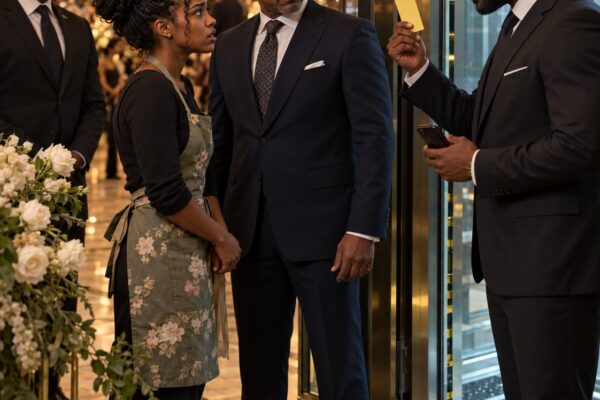
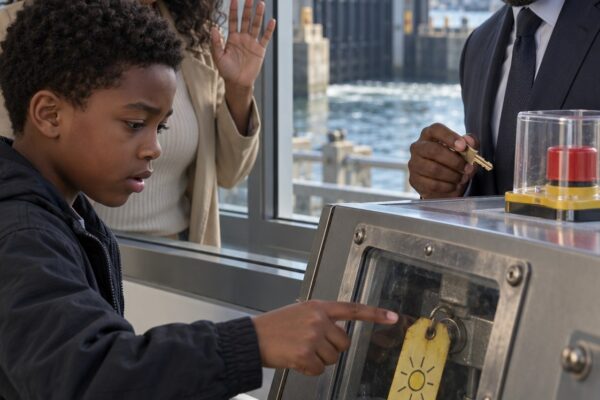
A Laid-Off Mechanic Grabbed a Feared Billionaire’s Wrist at a Floodgate Ceremony, and His Reaction Stunned Everyone Watching
Chapter 2: What the River Kept
Adrian reached for his phone.
Iris caught his sleeve.
“Call the gate operator first.”
He lowered the phone.
The gate struck its housing again.
“Where is the control room?”
“Under the east stairs.”
Adrian faced the city engineer.
“Shut down the demonstration.”
The engineer glanced toward the cameras.
“Mr. Voss, the mayor is waiting.”
“The mayor can wait.”
“I need authorization.”
“You have mine.”
“That isn’t how city equipment works.”
Iris pointed across the platform.
“Then get hers.”
The deputy public works director stood beside the mayor.
She had heard enough.
“Close the upstream valve,” she ordered.
The engineer hurried toward the stairs.
Adrian called the control room himself.
Iris listened to his side of the conversation.
“Keep the gate seated.”
A pause.
“Do not test it.”
Another pause.
“Tell me when the pressure drops.”
He ended the call.
“They’re shutting down the flow.”
“Good.”
Iris tried to step away.
Her knees objected.
Adrian moved closer without touching her.
“Sit down.”
“I’m fine.”
“You nearly fell.”
“I haven’t slept.”
“Then sit down anyway.”
A folding chair appeared beneath her.
One of the reporters had offered it.
Iris sat.
Across the river, the families began moving back from the railing.
Their homes stood beyond the bend.
The river had entered those streets once already.
Iris could still remember the smell of wet drywall.
Adrian crouched beside the chair.
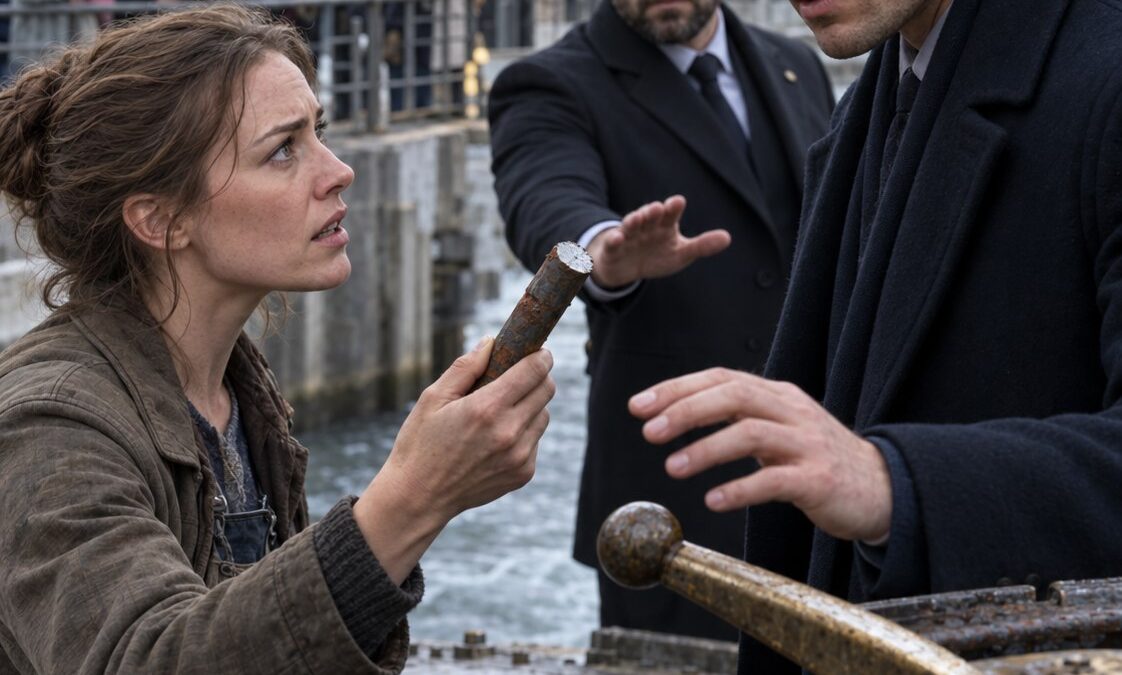
“Tell me about the pin.”
“It held the old lower linkage.”
“The old gate was replaced.”
“The housing wasn’t.”
“Who left it there?”
“I don’t know.”
“Why is it cut?”
“That’s what I came to ask.”
He examined the narrow end.
A clean groove circled the metal.
Rust covered the rest.
The cut was bright.
“It happened recently,” he said.
“Yes.”
“What do the initials mean?”
Iris watched his face.
“That’s your question?”
“They’re mine.”
“Your company ordered the repair.”
“My company funded it.”
“Your name is on the pin.”
“Which is why I’m asking.”
The distinction irritated her.
She pulled his coat tighter.
It was warm from his shoulders.
“Your office ignored seven messages,” she said.
“I told you I never received them.”
“You also said the gate passed inspection.”
“It did, according to the report.”
“My father had one of those.”
Adrian stopped turning the pin.
“Your father was Daniel Calder.”
“He was.”
“I know the case.”
“You bought the riverfront afterward.”
“I did.”
“People got pennies for their houses.”
Adrian looked toward the far bank.
Some of the buildings remained boarded up.
“I know.”
“Do you know who set the prices?”
“My acquisitions team.”
“You signed them.”
“Yes.”
The answer came without an excuse.
It left Iris briefly unsure what to say.
The gate gave a final dull knock.
Then it settled.
Adrian’s phone rang.
He listened.
“The pressure is falling,” he told her.
A city worker brought a plastic evidence bag.
Iris drew her hand back.
“Who sent you?”
“Deputy Director Chen.”
“Is she keeping it?”
“She wants to document it.”
Iris looked at Adrian.
“It stays with me until someone gives me a receipt.”
He nodded.
“She’s right.”
The worker fetched Chen.
She came herself, holding a form on a clipboard.
Iris read every line before surrendering the pin.
Chen signed.
So did Iris.
Adrian photographed the sealed bag and the receipt.
The reporter who had offered the chair lowered her phone.
“I didn’t record the pin,” she said.
“I recorded you stopping him.”
“That’s enough,” Iris said.
Chen looked up from the bag.
“Ms. Calder, I knew your father.”
Iris straightened.
“Then you know what happened to him.”
“I know what the report said.”
“That isn’t the same thing.”
“No,” Chen said.
“It isn’t.”
She turned the sealed bag over.
The initials caught the light.
“Daniel reported this exact cut three years ago.”
* * *
They met again at the public works office that afternoon.
Iris had slept for forty minutes in her sister’s car.
Her sister, June, waited downstairs with a paperback and strict instructions to call if Iris needed her.
Adrian arrived without his security chief.
He brought his attorney and the city’s outside engineer.
Chen brought the old incident file.
The folder was thick.
Most of its pages had been read aloud at the hearing that ended Daniel Calder’s career.
Iris knew the words by heart.
Improper adjustment.
Failure to document.
Probable operator error.
She had once searched them every night, hoping they would change.
Chen spread photographs across the table.
“The lower linkage failed during the flood,” she said.
“That much was true.”
The outside engineer studied an image.
“The shear pin shows a cut.”
Iris leaned forward.
“You can see it there?”
“The picture is poor.”
“But you can?”
“Yes.”
The photograph showed the pin still lodged in its housing.
Its narrow end had separated.
A thin bright ring marked the break.
“It looks like today’s pin,” Adrian said.
“It does,” said the engineer.
His attorney raised a hand.
“Similar damage doesn’t establish a cause.”
“I know,” Iris said.
She took a breath.
“My father said the cut was made before the flood.”
“Why?” the engineer asked.
“He found filings in the grease trap.”
Chen opened another folder.
“There’s no mention of filings.”
“Because the trap was emptied.”
“By whom?”
“I never found out.”
Adrian looked at Chen.
“Did the hearing ask?”
“No.”
“Why not?”
“The contractor’s report called it ordinary wear.”
Iris reached for one photograph.
The housing filled most of the frame.
Near its edge sat a tiny dark square.
“What is that?”
Chen leaned over.
“A piece of tape, perhaps.”
“No.”
Iris knew the mark.
Her father used to leave a black square of paint on parts he had inspected.
It was small enough to miss from a distance.
“Daniel marked this housing,” she said.
“He showed me how.”
“Can you prove when?”
“Maybe.”
She called June.
“Open Dad’s old tool case.”
“It’s under my bed,” June said.
“I know.”
“Which drawer?”
“The shallow one.”
A long pause followed.
“I found his notebook.”
“Look for the week of the flood.”
June turned pages.
Her voice grew quieter.
“Wednesday.”
“Read it.”
“Lower housing checked.”
“Keep going.”
“Black witness mark intact.”
Chen met the engineer’s eyes.
Iris asked June to photograph the page without removing it.
Within minutes, the image arrived.
Daniel’s handwriting was unmistakable to his daughters.
It still needed independent verification.
The attorney said so.
Iris agreed.
Adrian noticed.
“You’ve thought about this.”
“For three years.”
The notebook also held a name.
Daniel had written that he reported a thin cut on a spare pin to a supervisor.
The supervisor’s initials were R.M.
“Who was R.M.?” Adrian asked.
“Ruth Morrow,” Chen said.
“She managed the repair contractor.”
Adrian’s attorney checked his phone.
“Morrow now heads your infrastructure division.”
Adrian looked up sharply.
“She was promoted last year.”
“Did you know she worked on this gate?”
“I knew her firm had.”
Iris pushed the photograph toward him.
“Now you know what my father told her.”
They spent the next hour checking records.
The city had retained the contractor’s invoice.
It listed two replacement pins.
Daniel’s notebook listed three.
The engineer requested the city’s parts register.
It showed three pins received.
One had been assigned to the gate.
One remained in storage.
The third had no recorded location.
“Could be an inventory error,” the attorney said.
“Could be,” Iris replied.
Chen found the original maintenance roster.
Daniel had worked until six that evening.
Morrow signed a separate access entry at nine.
The flood began at midnight.
“Why would she return?” Adrian asked.
“She had authority,” Chen said.
“That isn’t an answer.”
“No.”
The engineer requested photographs from the independent survey completed after the flood.
A technician had photographed every damaged part before the contractor removed it.
The file was stored on the city server.
The images took time to load.
Iris went to the hallway for water.
Adrian followed at a distance.
“Your father should have been heard,” he said.
“He was.”
“I mean believed.”
“He didn’t ask for faith.”
“I understand.”
“He asked someone to check the grease trap.”
Adrian rested a hand on the windowsill.
“I attended the hearing.”
Iris turned.
“I saw you there.”
“I left before he testified.”
“Yes.”
“I thought the engineering report had settled it.”
“My father watched you leave.”
Adrian absorbed that.
“I’m sorry.”
She drank the water.
“That matters less than what you do now.”
“Agreed.”
Inside, the engineer called them back.
One photograph showed the removed lower housing.
Its grease trap had been lifted out.
The tray beneath it was clean.
Too clean.
The survey technician’s log supplied the reason.
Contractor staff had cleared the trap before the survey began.
Morrow had signed the access sheet.
“That violated the evidence hold,” Chen said.
Her voice had changed.
The engineer enlarged another image.
On the housing, Daniel’s black square remained intact.
“His mark survived,” Iris said.
“Yes.”
“If he’d adjusted that assembly after marking it, the square would be broken.”
The engineer nodded cautiously.
“It supports that conclusion.”
The attorney read the access sheet again.
“Morrow supervised the cleanup.”
Adrian’s phone lit up.
His chief operating officer was calling.
Iris saw the name before he turned the screen down.
Felix Voss.
Adrian’s cousin.
He had handled the company’s riverfront purchases.
Adrian let the call ring out.
Chen studied him.
“Why would Felix call you now?”
“He knows I cancelled the ceremony.”
“Did he hire Morrow?”
Adrian searched his memory.
Felix had recommended her firm.
Felix had later recruited her.
Adrian looked toward the old flood map on the wall.
The damaged streets lay inside the area his company now owned.
“He hired her,” he said.
“And I let him.”
* * *
The first warning reached Iris that evening.
A photograph appeared on her phone.
It showed June leaving their apartment.
The message beneath it contained seven words.
Tell your sister to take another route.
Iris showed Chen.
Chen called the police.
Adrian offered to send a car.
Iris shook her head.
“June can stay with our aunt.”
“She may need someone to take her.”
“I’ll take her.”
He accepted that.
The police officer who arrived asked to see the phone.
Iris handed it over.
He documented the number, the image, and the time.
Then he asked whether anyone had threatened her before.
“Not like this.”
Adrian stood beside the door.
He had already called his attorney.
No one suggested calling Felix.
That restraint surprised Iris.
She had imagined powerful men settling trouble in private rooms.
Adrian seemed angry enough to try.
He did not.
“Who knew she was at the office?” the officer asked.
“Several people,” Iris said.
“Did anyone know about the notebook?”
“June, us, and whoever heard the call.”
Adrian’s attorney looked troubled.
“The conference room wasn’t private.”
Chen closed her eyes briefly.
Staff had passed the door throughout the afternoon.
The officer asked for the original message.
Iris kept her phone unlocked while he photographed it.
The image of June filled the screen.
Her sister was twenty-four.
She taught swimming lessons and forgot umbrellas.
She had stayed with Iris through the hearing, their father’s death, and the long winter after.
Iris’s hands shook.
Adrian saw.
“Can I get you water?”
“No.”
“What would help?”
“Give me a minute.”
He stepped back.
She called June.
“Go inside Aunt Dot’s building.”
“I’m already here.”
“Stay there.”
“What happened?”
“I’ll tell you when I arrive.”
June heard the strain.
“Are you safe?”
“I’m with the police.”
“That was a terrible answer.”
“It’s the true one.”
Iris almost smiled.
The officer arranged a patrol near the building.
He did not promise instant protection.
He gave her a case number.
Outside, rain began falling.
Adrian waited while Iris booked a rideshare.
“No car,” she reminded him.
“I remember.”
He took the coat from his arm.
It was the one he had put around her at the gate.
“I washed it,” she said.
“When?”
“Before the city meeting.”
“You had forty minutes of sleep.”
“The lining smelled like river mud.”
“That sounds like my problem.”
“It was.”
She handed it over.
He checked the inner pocket.
A small brass button had come loose.
Iris had sewn it back.
Her stitches were neat.
“My father taught me that too,” she said.
“He taught you many things.”
“He expected us to break things.”
“Did you?”
“Constantly.”
For the first time that day, Adrian smiled.
Then Iris’s phone sounded again.
Another image.
This one showed the gate’s control room.
A caption followed.
The next test starts at dawn.
She gave the phone to the officer.
Within minutes, Chen had the control room secured.
The planned testing was suspended.
The engineer confirmed the valve would remain closed.
No one assumed the message meant the sender could reach the gate.
No one assumed it was harmless.
Adrian called his board chair.
“Preserve every riverfront record,” he said.
“Emails, contracts, payroll, access logs.”
He paused.
“Include mine.”
After the call, Iris looked at him.
“That will hurt you.”
“It might.”
“You could tell them to start with Felix.”
“They need everything.”
The police officer asked for the sender’s number again.
The message had come from a disposable account.
Tracing it would take time.
The immediate work was simpler.
Keep people away from the gate.
Protect June.
Preserve the records.
At Aunt Dot’s apartment, June opened the door before Iris knocked.
She hugged her once, hard.
Then she noticed Adrian.
“You brought the man from the video.”
“He brought himself,” Iris said.
“I wanted to check that you arrived,” Adrian said.
June gave him a long look.
“You look less terrifying without the microphone.”
“I’ll take that as progress.”
Aunt Dot appeared behind her.
She was Daniel’s older sister.
She had never forgiven the hearing.
“You own the riverfront,” she told Adrian.
“Yes.”
“Then you have some explaining to do.”
“I do.”
She let him in.
They sat at a kitchen table crowded with mugs.
Iris told them what the city had found.
June touched the photo of their father’s notebook.
“He kept writing even after they fired him,” she said.
“He thought someone would check.”
Aunt Dot stared at Adrian.
“Are you checking?”
“Yes.”
“All of it?”
“Yes.”
“Even if your cousin is in it?”
Adrian answered without looking away.
“Especially then.”
His phone rang.
The board chair had located an older project budget.
Felix had requested an emergency reserve before the flood.
The reserve would pay for rapid purchases if riverside property lost value.
The request was dated four months before the gate failed.
Aunt Dot gripped her mug.
“He planned to profit from a flood?”
Adrian read the attached memo twice.
Felix had called the reserve prudent preparation.
The date alone proved no crime.
But the numbers were specific.
They covered the very streets later flooded.
The chair had also found Felix’s approval for Morrow’s night access.
Adrian raised his eyes.
“He knew where the water would go.”
* * *
The next morning, Iris watched city crews secure the lower linkage.
She stood behind a temporary barrier with Chen.
The gate remained shut.
Water slid past it in the other channel.
No homes were at risk while the upstream valve stayed closed.
An independent engineer removed the replacement pin.
The city logged it as evidence.
Its narrow end carried the same fresh cut.
A machine shop would examine the tool marks.
Iris wanted to inspect it herself.
Chen understood.
“You found the first one,” she said.
“I still need the outside report.”
“I know.”
By noon, the police had obtained records from the repair contractor.
Morrow had approved a late-night work order three years earlier.
The description read routine alignment.
The labor entry named a technician.
The technician had retired.
Detectives found him at home.
He remembered Morrow asking him to remove the grease trap.
He said he had not cut a pin.
His timecard showed he left before the second access entry.
His account required checking.
It gave investigators somewhere to look.
Adrian’s board placed Felix and Morrow on administrative leave.
Their access to company systems was suspended.
An outside firm copied the relevant records.
No one called the decision a verdict.
Felix did.
He arrived at an emergency board meeting with counsel.
Iris attended at the city’s invitation.
Chen wanted someone who could explain the gate’s maintenance.
The board chair wanted to know why the company’s name had appeared on the pin.
Felix sat across the long table.
He resembled Adrian around the eyes.
Everything else about him seemed practiced.
“I hear Ms. Calder has become an expert witness,” he said.
“I was trained on that gate.”
“By the operator blamed for the flood.”
Adrian moved in his chair.
Iris answered first.
“My father trained half the crew.”
“Then perhaps the training was the problem.”
Chen opened the city file.
“Daniel’s inspection mark was intact.”
“An old paint mark.”
“Documented in his notebook before the flood.”
Felix turned to the board.
“Are we relying on a family notebook now?”
The outside engineer cleared his throat.
“We’re relying on several sources.”
“None establish sabotage.”
“No one has said they do yet.”
Felix spread his hands.
“Then why am I here?”
The board chair answered.
“Because you approved the contractor’s access.”
“I approved hundreds of entries.”
“You also proposed a purchase reserve.”
“That was my job.”
“Four months before the flood.”
“Riverfront property is vulnerable to floods.”
He made the sentence sound painfully obvious.
For several minutes, he nearly held the room.
He described projected water levels.
He produced old insurance estimates.
He pointed out that the city, not Adrian’s company, operated the gate.
He asked whether they intended to destroy a development over a photograph and a threat from an unknown account.
Then he looked at Iris.
“I am sorry your father died disgraced,” he said.
“It doesn’t make a theory true.”
Iris felt the familiar heat in her face.
At the hearing, she had let that heat silence her.
She put her hands flat on the table.
“My father’s death isn’t evidence.”
Felix nodded, pleased.
“The notebook is.”
His smile faded.
“His mark is.”
She turned to the engineer.
“And the pin may be.”
The engineer brought up an enlarged photograph.
“Here’s the pin found yesterday.”
He pointed to the groove.
“The cut was made with a narrow rotary tool.”
Felix leaned back.
“Anyone can buy one.”
“Yes.”
The engineer displayed the old survey image.
“The flood pin has a matching groove.”
“Photographs can mislead.”
“They can.”
The engineer changed the image.
This was a photograph of a metal drawer.
Inside lay the unused third pin from the original parts order.
The city had found it in the contractor’s retained stock that morning.
Its head bore A.V.
Its narrow end had a shallow starter cut.
Felix glanced at Morrow.
She stared at the table.
Adrian leaned forward.
“Why were my initials stamped on those parts?”
Morrow said nothing.
Felix answered.
“Branding.”
“We did not brand city components.”
“It was a pilot project.”
“Show me the authorization.”
Felix opened his mouth.
Nothing followed.
The board chair looked to the attorney.
“Where did the pin originate?”
“From a machine shop in North Harbor,” she said.
“The shop kept the design files and purchase order.”
She placed a copy on the screen.
The buyer was a company Felix controlled through two holding firms.
The order specified three pins.
It also specified shallow starter grooves.
The shop had not been told their intended use.
Felix recovered quickly.
“A weakened pin would fail during a pressure test.”
“That is exactly what happened yesterday,” Iris said.
“Someone installed the second one before the ceremony.”
Felix looked at Adrian.
“You told me to solve the gate problem.”
“I told you to fund repairs.”
“You wanted the riverfront.”
“I wanted a safe gate.”
“You wanted the whole project finished before your investors walked.”
The board chair lifted a hand.
“Felix.”
“No,” Adrian said.
“Let him speak.”
Felix did.
He described the company’s debts.
He described the mayor’s pressure.
He described a neighborhood that had been promised protection for decades and never received it.
“After the flood, we built new defenses,” he said.
“Those families took the money.”
“They had water in their walls,” Iris said.
“They chose to sell.”
“They chose from the options you left them.”
He turned back to the board.
“I kept this company alive.”
A detective entered with Chen.
They had not come to stage an arrest.
They had come because the city requested the unused pin and the shop records.
The board attorney gave them copies.
Felix watched the exchange.
Then Morrow spoke.
“I signed the access entries.”
Every face turned toward her.
“I removed the trap after the flood.”
Felix’s attorney touched his arm.
Morrow’s voice shook.
“He told me Daniel would be blamed anyway.”
Felix said her name sharply.
She stopped.
The detective asked whether she wished to speak with counsel present.
She said yes.
The meeting ended.
Over the following weeks, investigators compared the pins, tool marks, purchase records, messages, and financial transfers.
The threatening photographs came from a phone bought by a contractor who reported to Felix.
The contractor admitted taking them.
He said Felix paid him to frighten Iris away from the city office.
Felix denied ordering the threats.
The payment record and messages contradicted him.
Morrow’s account was checked against gate logs, building access records, and the machine shop order.
She had cut the first installed pin deeper before the flood.
She had helped place the second at the gate before the ceremony.
The police referred the case to prosecutors.
They charged Felix and Morrow with offenses tied to the gate damage, fraud, and the threats.
Their cases moved slowly.
The city reopened Daniel Calder’s finding first.
An independent panel heard from the technician, the survey engineer, Chen, and Iris.
Adrian testified about the purchases.
He did not claim ignorance erased his signature.
He had approved the offers.
The panel cleared Daniel of the reported maintenance failure.
The city issued a correction.
It was printed in the same place as the original finding.
Iris read it at Aunt Dot’s kitchen table.
June read it aloud once.
Then Aunt Dot folded the newspaper with careful hands.
At Felix’s first court appearance, he passed Iris in the hallway.
“You got your father’s name back,” he said.
“Enjoy it.”
Iris held his gaze.
“I never lost it.”
* * *
By spring, the riverfront looked ordinary again.
That was its greatest improvement.
People walked their dogs past the locked gate.
The city posted a maintenance schedule beside the public path.
It published inspection summaries online.
Chen insisted on both.
Iris had helped write the plain-language section.
She had also returned to work.
The bus depot offered her a supervisor’s position.
She accepted after negotiating better night staffing and a reliable way to report safety defects.
June said Iris had become impossible in meetings.
“You were always impossible at home,” she added.
“I practiced on you.”
“You charged rent for the privilege.”
“I gave you a discount.”
Their apartment had a new table.
It was secondhand and slightly uneven.
Aunt Dot called it honest furniture.
Adrian came to dinner one Thursday with a bakery box.
He asked June which cake she liked.
June named the most expensive one through the window.
He brought it.
Iris gave him a look.
“I bought one cake,” he said.
“You asked her.”
“She answered.”
“You’ve learned nothing.”
“I’ve learned to keep the receipt.”
Aunt Dot laughed before she could stop herself.
After dinner, June and Aunt Dot walked to the corner store.
Iris knew they needed nothing.
Adrian stood beside the kitchen sink.
The repaired button on his coat caught against the chair.
“It’s still holding,” she said.
“You sound surprised.”
“I’ve seen you close a door.”
“I’ve become gentler with doors.”
He folded the coat over his arm.
The company’s independent review had finished that week.
It found that Felix had hidden the parts order, but several executives had ignored warnings about rushed acquisitions.
Adrian was among those executives.
He had missed Daniel’s testimony.
He had signed offers without examining how the company calculated its prices.
“I read the review,” Iris said.
“So did I.”
“You’re making the company pay restitution.”
“Yes.”
“The families decide whether to accept?”
“Each one.”
“Legal help is covered?”
“Yes.”
She nodded.
Adrian waited.
“I’m sorry I left the hearing,” he said.
“You’ve said that.”
“I know.”
“Say what you’ve done.”
He understood.
“I asked the board to separate the gate work from the development company.”
“The city will choose the contractor?”
“Through its own process.”
“And you?”
“I won’t bid.”
She studied him.
“That’s a better answer.”
“I thought so.”
“You still own the houses your company bought.”
“Some of them.”
“Families want first chance to buy back.”
“We’ve offered it.”
“At their old purchase price?”
“At that price, with repairs covered.”
Iris had helped the neighborhood group negotiate those terms.
She knew he was telling the truth.
Knowing did not make the past disappear.
Adrian knew that too.
“My foundation can fund the bus depot program,” he said.
“No.”
“I haven’t told you what program.”
“You called it mine.”
“It is your idea.”
“Then the city can fund it publicly.”
“They’re short this year.”
“We’ll find other partners.”
“You could do both.”
“I could.”
She leaned against the counter.
“I need it to outlive your interest in me.”
Adrian accepted the blow.
“That’s fair.”
“It’s also why I won’t let you name it after Dad.”
“I hadn’t asked.”
“Felix wanted to put his name on everything.”
“I am aware.”
Iris looked down.
Adrian placed the bakery box lid in the recycling.
“May I ask you something personal?”
“You already came to dinner.”
“May I ask anyway?”
“Yes.”
“When we first met, did you think I would pull the lever?”
“Yes.”
“Even after you showed me the pin?”
“You hadn’t seen it yet.”
He nodded.
“I believed the report,” he said.
“That’s why I grabbed your wrist.”
“I know.”
“You stopped.”
“I listened.”
“That was a choice.”
“So was yours.”
Iris moved toward the table.
She was suddenly tired of standing apart.
Adrian did not move until she reached him.
“Would you have dinner with me,” he asked, “somewhere June hasn’t chosen the cake?”
“She’ll be offended.”
“I can survive that.”
“Ask me again after the city hearing.”
“Why?”
“Because you still have to answer questions there.”
“I’ll be there.”
“I know.”
He left without pressing her.
At the public hearing two weeks later, he sat through four hours of testimony.
He answered questions about prices, warnings, and oversight.
When he did not know an answer, he said so.
He returned later with records.
Iris watched from the back.
Afterward, he found her near the exit.
“Dinner?” he asked.
“Friday.”
“May I pick you up?”
“Walk with me from the depot.”
“Gladly.”
Their first dinner lasted three hours.
Their second ended early because Iris had a morning shift.
By the fourth, June had stopped pretending she did not want details.
Months passed.
Felix’s criminal case ended with a conviction after trial.
Morrow entered a plea under an agreement that required her testimony and barred her from managing public infrastructure contracts.
The civil claims took longer.
Adrian’s company paid restitution under court oversight.
Some families bought their homes back.
Others chose to stay elsewhere.
No result returned the years they had lost.
Iris attended each neighborhood meeting she could.
Adrian attended when invited.
At home, the uneven table remained.
One evening, he asked whether she wanted to replace it.
“No.”
“It rocks.”
“So do boats.”
“This is not a boat.”
“Then put a folded card under the leg.”
He did.
The card worked.
June called it his first successful infrastructure project.
* * *
Four years later, the gate opened for its annual public inspection.
The city had turned the ceremony into a practical event.
Children watched engineers explain the controls.
Neighbors asked about water levels.
A printed maintenance log sat on a table where anyone could read it.
Iris stood on the same platform where she had seized Adrian’s wrist.
She wore a city visitor badge.
Adrian stood beside her with their daughter’s small hand in his.
Nell was two.
She disliked the wind and loved the yellow safety helmets.
“Again,” she said, pointing to one.
“You already have a helmet,” Adrian told her.
“That one is bigger.”
“She takes after you,” Iris said.
“She argues better.”
Chen approached with a sealed display case.
Inside lay the rusted pin.
The criminal case was closed.
The city had asked the family whether it could show the object during safety tours.
Iris had agreed on one condition.
The label had to explain what workers reported and what officials failed to check.
Daniel’s name appeared there.
So did the date the city cleared him.
The initials on the pin remained visible.
A.V.
For years, Iris had hated seeing them.
Now they reminded her where Adrian’s hand had stopped.
Chen set the case on the table.
“Ready?” she asked.
Iris looked across the river.
Some homes had fresh paint.
One empty lot held a playground.
The bus depot’s safety program had spread to every city garage.
June ran swim classes at the new community pool.
Aunt Dot still claimed the kitchen table was perfect.
Adrian slipped his free hand into Iris’s.
“Are you?” he asked.
She smiled at the question.
Four years earlier, she had come here alone because no one returned her calls.
She had carried a piece of metal and her father’s certainty.
She had been afraid of the gate.
She had been more afraid of letting someone pull the lever.
“Take your hand off me,” Adrian said softly.
Iris glanced at him.
He remembered the first words he had spoken to her.
She tightened her fingers around his.
“No.”
Nell lifted her helmet with both hands.
It slipped over her eyes.
Adrian caught it before it fell.
The crowd gathered.
Chen began the inspection.
The gate held.
The river passed safely beneath it.
Iris kept Adrian’s hand in hers.
THE END