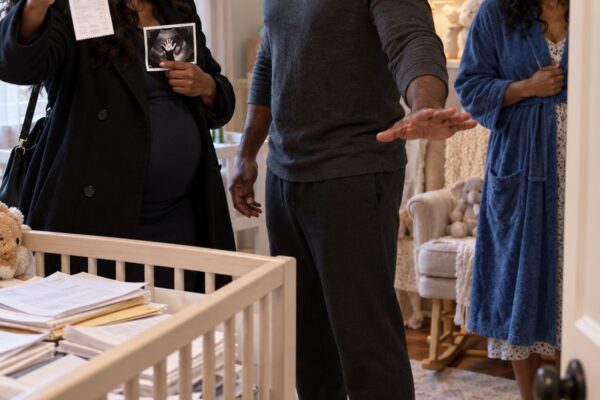
I Came Home With Our Baby’s Heartbeat and Found My Husband and Best Friend Planning to Mortgage My Mother’s House
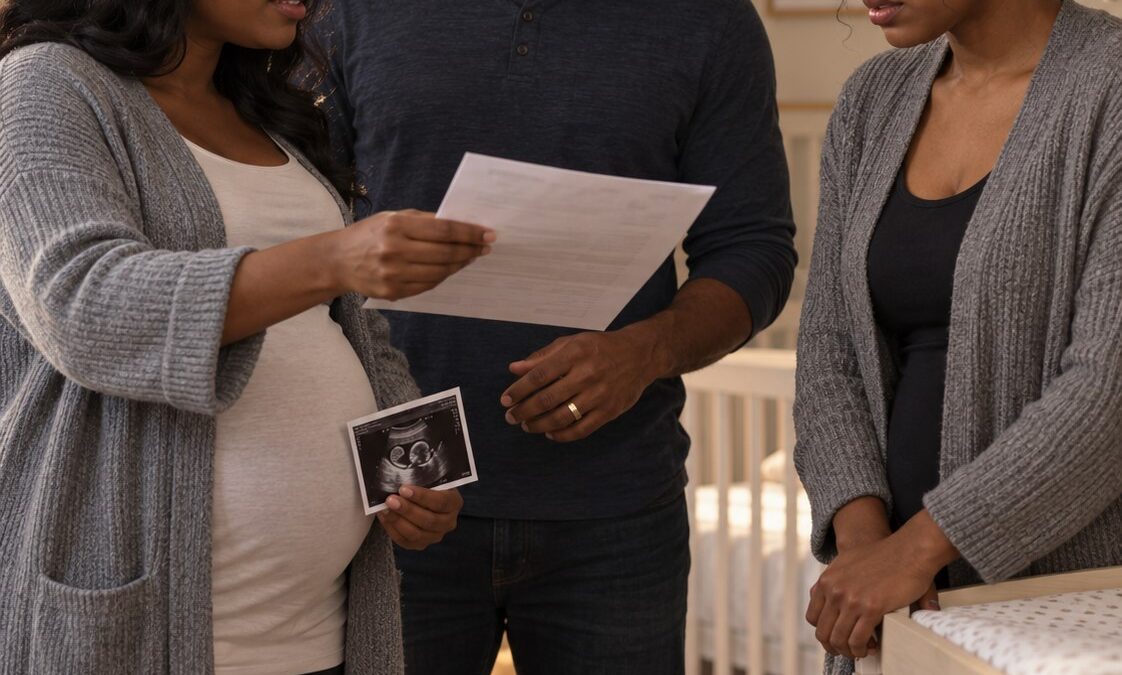
Chapter 2: The Fourth Signature
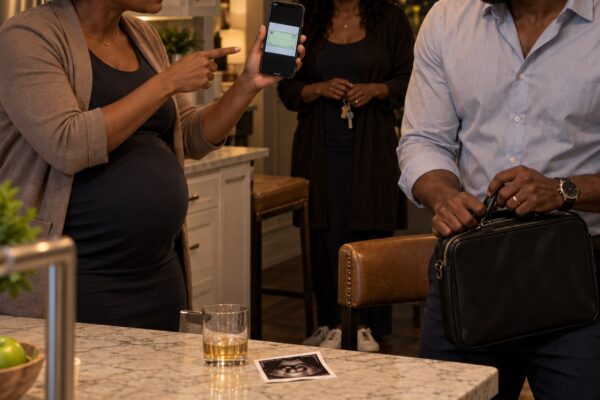
Evan reached for the phone in my hand.
I stepped back.
“Don’t,” I said.
“I wasn’t going to take it.”
His arm remained between me and the door.
Tessa looked at the clock.
“June, you need to sit down.”
“Move, Evan.”
He moved.
I walked to the nursery window and called my attorney.
The room smelled of fresh paint and the cinnamon rolls nobody wanted.
Evan had chosen the pale yellow himself.
A month ago, I had found him standing here after midnight, testing the rocker with his foot.
I had believed he was imagining our daughter in it.
My attorney answered on the second ring.
“Marianne, I have a signed power of attorney I didn’t sign.”
Tessa’s eyes closed.
“Who is the notary?” Marianne asked.
“Tessa Bell.”
“Photograph every page and send them to me.”
“I already photographed the first.”
“Send the rest.”
Evan came closer.
“You called a lawyer?”
“I called mine.”
“We can explain.”
“You have until I finish these photographs.”
Neither spoke while I turned the pages.
The loan amount was $640,000.
My mother’s house was worth more than that, but its worth had never been the point.
She had bought it when I was eleven, after my father left.
She cleaned offices at night and painted each room on her days off.
After she died, I kept the property in a trust and rented it below market to families referred by a local housing group.
The latest tenant, Mrs. Alvarez, had two sons and a garden my mother would have loved.
A lender could eventually force a sale if this debt went unpaid.
I photographed the final page.
“Why do you need the money?” I asked.
Evan stared at the rocking chair.
“My restaurant is behind.”
“How far?”
He swallowed.
“More than I told you.”
Tessa checked the clock again.
“Evan,” she said.
He looked at her.
It was a small look.
Familiar.
I had seen it across dinner tables for months without understanding it.
“How long?” I asked.
Neither answered.
“How long have you been together?”
“Since January,” Evan said.
Tessa’s face hardened.
“February.”
Evan looked at her.
I remembered January.
That was when I had spent three weeks helping Tessa after her father’s surgery.
I gripped the window ledge until the first sharp wave inside me passed.
Then I called my obstetrician’s office and described the tightening in my abdomen.
The nurse asked a few questions.
She told me to come in if it continued, intensified, or brought any bleeding.
I told her I would.
Evan reached for my coat.
“Let me drive you.”
“I’m getting another ride.”
He pulled his hand back.
Marianne called again.
“I’ve contacted the lender’s fraud desk,” she said.
“They’re holding the transfer while they review it.”
Tessa stopped looking at the clock.
“For now?” I asked.
“For now.”
Marianne’s voice changed.
“June, there’s something else.”
I watched Tessa’s thumb press into her palm.
“The document references an earlier authorization,” Marianne said.
“What authorization?”
“A power of attorney dated last August.”
Last August, my mother had been dead for eleven months.
I had been in the hospital after a pregnancy loss.
Evan knew exactly where I was that day.
* * *
My driver took me to Marianne’s office.
The tightening had stopped before we crossed the river.
My doctor’s nurse called again while we were in traffic.
I answered every question and promised to keep the appointment they offered that afternoon.
Marianne met me downstairs.
She was fifty-four, sharp-eyed, and impossible to hurry when facts mattered.
She carried my bag because I let her.
Upstairs, her assistant had printed the pages I had sent.
The earlier authorization was attached to the loan file.
It gave Evan limited authority to handle a property tax payment on my behalf.
Someone had added a second page later.
That page let him obtain financing.
My signature appeared on the first page.
It was real.
I remembered signing it.
I had been lying in a hospital bed, weak and frightened, when Evan brought in the tax notice.
He said he would take care of it.
Marianne placed the two pages side by side.
“The typeface is different,” she said.
I leaned closer.
The margins were different too.
“Can we prove when it was added?”
“We can request the file history.”
“The original went to my accountant.”
“Then we ask her for it.”
My accountant, Nia, answered before Marianne finished leaving a message.
She had the original scan.
Within twenty minutes, it arrived.
One page.
Only one.
The lender’s copy carried two.
Marianne saved both files and noted when Nia had received hers.
Then she called Harbor Lending with me beside her.
Their fraud officer, a woman named Ms. Vale, confirmed the transfer was paused.
She would not disclose who had submitted the file without a formal review.
She did tell us the lender had relied on the August authorization and the document from my nursery.
The second document claimed I had personally confirmed the new loan.
“I did not,” I said.
Ms. Vale recorded my statement.
Marianne asked for preservation of the application, communications, identification records, and all versions of the documents.
She sent that request in writing before we hung up.
Evan called six times.
I let each call go to voicemail.
On the seventh, he left a message.
“June, Tessa said the money was temporary.”
I played it once for Marianne.
She listened without changing expression.
Then she asked me to save it.
At the clinic, the doctor examined me and checked the baby.
Everything looked steady.
The tightening might have been stress, she said, but she wanted me to call if it returned.
She asked whether I felt safe going home.
I thought about Evan standing across the nursery door.
“I’m staying somewhere else tonight.”
I went to my firm afterward.
My firm did not own my mother’s house.
Its staff had no reason to touch the property, and I wanted them nowhere near a personal dispute.
I went because the meeting room was quiet and Nia could join us there.
Nia brought the tax file and her laptop.
She had worked for me since the year I started the firm.
She had also met my mother, who once sent her home with enough soup for three people.
“The original authorization came directly to me,” Nia said.
“Did Evan ever ask for it back?” I asked.
“Twice.”
“When?”
“Last month.”
She opened the email thread.
Evan had claimed he needed a cleaner copy for his taxes.
Nia had sent a scan.
The added page appeared in Harbor’s file four days later.
Marianne wrote down the dates.
A third email waited in the thread.
It had come from Tessa’s business address.
Tessa had asked Nia who held the property deed and whether the trust required another signature to secure a loan.
Nia had answered only that counsel handled trust matters.
She had forwarded the email to Marianne at the time.
I had never heard about it because Marianne considered it an inquiry she could decline.
“I’m sorry,” Marianne said.
“You had no reason to think she would forge anything.”
Tessa had organized my baby shower.
She had carried my mother’s photograph from its shelf and asked where I wanted it placed.
I had told her everything about the trust except one detail.
My mother had insisted that no single trustee could borrow against the house.
The document in Harbor’s file had my name.
It had Evan’s.
And it listed a fourth signature as already obtained.
Marianne looked at the name.
“June,” she said, “your co-trustee is listed here.”
It was Nia.
* * *
Nia went very still.
“I never signed that.”
Her name appeared beneath an electronic signature mark.
There was no handwritten page for her.
Harbor had received a certificate saying she approved the transaction through its online portal.
Nia turned her laptop toward Marianne.
“My email has an alert from this morning.”
A sign-in attempt had come from an unfamiliar device.
She had changed her password and reported it to her provider.
Marianne asked her to keep the alert.
Then she called Ms. Vale again.
The fraud officer confirmed that the co-trustee approval was under review with the rest of the file.
She would preserve the portal logs.
An hour later, Mrs. Alvarez called.
Two men had come to the house.
They had said they were checking its condition for a lender.
She had not let them in.
“Did they frighten the boys?” I asked.
“They were at school,” she said.
“Are you all right?”
“I am now that I’ve called you.”
I told her she had done the right thing.
Marianne advised her to call us if anyone returned and to contact the police if she felt threatened.
The men might have been ordinary appraisers sent before the fraud hold.
That did not make the visit harmless.
Mrs. Alvarez had signed a lease with me because I had promised stability.
I had brought strangers to her door without knowing it.
By five, Marianne had helped me make a police report.
We provided the documents, my photographs, Nia’s original scan, and Evan’s voicemail.
The officer did not promise an arrest.
He gave us a case number and told us an investigator would follow up.
Marianne was satisfied with that.
The records needed to be gathered properly.
A rushed accusation could give Tessa room to call everything a misunderstanding.
That evening, I went to my sister’s apartment.
Dana opened the door before I knocked twice.
She took one look at my face and led me to her kitchen.
A bowl of pasta waited on the table.
“I made too much,” she said.
She always said that.
I ate half of it.
Then I played the heartbeat recording.
Dana stood beside me while the tiny rush of sound filled her kitchen.
“There she is,” she said.
I nodded.
For most of the day, I had spoken about the baby as a medical fact.
Now I put my palm against her heel through my shirt.
She pushed back.
Dana sat down.
“What do you need tonight?”
“A place to sleep.”
“You have one.”
“And I need to know Mrs. Alvarez can stay.”
“We’ll make sure she can.”
Dana had no legal role.
She said it anyway because she knew I needed to hear a human voice make the promise.
Evan sent a text at nine.
Tessa had handled the paperwork, he wrote.
He had believed it was a short-term bridge loan.
He would tell me everything if I came home.
I forwarded it to Marianne.
Then another message arrived.
It was from Tessa.
YOU SHOULD ASK HIM WHAT HE SPENT THE FIRST LOAN ON.
I read it three times.
I called Marianne.
“What first loan?”
She asked me to wait while she searched the county records.
The house showed no recorded mortgage.
But Nia remembered a line in Evan’s restaurant books.
For more than a year, his business had made monthly payments to Bell Capital.
Bell was Tessa’s last name.
Nia sent the entries.
They began three months before Evan and Tessa’s affair.
The amounts rose every quarter.
By midnight, Marianne had obtained the public filing for Bell Capital.
Tessa owned it.
Evan had borrowed from her business while his restaurant was failing.
Then she had used that debt to make him help steal from me.
* * *
Two days later, Harbor held an internal review meeting.
Marianne arranged for Nia and me to attend with counsel.
Evan came with a lawyer.
Tessa brought one too.
No one sat beside her.
We met in a conference room with glass walls and a view of the river.
The loan had not funded.
Harbor’s fraud officer made that clear first.
The question was how the false documents had entered its system.
Tessa’s lawyer described her as a notary who had been shown identification and a signed page.
“She relied on what she was given,” he said.
I thought of her in my cardigan.
Evan stared at the table.
Ms. Vale asked him who had assembled the application.
“Tessa did,” he said.
“She said June knew.”
“You saw me sign?” I asked.
He looked up.
“No.”
“You heard me agree to a loan?”
“No.”
“Then you chose what she said over what I would have told you.”
He had no answer.
Tessa leaned forward.
“June, you were facing another difficult pregnancy.”
The room changed around that sentence.
I heard the quiet hum of the vent.
She went on.
“Evan was trying to keep his business alive without adding pressure.”
“By mortgaging my mother’s house?”
“It was a bridge.”
“It was my house.”
“An asset you barely use.”
I looked at her.
Mrs. Alvarez had planted tomatoes by the front steps.
Her younger son had painted his bedroom blue.
Tessa had been there for dinner.
She had praised the garden.
“People live there,” I said.
“They have a lease.”
“Which the loan wouldn’t affect if it was repaid.”
“If.”
Tessa folded her hands.
She was good at meetings.
For years, I had watched her turn a weak position into a reasonable sounding compromise.
Now she told the room Evan’s restaurant employed nineteen people.
She said a delayed payment would ruin them.
She said she had offered him private financing when no bank would.
Every fact made Evan seem smaller.
Every fact made her seem necessary.
Then she turned to me.
“You could have helped him.”
Evan’s jaw tightened.
He knew what I had offered.
I had offered to pay the staff directly while he closed the restaurant in an orderly way.
I had offered to bring in a manager to review the books.
He had refused both.
“I offered help,” I said.
“I wouldn’t give him cash without seeing his debts.”
Tessa looked toward the river.
Ms. Vale opened the portal log.
The co-trustee approval had come from an account created with Nia’s name and an email address Nia had never used.
Harbor had suspended the loan when I called.
Its review had found the address was created using contact details supplied by the applicant.
The verification number belonged to a phone registered to Bell Capital.
Tessa’s lawyer interrupted.
“A company phone can be used by several people.”
“That’s true,” Ms. Vale said.
She moved to the next record.
The notarial journal entry listed me as present at Tessa’s office at 10:42 on Tuesday.
At 10:42, I had been at the hospital scan.
The hospital had given me my check-in time and visit summary at my request.
I slid the papers across the table.
Tessa’s lawyer looked at them.
Then he looked at his client.
Tessa said I could have signed later and the time could have been entered incorrectly.
Marianne placed my photograph on the screen.
The notary seal, Tessa’s phone, and Harbor’s funding message filled the wall.
“What about this?” Marianne asked.
Tessa sat back.
“The phone was on the table,” she said.
“Yes,” I said.
“So was your seal.”
Evan reached for his water and missed it.
Ms. Vale turned one more page.
An employee in Harbor’s closing department had flagged the trust requirement the previous week.
The employee had emailed Tessa asking why Nia’s approval had no separate identification record.
Tessa had replied that she would supply one before funding.
There was no reply from Nia.
There was no call to her.
There was only the false portal account.
Tessa watched the river for a long time.
Then she said, “The restaurant was going under.”
Evan closed his eyes.
She looked at me.
“He was ashamed to tell you.”
“That didn’t give you my name.”
“I was going to replace the money.”
“With what?”
“My father’s estate settles this winter.”
Her father was alive.
His surgery had gone well.
Nobody at the table spoke.
Tessa looked down at her hands.
Marianne asked whether the meeting could end.
Harbor would keep the loan closed and cooperate with investigators.
Its legal team would review its own failures.
My lawyer had already asked the county to flag any attempted filing against the property.
Outside, Evan caught up with me by the elevator.
“June.”
I waited.
“Tessa made me think there was no other way.”
“You brought her into our daughter’s room.”
He looked at the floor.
“I’m sorry.”
“I believe you’re sorry now.”
The elevator arrived.
Before I stepped in, he said, “You’re going to make sure I never see her.”
I knew he meant our daughter.
For the first time all day, my voice shook.
“She’ll get the truth from me when she’s old enough.”
I stepped into the elevator.
“I won’t teach her to carry yours.”
Six months later, Tessa pleaded guilty to charges arising from the false notarization and attempted loan fraud.
Evan entered his own plea for his part in the application.
Their sentences included restitution, supervision, and restrictions on Tessa’s notary commission.
The loan never funded.
Mrs. Alvarez kept her home.
* * *
Our daughter was born on a rainy Thursday in November.
I named her Ruth, after my mother.
She arrived with a serious expression and a grip that startled every nurse who tried to move her hand.
Dana cried when she met her.
I did too.
For weeks, Ruth slept in the nursery I had avoided.
Dana offered to repaint it.
I said no.
The yellow had never belonged to Evan.
It was the color of the kitchen in my mother’s house.
At three months, Ruth began laughing at the ceiling fan.
At four, she found her feet.
At five, she learned that dropping a spoon brought an adult running.
She considered this a remarkable discovery.
I went back to work gradually.
Nia handled the firm while I was away.
She never asked for praise, so I made sure she got it in public.
We repaired the trust records and added safeguards that required direct verification from both trustees.
Marianne helped me review every property file.
We found no other loans against my mother’s house.
Evan’s restaurant closed.
Its employees received their last wages after the business assets were sold and a reserve from our divorce settlement covered what remained.
I had insisted on seeing the payroll records myself.
The people who worked there had not forged anything.
Evan moved into an apartment across town.
He began seeing Ruth under the parenting schedule our lawyers had negotiated.
At first, a supervisor attended the visits.
Later, after he met the court’s requirements, the visits changed.
I did not call him when Ruth first rolled over.
I sent a video through the agreed channel.
He replied, Thank you.
That was enough.
One afternoon, when Ruth was seven months old, Evan asked to speak with me after a visit.
We stood in Dana’s hallway.
He looked thinner.
His shirt was neatly pressed.
“I told myself I was protecting nineteen jobs,” he said.
“You told yourself several things.”
“Yes.”
He glanced toward Ruth, asleep in Dana’s arms.
“I’m sorry for what I did to you.”
I waited.
“And for using your mother’s house.”
“Mrs. Alvarez was frightened.”
“I know.”
“She let you eat dinner at her table.”
“I know.”
His face reddened.
“I’ve written to her.”
“She doesn’t owe you an answer.”
“I understand.”
I believed he did.
That belief changed nothing about what he had done.
But it gave Ruth a better chance of knowing a father who could tell the truth.
A month later, Tessa’s father sent me a letter through Marianne.
He offered to repay every cost connected to the attempted loan.
He enclosed a check for more than we had spent.
Marianne asked what I wanted to do.
I kept an exact accounting.
Harbor had covered its own costs.
The court had ordered Tessa and Evan to pay mine.
I returned the check.
Then I called Tessa’s father.
He sounded tired.
“I thought it might help,” he said.
“You can help someone.”
I gave him the name of the housing group that had introduced me to Mrs. Alvarez.
“They need repairs for three houses this year.”
He was quiet.
“I’ll call them,” he said.
Whether he did was his decision.
I would not turn his money into forgiveness on my behalf.
In September, Mrs. Alvarez invited Ruth and me over.
Her sons had grown so tall that the older one had to duck through the kitchen doorway.
There were tomatoes on the counter.
Mrs. Alvarez put Ruth on a quilt beneath the window.
“She’s got your mother’s eyes,” she said.
“Everyone tells me she has Evan’s.”
“They’re wrong.”
We both smiled.
After lunch, Mrs. Alvarez showed me a loose rail on the back steps.
I called the carpenter who handled the trust properties.
He came the next morning.
Ordinary repairs felt unusually good.
A rail made firm.
A bill paid on time.
A door that locked when someone wanted it locked.
Before we left, Mrs. Alvarez touched my arm.
“May I keep a picture of Ruth here?”
I looked at the photographs on her refrigerator.
Her sons at graduation.
Her sister in Florida.
My mother at the first garden dinner, smiling with dirt on her sleeve.
“Yes,” I said.
I chose one of Ruth laughing at the ceiling fan.
Mrs. Alvarez placed it beside my mother.
For the first time since the nursery, I could look at those two faces together without seeing the papers between them.
* * *
Five years later, Ruth asked why her grandmother’s house had two front doors.
We were standing on its steps.
The afternoon sun warmed the brick.
Inside, Mrs. Alvarez was setting out plates for a neighborhood supper.
Ruth carried a small paper bag with three cinnamon rolls.
“One door used to lead to a shop,” I told her.
“What did Grandma sell?”
“She didn’t.”
“She could have.”
“She would have liked you saying that.”
Ruth studied the second door.
“Can we open it?”
“When Mrs. Alvarez says we can.”
She ran inside to ask.
I stayed on the steps for another moment.
The house still held the marks of my mother’s work.
A careful line of paint along the window.
A repaired tile by the threshold.
The brass number she had screwed into the brick herself.
Five years had changed the rest.
Tessa had completed her sentence and left the city.
Evan kept his scheduled time with Ruth.
He answered her questions plainly.
Nia remained my co-trustee and my friend.
Mrs. Alvarez’s older son had started nursing school.
The younger one still grew tomatoes.
Ruth came back and took my hand.
“She said yes.”
We opened the second door together.
It led to a narrow room with two long tables.
The housing group used it for homework help on weekdays.
Tonight, its tables held food.
Mrs. Alvarez waved us in.
Ruth put the cinnamon rolls beside a dish of peaches.
“What’s this?” she asked, pulling a small card from my coat pocket.
I had forgotten it was there.
The hospital had printed it for me on the day of her scan.
I had carried it through the nursery.
Later, I had put it away.
This morning, while looking for a photograph of my mother, I had found it again.
“It’s the first time I heard your heartbeat,” I told her.
“Was I loud?”
“Very.”
“Can we hear it?”
I took out my phone and found the recording.
The little room grew quiet for a few seconds.
Ruth listened hard.
Then she pressed two fingers to her wrist.
“I can hear it now too,” she said.
I held her hand while she counted.
Across the room, Mrs. Alvarez called us to supper.
Ruth slipped the card back into my pocket.
“Keep it safe,” she said.
“I will.”
Then she pulled me toward the table.
THE END