The exhausted daughter grabbed a feared billionaire on the courthouse steps, and the paper he saved exposed a secret he had buried.

Chapter 2: What the Paper Kept
Rain ran from the edge of Mercer’s coat onto the courthouse steps.
Wren stared at the number.
It was small enough to pass for a printer’s mark.
Three digits.
A letter.
Her father had never mentioned it.
“What does it mean?” she asked.
Mercer folded his coat around the slip.
“Every document sent to my office received a routing code.”
“You said you never saw it.”
“I didn’t.”
“Then how do you know the code?”
“I helped design the system.”
Hazel tugged Wren’s sleeve.
“I’m cold.”
Wren turned at once.
Mercer noticed the girl’s blue lips and stepped away from the rain.
“The hearing room is warm,” he said.
“I know where it is.”
“Then let’s go inside.”
He held the courthouse door while Wren and Hazel passed.
The lobby smelled of wet wool and floor polish.
Wren could feel blood under her torn stocking.
Hazel watched it.
“It’s little,” Wren told her.
“It’s still blood.”
Mercer took a clean handkerchief from his pocket.
Wren almost refused it.
Hazel took it first.
“She needs this,” the girl said.
Mercer nodded.
They sat beneath a portrait of a judge whose painted expression suggested he had never been late for anything.
Wren pressed the cloth to her knee.
The slip lay between them, protected inside Mercer’s coat.
A clerk came through the security doors.
“The East Harbor petition will be called in ten minutes.”
Wren raised her hand.
Mercer spoke before the clerk left.
“We need a document sleeve.”
The clerk looked at the paper.
“Ask at the filing counter.”
“And a record that we presented it today.”
“That requires a motion.”
“Then my attorney can make one.”
Wren looked at him.
“Your attorney is here to oppose me.”
“Yes.”
“You expect me to trust him with this?”
“No.”
That answer stopped her.
Mercer took out his phone.
“I’ll ask the judge for a short recess when the hearing begins.”
“You can ask.”
“I can.”
Hazel leaned against Wren’s shoulder.
“Is he helping?”
Wren watched Mercer dial.
“I don’t know yet.”
His call lasted less than a minute.
He asked his attorney to preserve the day’s security footage and obtain a clear document sleeve.
He also told him to make no copies until the court gave directions.
Wren heard every word.
When he ended the call, she asked why.
“Because somebody already hid this once,” he said.
The clerk returned with a sleeve.
Wren slid the blue slip inside herself.
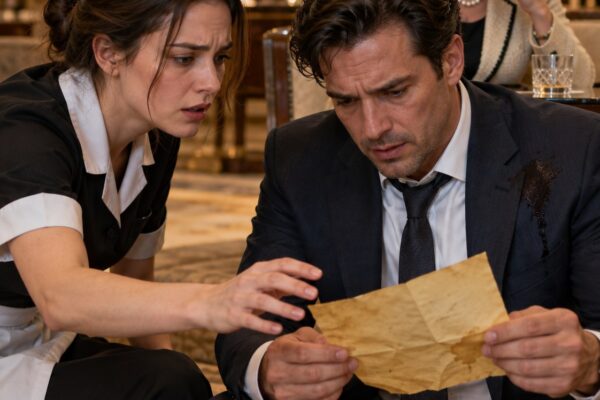
A stain had spread along one corner.
The writing remained legible.
Mercer pointed to the routing code.
“B-417.”
“My father wrote that?”
“Our office stamped incoming papers.”
“Who ran the office?”
“My grandfather did then.”
Wren had prepared herself for Mercer’s denial.
She had prepared for contempt, too.
She had not prepared for the way his voice tightened around that last sentence.
“Your grandfather testified,” she said.
“I know.”
“He said Dad never warned anyone.”
“I know that too.”
Wren closed the sleeve.
Across the lobby, a door opened.
The clerk called their case.
Mercer stood, then waited while Hazel helped Wren to her feet.
At the security doors, he spoke quietly.
“The B meant basement.”
“What about the number?”
“It was entered in the private log.”
“So your office had a log?”
“Yes.”
Wren felt Hazel’s hand slip into hers.
Mercer met her eyes.
“My grandfather told the court that log had been destroyed.”
* * *
The judge allowed a forty-eight-hour pause.
Mercer’s attorney had opposed Wren’s petition that morning.
By noon, he was helping her preserve the slip under a court order.
Wren did not mistake that for friendship.
She watched him place the document in a marked envelope and sign across the seal.
Then she signed beside him.
The clerk signed last.
Hazel counted each signature.
“Three,” she whispered.
“That’s right,” Wren said.
Her petition asked the court to reopen a civil finding that had declared her father responsible for the East Harbor fire.
A separate criminal conviction had followed.
Wren’s lawyer, a legal aid attorney named Priya Shah, had warned that one old paper would not clear him alone.
Priya arrived during the pause with rain in her hair and a folder under her arm.
She examined the photograph Wren had taken before leaving home.
“Where was the original?”
“In Dad’s sewing machine.”
“You told me he couldn’t sew.”
“He couldn’t.”
Wren had bought the machine at the prison property auction after his death.
It had sat in her closet for five years.
That morning, Hazel had dropped a hair clip through the open top.
Wren had removed a metal panel to retrieve it.
Inside was an oilcloth packet, taped beneath the motor.
The blue slip had been folded around a letter.
Wren had brought both.
The letter was addressed to her.
It said only that the paper should reach a court if she ever found it.
Her father had been afraid it would disappear again.
Priya asked Wren to write down each step of the discovery.
Wren did so at a small table.
She included Hazel’s dropped clip.
She included the time.
She included the fact that she had handled the paper before putting it in a freezer bag.
“Will that ruin it?” Hazel asked.
“No,” Priya said.
“It helps us tell the truth about where it’s been.”
Mercer stood by the window, speaking to an older man on the phone.
His attorney waited nearby.
Wren heard Mercer ask for the private office archives.
Then she heard him say, “Do not tell my grandfather.”
He ended the call.
“Why not?” Wren asked.
“Because I want the records before he knows what we found.”
Priya looked up.
“Those records may belong under the preservation order.”
“I told the archivist to hold them.”
“Good.”
“Your grandfather still works for you?” Wren asked.
“He chairs our charitable foundation.”
“That sounds comfortable.”
“It probably is.”
Mercer accepted the blow.
Priya asked for a copy of the original fire investigation.
Wren had already read it so many times she knew its page numbers.
She worked nights cleaning the city records center.
The job paid for rent, groceries, and Hazel’s school supplies.
It also meant she knew how public files were stored.
Three months earlier, a retired investigator’s index had been released after a routine retention review.
Wren had seen a reference to a missing basement inspection photograph.
That reference had led her to Priya.
Now she pointed to a line in the investigation report.
“Page eighty-six.”
Priya turned to it.
The report said the electrical cabinet showed signs of recent work.
The next page described that work as unauthorized.
The cabinet key had been assigned to Wren’s father.
“They built the whole case around the key,” Wren said.
Mercer leaned closer.
“My grandfather’s company replaced that cabinet the previous winter.”
“Your grandfather said Dad altered it afterward.”
“That’s what I was told.”
“By him.”
“Yes.”
Priya tapped the photograph index.
“Can your company produce the winter repair records?”
“I’ll find out.”
“Through counsel.”
Mercer nodded.
“I understand.”
They spent the afternoon in separate offices.
Priya requested the court file, the archived inspection index, and the missing photograph’s tracking history.
Mercer’s attorney sought company records and agreed to preserve the private office log.
Wren went home with Hazel.
She made grilled cheese sandwiches.
Hazel placed her hair clip on the kitchen table.
“It found the paper,” she said.
“It did.”
“Will it help Grandpa Bell?”
Wren looked at the little silver butterfly.
“Maybe.”
Hazel had been three when Wren’s father died.
She remembered his voice from one saved birthday video.
She knew he had taught Wren to fix loose buttons.
She knew people had called him a bad man.
Wren had never told her she had to love him.
Hazel had made up her own mind.
The next day, Priya called.
The court archive still held the missing photograph.
It had been filed under a wrong street number.
A clerk had found it by checking the retired investigator’s index against the physical box.
The image showed a new breaker cabinet installed beside old, damaged wiring.
There was a manufacturer’s label on the cabinet.
Its installation date preceded the fire by six months.
“That doesn’t prove who ignored the warning,” Priya said.
“It proves there was a warning to ignore.”
Later, Mercer brought a certified copy of the private log to Priya’s office.
He did not bring it alone.
His attorney carried it.
The company archivist had signed a statement describing where it had been kept.
The log was bound.
Its pages were numbered.
Entry B-417 appeared on the date stamped on Wren’s blue slip.
The sender was listed as Daniel Bell.
The subject was written in a narrow hand.
BASEMENT WIRING.
Under action taken, someone had written two words.
HOLD INTERNAL.
Wren touched the table beside the page.
She did not touch the log.
“Who wrote that?” she asked.
“The entries were made by office staff,” Mercer said.
“Who gave the order?”
“We’re checking.”
Priya turned another page.
A notation sent the matter to company counsel.
The initials beside it belonged to Martin Mercer.
Julian’s grandfather.
But below them was a second set.
Wren recognized them.
They appeared on the letter that had dismissed her father three weeks before the fire.
E.H.
Eleanor Hale.
Julian’s aunt.
The woman who had visited Wren’s family after the funeral and said the company wanted to help.
* * *
Eleanor Hale called Wren that evening.
Wren let the first call go to voicemail.
The second arrived while Hazel brushed her teeth.
Eleanor’s message was gentle.
She hoped Wren and Hazel were well.
She had heard that difficult memories were being stirred up.
She wanted to spare them more pain.
Then she offered to pay for Hazel’s future education.
Wren saved the message.
She sent it to Priya.
Priya replied with three words.
Do not respond.
The next morning, Wren’s supervisor told her a complaint had been filed about her access to city records.
The complaint claimed she had searched private files for personal reasons.
Her access badge was suspended pending review.
Wren emptied her locker under the supervisor’s embarrassed gaze.
She had used only public records.
She had kept the request receipts.
The supervisor knew that.
The review would still take days.
Outside, Wren sat on a bench with her work shoes in a paper bag.
She called Priya.
Then she called Hazel’s school to confirm the girl could still attend the after-school program.
By the time Mercer called, Wren was standing at a bus stop.
“I heard about your job.”
“From whom?”
“Eleanor mentioned a concern.”
“That was fast.”
“I didn’t ask her to contact your employer.”
“Yet she knew exactly where I work.”
Mercer said nothing.
A bus passed without stopping because it was full.
Wren watched its windows slide by.
“She offered to buy Hazel a future,” Wren said.
“I’m sorry.”
“Find out how she knew about the complaint.”
“I will.”
“Through your attorney.”
“Yes.”
That afternoon, Priya sent the saved message and the complaint to the court.
She asked that both be preserved as possible interference with a pending case.
The city confirmed the complaint had arrived through its public portal.
The submission included a contact number.
Priya did not try to trace it herself.
She asked the court to direct the relevant records be retained.
Mercer’s attorney made a matching request for company communications.
The two lawyers had begun finishing each other’s sentences.
Wren found that unsettling.
On Friday, Mercer appeared at her apartment with a grocery bag.
Wren opened the door only because he had called first.
“I told you not to send money.”
“It’s soup.”
“That still costs money.”
“I made it.”
“You made soup?”
He held up a container.
“Poorly, according to my housekeeper.”
From the kitchen, Hazel called, “I like bad soup.”
Wren let him in.
The soup was too salty.
Hazel added crackers and declared it fixed.
Mercer sat at the small table in a chair that wobbled.
He folded a napkin beneath one leg without comment.
Wren watched him.
“You could have sent someone,” she said.
“I wanted to speak to you.”
“Then speak.”
“I was twenty-four when the fire happened.”
“I know.”
“I had just joined the company.”
“I know that too.”
“I believed Eleanor when she said the investigation was complete.”
“You could have read it.”
“Yes.”
He did not add an excuse.
Hazel asked if he could fix the loose handle on the kitchen drawer.
Wren said it could wait.
Mercer said he could try.
He tightened it with the small screwdriver Wren kept beside the stove.
When he finished, Hazel opened and closed the drawer twice.
“Better,” she said.
It was such an ordinary judgment that Wren nearly smiled.
Mercer saw it.
He looked away first.
After Hazel went to bed, he placed a folder on the table.
Priya had received the same documents.
They were copies of company invoices for the winter cabinet replacement.
The contractor had been paid twice.
One payment was for the work.
The second had gone to a different company after the fire.
The description said document recovery.
“Is that legal?” Wren asked.
“It can be.”
“Was it?”
“We don’t know yet.”
Priya had asked for the second company’s registration.
Its listed manager was Eleanor Hale’s personal assistant.
Wren read the name twice.
“That’s close.”
“Yes.”
Mercer’s phone rang.
He read the screen.
“What?”
His attorney spoke for several seconds.
Mercer stood.
“What happened?” Wren asked.
“The archivist found a removal request.”
“For the log?”
“For the log and the original warning.”
“Who signed it?”
He held her gaze.
“Eleanor.”
Wren thought of the visit after the funeral.
Eleanor had brought flowers.
She had known Hazel’s name.
She had stood in this same kitchen and promised help.
“Why would she do it?” Wren asked.
Mercer lowered the phone.
“Because the wiring repairs had been charged to a fund she controlled.”
* * *
The hearing resumed the following Wednesday.
Rain had cleared.
Wren still carried an umbrella because Hazel insisted courts were places where things got wet.
Priya met them on the steps.
She had news.
The city had completed its badge review.
Wren would return to work on Monday.
The complaint had cited a records request she had made openly, using the public counter.
It had not involved her employee access.
Wren folded the letter into her bag.
Inside the courtroom, Mercer sat beside his attorney.
Eleanor sat two rows behind him.
She wore a gray suit and a small gold pin shaped like a house.
For twelve years, that pin had appeared in photographs of charity dinners.
Eleanor’s foundation had raised money for families displaced by the fire.
Wren had once accepted a winter coat from it.
Eleanor smiled when their eyes met.
Wren sat beside Priya.
Hazel stayed with a trusted neighbor downstairs.
The judge began by explaining the narrow question before her.
The court would decide whether newly found evidence justified reopening the old civil finding.
It would not decide criminal guilt that morning.
It would not award damages.
Wren appreciated the care in those limits.
Too many people had promised her a single day that could repair everything.
Priya called the company archivist.
He described the log’s storage.
It had remained in a locked room through two office moves.
The cabinet inventory identified it by year and shelf.
The entries were written in sequence.
No page was missing around B-417.
Mercer’s attorney asked the same witness about the removal request.
The archivist had refused it because the court’s preservation order was already in place.
Eleanor’s attorney stood.
“My client is authorized to review company materials.”
The judge nodded.
“Review is different from removal.”
The attorney sat.
Priya then called the retired fire investigator.
He was older and walked with a cane.
He had kept an index because photographs were sometimes returned to storage under the wrong address.
The missing photograph had troubled him.
At the time, he had been told the cabinet was repaired after Daniel Bell worked on it.
The manufacturer’s label showed a different timeline.
“I should have checked that label,” he said.
Priya did not ask him to apologize.
She asked what the photograph showed.
He answered carefully.
It showed old wiring still in use beside a newly installed cabinet.
It showed visible heat damage near the connection.
It did not show who had approved the work.
“Could Mr. Bell’s warning have been relevant?” Priya asked.
“Very.”
Eleanor’s attorney cross-examined him.
He pointed out that photographs could not explain every cause of a fire.
The investigator agreed.
He also agreed that Daniel Bell had held a basement key.
Wren watched the attorney gather strength from each answer.
When Priya called Wren, her hands shook.
She placed them flat against the witness stand.
She described the sewing machine.
She described the hair clip.
She described the oilcloth packet and the freezer bag.
The attorney asked why her father had hidden evidence.
“I can’t ask him,” Wren said.
“But he wrote you a letter.”
“Yes.”
“He expected you to find it?”
“He hoped I would.”
“Five years after his death?”
“I found it five years after his death.”
“That wasn’t my question.”
Wren looked at the judge.
“My father hid it where he thought it would be safe.”
The attorney held up a photograph of the blue slip.
“Your father could have made this.”
“He could make many things,” Wren said.
“He fixed our oven with a spoon once.”
A few people smiled.
Wren did not.
“He couldn’t make a routing stamp appear in Mercer’s private log.”
The attorney paused.
Then he asked whether she blamed Eleanor Hale.
“I blame whoever hid the warning.”
“Do you have proof my client did?”
“Priya has the records.”
The judge asked the attorney to move on.
Next came the blue slip.
A document examiner explained what could and could not be concluded from it.
The paper was consistent with the carbon forms used by the company that year.
The stamp matched the office log’s format.
The ink and folds were consistent with age.
The examiner could not identify who had placed it in the sewing machine.
Then she pointed to a pale impression beneath the visible writing.
On the original sheet, someone had written a note while it lay over the blue carbon.
The words had been pressed into the fibers.
Under angled light, they could be read.
SEND TO E.H. BEFORE J.M. RETURNS.
Wren turned toward Mercer.
He was already looking at Eleanor.
The judge called a short break.
In the hallway, Eleanor approached Wren.
Priya stepped between them.
Eleanor addressed her anyway.
“Your father was frightened.”
Wren felt the old anger rise.
“Of the fire?”
“Of losing his job.”
“Who told you that?”
“He did.”
“When?”
Eleanor glanced at Priya.
“Years ago.”
“On what day?”
“I couldn’t possibly remember.”
Wren took one step closer.
“You remembered Hazel’s name.”
Eleanor’s face softened for anyone watching.
“I’ve always cared about this family.”
“That’s what makes it worse.”
Eleanor’s smile disappeared.
The clerk called them back.
The final witness was Mercer’s former executive assistant.
She had kept appointment books and delivery receipts.
She confirmed Julian had been in another city when B-417 arrived.
She confirmed Eleanor had access to his office.
More than that, she had found a dated note in her own retained work diary.
Eleanor had instructed her to send the basement warning to outside counsel.
The assistant had copied the note because she worried about the residents.
She had given her diary to company lawyers after the preservation order.
Eleanor’s attorney challenged her memory.
The assistant showed the dated page.
He challenged why she had stayed silent.
“I thought counsel had handled it,” she said.
“After the fire?”
“I asked.”
“And?”
“I was told the investigators had everything.”
“By whom?”
“Ms. Hale.”
The judge allowed the answer.
The attorney argued that none of this proved Eleanor caused the fire.
He was right.
He argued that Daniel Bell’s key still mattered.
He was right about that too.
Then Priya asked to play a recorded call.
It was Eleanor’s voicemail to Wren.
The offer for Hazel’s education sounded tender at first.
In the quiet courtroom, the sentence about sparing them more pain sounded different.
Priya did not claim it proved the old lie.
She said it explained why Wren had asked the court to preserve current communications.
The judge admitted it for that limited purpose.
Eleanor stood when the judge invited statements.
She had not been called as a witness.
She could still speak for her foundation as an interested party.
She spoke well.
The repair fund had been strained.
The company had managed dozens of aging buildings.
Daniel Bell had held the key.
Records from twelve years ago could be misunderstood.
The fire had harmed everyone.
She turned toward Wren.
“I helped your family because I believed they deserved compassion.”
Wren gripped the edge of the table.
Eleanor faced the judge again.
“I ask the court not to replace one painful uncertainty with another.”
For a moment, Wren saw how the argument might win.
The judge could reopen the case without naming anyone else.
The world could remain mostly as it had been.
Then Mercer’s attorney stood.
The court had ordered an independent review of the fund’s accounts.
The reviewer had found the second payment.
It went to the company managed by Eleanor’s assistant.
Its invoice number matched a memo in outside counsel’s archived file.
That memo instructed the company to retrieve and withhold “unverified maintenance correspondence” before investigators received the records.
Eleanor had approved the invoice.
Her initials appeared on the payment authorization.
Her attorney objected to the interpretation.
The judge agreed that the record did not establish every intention.
It did establish that Daniel Bell’s warning had reached the company before the fire.
The warning had not been given to investigators.
The old civil finding had rested in part on a claim that no warning existed.
That claim was false.
The judge reopened the finding.
She ordered the new evidence sent to the district attorney and the state agency reviewing the fire investigation.
She also ordered the preserved records maintained.
Eleanor gathered her papers.
As she passed Wren, she stopped.
“He still had the key,” she said.
Wren looked at her.
“My father used it to open doors people paid you to keep safe.”
Eleanor walked on.
There was no arrest in the courtroom.
There was no sudden confession.
There were only documents, people willing to explain them, and a judge who had finally seen the warning.
Six months later, the district attorney moved to vacate Daniel Bell’s conviction.
The old case had withheld material evidence from the defense.
The court granted the motion.
A separate investigation into the records and payments continued.
Eleanor resigned from the foundation.
The state later charged her with offenses related to the withheld documents and the false payment records.
She pleaded guilty to two charges before trial.
The sentence included restitution and a period of supervised release.
Wren attended the hearing.
She did not speak to Eleanor.
She listened while the judge made clear that the plea did not settle every question about the fire.
That distinction mattered to Wren.
Her father’s warning was real.
His conviction was gone.
The people who died did not return.
* * *
In November, Wren went back to cleaning the records center.
Her supervisor apologized for the suspended badge.
He offered her the day shift.
She accepted it after checking Hazel’s school schedule.
The first afternoon she came home before dark, Hazel opened the door wearing two mismatched socks.
“Is this our new time?” she asked.
“For now.”
“Good.”
They made pancakes for dinner.
One stuck to the pan.
Hazel named it after the judge.
Wren tried not to laugh.
She failed.
Mercer called less often after the hearing.
When he did, he asked before visiting.
Sometimes Wren said no.
He accepted it.
Sometimes she said yes.
They walked through the public garden near her apartment.
He learned that Hazel disliked peas unless they were in soup.
He learned Wren had once wanted to restore old books.
Wren learned he hated formal dinners and kept every cheap postcard anyone had sent him.
One Saturday, he brought the postcard from his first trip outside the country.
It showed a bridge.
On the back, his grandfather had written, Build something that lasts.
Wren read it twice.
“Did you?” she asked.
“I’m trying.”
He had stepped away from the housing company’s daily management.
An independent board reviewed its buildings.
Tenants joined the safety committee.
Inspectors visited properties that had been overlooked for years.
Wren knew those changes had come late.
She also knew families living there needed them now.
Mercer’s attorney sent Priya an offer of compensation for Daniel Bell’s wrongful conviction and the harm caused by the company’s withheld records.
Priya explained the terms.
Wren asked for time.
Money could pay for a better apartment.
It could fund Hazel’s education.
It could also become the last thing anyone said about her father.
She negotiated.
Part went to her family.
Part established a tenant safety fund administered outside Mercer’s company.
The agreement did not require her silence.
It did not require her forgiveness.
Priya insisted on both points.
Mercer agreed.
When he came to sign, Wren met him at Priya’s office.
He wore an ordinary blue sweater.
It did not make him ordinary.
He waited while she read every page.
“You trust Priya?” he asked.
“With my life.”
“And me?”
Wren capped her pen.
“I trust you to keep learning what your name has covered.”
He accepted that.
“I’m sorry I believed Eleanor.”
“I know.”
“I’m sorry I didn’t read the file myself.”
“That one is yours.”
“Yes.”
Wren signed.
Afterward, he asked if she would come to dinner.
“With Hazel?”
“If she wants.”
Hazel did.
She ordered a dessert bigger than her face.
Mercer paid only after Wren agreed he could.
That became their rule.
He asked.
She answered.
The answer counted.
Winter brought a small ceremony at the records center.
A display about the East Harbor fire included the corrected timeline.
Daniel Bell’s warning appeared on a panel beside the old photograph.
The names of the three residents who died appeared above it.
Wren had insisted on that order.
She brought Hazel before the public opening.
They stood in front of the display.
“Grandpa tried,” Hazel said.
“He did.”
“People know?”
“They do now.”
Hazel read each resident’s name aloud.
Then she took Wren’s hand.
Mercer stayed across the room until Wren beckoned him over.
He looked at the blue slip behind its protective glass.
It belonged to the court record now.
The display held a certified copy.
“I used to think that number proved my office worked,” he said.
“What do you think now?”
“It proves someone can record a warning and still fail to hear it.”
Wren looked at him.
“That sounds rehearsed.”
“It was.”
“Try again.”
He considered the paper.
“I should have asked your father what he saw.”
“That’s better.”
In the spring, Wren enrolled in a conservation course two evenings a week.
She liked the work.
She liked that damaged things could be studied without pretending they were new.
Mercer offered to pay the tuition.
She declined.
The settlement covered it.
He offered to drive Hazel on class nights.
Wren agreed after Hazel voted yes.
One evening he arrived with an umbrella, although the sky was clear.
Hazel accused him of expecting trouble.
“I’ve learned from experience,” he said.
Wren took the umbrella.
“You can leave it here.”
“Is that an invitation?”
“It’s weather planning.”
He smiled.
She did too.
Three months later, he asked her to visit the company’s renovated East Harbor building.
Wren had avoided it for years.
She agreed because the tenant committee had invited her.
The old basement had been rebuilt and documented.
A resident named Mrs. Alvarez showed her the inspection reports posted by the entrance.
Hazel pressed every button on the new elevator until Wren stopped her.
At the end of the visit, Mercer waited outside.
He had not asked the committee to give him a speech.
He had simply come.
Wren stood beside him under the awning.
“I’m glad you saw it,” he said.
“I’m glad they did the work.”
He looked toward the sidewalk.
“There’s something I’d like to ask.”
“You can ask.”
“I’d like to see you when there isn’t a hearing, a repair, or a committee meeting.”
“We had dinner.”
“With Hazel.”
“She’s excellent company.”
“She is.”
A bus hissed to a stop across the street.
Wren watched the doors open.
“I don’t need rescuing,” she said.
“I know.”
“And I won’t be grateful for something you should have done anyway.”
“I know that too.”
She faced him.
“Ask me plainly.”
“Would you go out with me Friday?”
“Yes,” she said.
Mercer looked startled.
Wren laughed.
“You asked.”
“I did.”
“And I answered.”
Friday became other Fridays.
Some went badly.
He talked too much about a building sale once.
She left early.
He apologized without sending flowers.
She told him when she needed space.
He gave it.
Hazel continued to ask whether he could fix things.
Sometimes he could.
Once he made a cabinet door worse.
Hazel banned him from hinges for a month.
By the end of the year, Wren had stopped measuring their days against the courthouse.
The past still mattered.
It no longer occupied every room.
* * *
Four years later, rain fell on the courthouse steps again.
Hazel was twelve and nearly as tall as Wren.
She carried a folder for her school’s history project.
Inside was a copy of Daniel Bell’s warning, a photograph of the old basement, and interviews with residents who had helped change the building.
Her teacher had asked students to research a local decision that mattered.
Hazel had chosen a decision nobody made.
The warning that sat in an office.
The repair that waited.
The question no one asked.
Mercer met them at the bottom of the steps.
He carried a dry coat over one arm.
“Prepared?” Hazel asked.
“For your presentation?”
“For the rain.”
“For both.”
They were early.
Hazel ran ahead to check the room.
Wren stayed beside Mercer.
The stone step where she had fallen looked smaller than she remembered.
“You grabbed me here,” he said.
“For the paper.”
“I remember.”
“You nearly stepped on it.”
“I remember that too.”
He held out his coat as the rain grew harder.
Wren took one side.
Together they covered Hazel’s folder.
It was an awkward shelter.
It worked.
Years ago, Wren had told him to keep the coat over the paper.
Now Hazel’s work rested beneath it.
The original blue slip remained in the court archive.
It had done what Daniel Bell hoped.
It had reached people who could check it.
His name was cleared.
The tenant fund paid for independent inspections.
Eleanor’s case was closed.
Hazel had grown into a girl who asked hard questions.
Wren had become a conservator.
Mercer had learned to answer those questions without borrowing anyone else’s certainty.
The courthouse door opened.
Hazel called for them.
Wren looked once more at the wet steps.
Then she took Mercer’s hand.
“Keep the coat over the paper,” she said.
“I’ve got it.”
This time, she believed him.
THE END