The Little Girl Rang the Harbor’s Forbidden Bell With Her Dead Father’s Compass, and Her Mother Saw the Owner Coming
Chapter 2: What the Compass Held
Gideon closed his hand around the paper.
Tessa held out hers.
“Let me see it.”
He gave it to her.
No argument.
The paper was a narrow strip.
On it, Owen had written three things.
MARCH 14.
LOCKER 28.
ASK HOLLIS.
Tessa read the words twice.
Wren stayed close enough to feel her mother’s hand shaking.
“Who’s Hollis?” Tessa asked.
“Etta Hollis,” Gideon said.
“She kept our accounts.”
“Did Owen speak to her?”
“I thought he had.”
Across the dock, a microphone squealed.
The dedication was about to begin.
Gideon turned toward it.
“Stop the ceremony.”
The man with the broom hurried away.
Tessa folded the paper along Owen’s crease.
“Why did you fire him?”
Gideon looked at Wren.
Tessa understood.
“She knows people think he stole.”
“I signed the dismissal,” Gideon said.
“For what?”
“Missing equipment money.”
“How much?”
“Eighteen thousand dollars.”
Tessa felt Wren grip her sleeve.
Owen had never brought eighteen thousand dollars home.
During his final winter, he had patched Wren’s boots with glue.
Gideon seemed to know what she was thinking.
“I should have asked him face-to-face.”
“You didn’t?”
“My operations manager brought me records.”
“And you believed them.”
“Yes.”
“Who was the manager?”
“My cousin, Miles.”
Wren looked between them.
“Dad said a wrong number can make a light go out.”
Tessa stroked her hair.
“He said that?”
“When he taught me the switches.”
Gideon’s face tightened.
He knelt so Wren could see him without looking up.
“I was wrong to let people say your dad stole.”
Wren studied the tattoos on his wrist.
“Did you tell them to?”
“No.”
“Did you stop them?”
Gideon looked at Tessa.
“No.”
The microphone fell quiet.
Wind moved through the rigging.
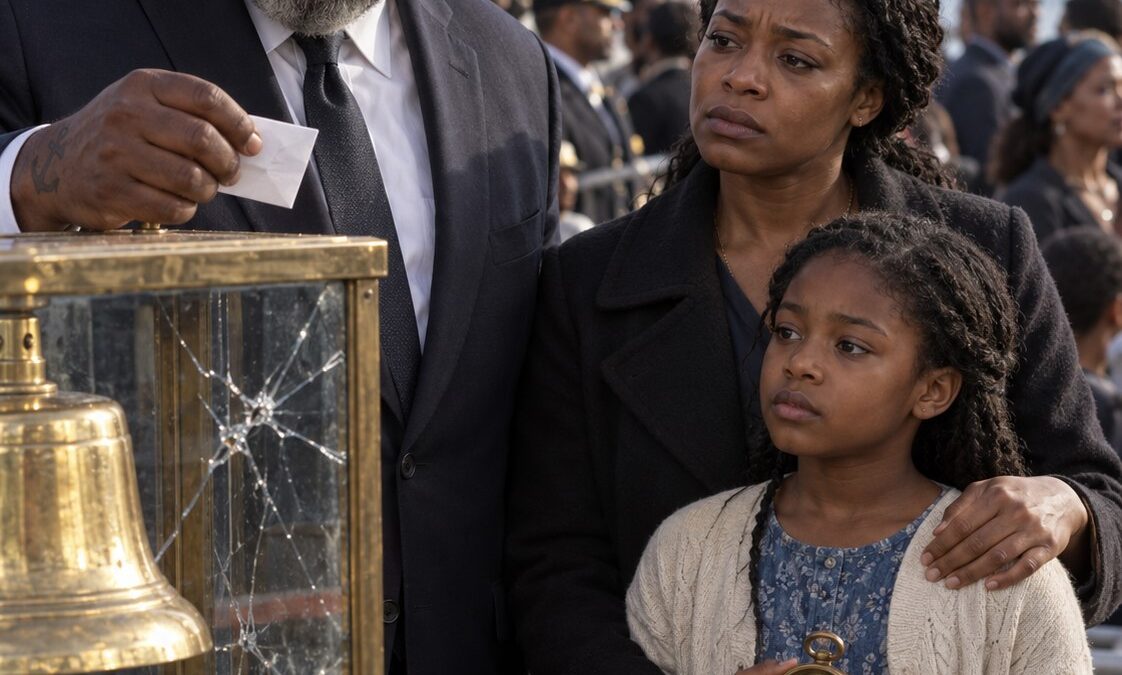
Gideon slipped off his suit jacket and laid it over the broken glass.
“Please step back, Wren.”
She obeyed.
He checked her hands for cuts without touching them.
Then he stood.
Tessa kept the paper.
“What happens now?”
“We find Etta.”
“And the locker.”
“Yes.”
“You won’t send someone else?”
“No.”
Tessa looked at the launch beside them.
Owen had once brought her here after midnight to show her the new lights.
He had been proud.
She had not seen him proud again after the dismissal.
“The ceremony can wait,” Gideon said.
He turned toward the crowd.
Before he reached the microphone, Tessa called him back.
“Why did you recognize the compass?”
Gideon glanced at Wren.
“Owen found it in my brother’s old tool chest.”
“Why give it to him?”
“I didn’t.”
He looked at the folded paper in her hand.
“I asked him to fix it.”
* * *
Etta Hollis lived above a bakery four blocks from the harbor.
She opened her door before Gideon finished knocking.
At seventy-one, Etta still wore her reading glasses on a chain.
She saw Tessa.
Then Wren.
Then the compass.
“Come inside,” she said.
Gideon remained on the landing.
“You knew?”
Etta’s eyes filled.
“I knew Owen left something.”
“Why didn’t you tell me?”
“I tried.”
“When?”
“The day he was dismissed.”
Etta took them to her kitchen table.
She brought out a folder with softened corners.
Inside was a copy of an email.
Etta had sent it to Gideon on March 14.
Please call me before you sign anything concerning Owen Vale.
The printed delivery notice said it had reached his office.
Gideon frowned.
“I never saw it.”
“Miles answered for you,” Etta said.
“He said you were at the hospital.”
That had been true.
Gideon’s wife had been having surgery that morning.
Miles had run the yard for six years.
He knew Gideon would answer a family emergency.
Tessa set down Owen’s paper.
“Why did he write ‘ask Hollis’?”
Etta opened the folder farther.
“I kept copies.”
There were payment requests.
Equipment orders.
Invoices for replacement batteries and navigation lights.
Owen had signed to confirm installing lights on three boats.
One of those boats had been sold two years earlier.
A second had never belonged to the yard.
Tessa pointed at the third line.
“This one’s real.”
Gideon nodded.
“It’s the launch outside.”
Etta slid over another sheet.
A bank statement showed the yard paying a supplier called Channel Marine.
The supplier’s address was a rented mailbox.
“Who approved this?” Tessa asked.
“Miles submitted the requests,” Etta said.
“Gideon approved batches.”
“I trusted the totals,” Gideon said.
Etta nodded.
“That was the problem.”
Owen had come to her with a question about the lights.
She had checked the orders and found fourteen more suspect payments.
Together, they totaled more than a hundred thousand dollars.
She had made copies.
Owen had planned to bring Gideon the documents.
Then, that morning, Miles produced a report accusing Owen of taking eighteen thousand dollars.
“The same amount?” Tessa asked.
“No,” Etta said.
“A different account.”
“Why didn’t you go to the police?”
“I did.”
Etta pulled out a card with a case number.
A detective had taken her statement.
At the time, she had invoices and a suspicion.
The yard’s own records said the equipment had arrived.
Owen was sick by then.
He had promised to find the original receiving sheets.
“I thought he’d hidden them in the locker,” Etta said.
Gideon pushed back his chair.
“Which locker?”
“The one he used at the yard.”
Tessa looked at Owen’s writing.
“Twenty-eight.”
They returned to the waterfront.
Gideon called a locksmith because he did not have a key.
He also called the detective listed on Etta’s card.
The detective asked them to leave the locker closed until she arrived.
They waited beside a row of dented metal doors.
Wren sat between Tessa and Etta.
“Was Dad scared?” she asked.
Etta took time to answer.
“He knew the records mattered.”
“That means yes.”
“Yes,” Etta said.
“He was scared.”
“But he went anyway?”
“He tried.”
Detective Anika Shaw arrived with a technician and photographed the lock before opening it.
Inside were old rain gear, a pair of work boots, and a flat document envelope.
The technician removed the envelope.
Shaw asked Tessa if she recognized the handwriting.
“Yes.”
Owen had written their home address on the back.
Inside were receiving sheets.
Several had his signature printed on them.
Not signed.
Printed.
Tessa had watched Owen sign school forms for years.
He crossed his V in one quick stroke.
These marks were identical, down to a blot that repeated in exactly the same place.
Shaw photographed each page.
“Who had access to these forms?” she asked.
Gideon swallowed.
“Miles controlled purchasing.”
A voice came from the end of the corridor.
“I wondered when you’d find those.”
Miles Rusk stood beneath the exit sign.
He looked at the envelope.
Then he looked at Wren.
* * *
Miles smiled as though they had met over lunch.
“You called the police for old paperwork?”
Shaw identified herself.
His smile held.
“I’ve seen those forms,” he said.
“They were investigated.”
“By whom?” Shaw asked.
“An outside auditor.”
“Name?”
“I’ll send it.”
He looked at Gideon.
“You stopped the dedication.”
“I postponed it.”
“Donors flew in.”
“They can wait.”
Miles’s gaze shifted to Tessa.
“I’m sorry your daughter heard about Owen today.”
Tessa put one hand on Wren’s shoulder.
“She heard about him before today.”
Miles glanced at the compass.
“That old thing survived?”
Shaw watched him.
“You recognize it?”
“Owen carried it.”
“He hid a note inside,” Gideon said.
Miles’s smile faded for a moment.
Then he shrugged.
“People leave strange notes when they’re ill.”
Tessa felt the familiar heat of anger.
She knew how easy it would be for Miles to say Owen had been confused.
During his last months, pain and medication had sometimes made him lose track of a sentence.
She also knew what he had done on March 14.
That morning, before work, he had packed Wren’s lunch.
He had drawn a careful heart on the bag.
He had told Tessa the yard finally made sense.
Miles turned toward the exit.
“I’ll have the auditor contact you.”
Shaw spoke calmly.
“I’ll contact the auditor myself.”
Miles left.
Gideon watched the door close.
“He came here fast.”
“I called the yard office,” Shaw said.
“I didn’t tell them about the locker.”
Etta lifted her phone.
“I called my neighbor to watch the bakery delivery.”
Everyone looked at Gideon.
“I told my assistant.”
“Who reports to Miles?” Tessa asked.
“Yes.”
Shaw wrote that down.
Wren reached for Tessa’s hand.
“Can we go home?”
“Yes.”
Gideon walked them to the street.
He did not ask them to stay.
At home, Tessa put Owen’s compass on the kitchen table.
Wren sat beside it with a bowl of cereal.
“Are they going to say Dad was good?”
“They’re going to check what happened.”
“He was good already.”
Tessa kissed the top of her head.
“I know.”
After Wren went to bed, Tessa opened the folder she kept for taxes.
Owen’s final pay records were inside.
She had saved every one because the dismissal had cut off their health coverage earlier than expected.
One sheet showed an unpaid reimbursement.
Parking.
March 14.
Tessa stared at the location.
Not the yard.
A public records office across town.
The receipt was stapled behind the form.
Owen had paid for certified copies of business registration documents.
Tessa called Shaw.
The detective answered on the second ring.
“We have a place to start,” Tessa said.
The records office could retrieve the copies Owen ordered.
It would take a day.
The next morning, Gideon called.
Someone had delivered a new glass case to Tessa’s apartment.
It sat outside her door in a wooden crate.
There was no card.
Gideon had ordered glass for the harbor.
He had not sent it to her.
Shaw came by to photograph the label.
The sender’s name was a shell company.
By afternoon, the records office produced Owen’s request.
He had asked who owned Channel Marine.
The registered agent was a lawyer.
The manager named on its original filing was Miles Rusk.
Shaw checked the state record herself.
She called Tessa before calling Gideon.
“I need to ask what Owen told you about the yard.”
“Only that he found missing money.”
“Did he name anyone?”
“No.”
Shaw paused.
“Then I’m telling you now.”
Tessa looked at the compass.
“Miles?”
“Yes.”
“He framed Owen to stop him?”
“That’s what the documents suggest.”
Gideon arrived while she was still on the phone.
Tessa told him.
He put one hand against the wall.
For years, Gideon had given Miles a place in the family business.
Miles had given him reports to sign.
Now there was a company in Miles’s name receiving yard money.
Gideon looked at the crate on the landing.
“He knew we’d find the company.”
Shaw’s voice came through the phone.
“He also knew where you lived.”
* * *
Three days later, the harbor board met in the old sail loft.
The board controlled the rescue launch’s operating money.
Gideon had asked for a public meeting.
Miles had asked for the same thing.
By six, the room was full.
Workers stood along one wall.
Donors filled folding chairs.
Tessa sat beside Wren near the door.
She had wanted to leave Wren with a neighbor.
Wren had asked to hear Owen’s name spoken correctly.
So Tessa brought her.
Shaw waited outside.
She was gathering evidence for a financial investigation, not staging an arrest.
The board’s attorney sat at the front with copies of the relevant records.
Gideon spoke first.
He said the boatyard had dismissed Owen Vale after he received a report accusing Owen of misusing funds.
“I signed it,” he said.
“I did not verify it.”
He turned toward Tessa.
“I owe his family an apology.”
The room went still.
Miles stood.
He wore the same neat navy coat he wore for donor photographs.
“You do,” he said.
“But apologizing doesn’t prove Owen’s work was sound.”
He passed out a packet.
It showed orders signed by Owen.
It showed money paid for equipment no one could find.
Miles spoke with care.
He did not insult Owen.
He praised him.
“He was talented,” Miles said.
“He was also under terrible pressure.”
Tessa felt Wren lean against her.
Miles continued.
“I tried to handle this privately because he was ill.”
A few donors lowered their eyes.
Gideon started to stand.
Tessa touched his arm.
“Let him finish.”
Miles looked at the board.
“A grieving family deserves compassion.”
“So does a charity protecting donated funds.”
He had almost won the room.
Tessa could see it.
Then the attorney asked him about Channel Marine.
Miles spread his hands.
“I formed it years ago to source parts.”
“Did you disclose that to the board?”
“I believed Gideon knew.”
“I didn’t,” Gideon said.
Miles turned to him.
“You approved the payments.”
“That doesn’t answer her.”
Miles opened his packet.
“We used that supplier repeatedly.”
Tessa stood.
She had not planned to speak.
But she knew something the packets missed.
“Owen kept the receipts from home,” she said.
Miles gave her a sympathetic look.
“No one doubts he kept records.”
“I worked two jobs after he was fired.”
Her voice stayed steady.
“I checked every bill he left us.”
She held up the certified record.
“He paid for this himself.”
The attorney took it.
It showed Owen had requested Channel Marine’s registration before Miles accused him.
Tessa held up his reimbursement form.
“He asked the yard to repay him.”
“He attached the receipt.”
“Your office refused.”
Miles looked at Gideon.
“I never saw it.”
“Your initials are on the refusal,” the attorney said.
“That could mean anything.”
“It means you saw the request,” Tessa said.
A chair scraped.
Etta stood at the rear of the room.
“I kept the copy.”
She carried her folder forward.
Her email to Gideon was there.
So was Miles’s reply from Gideon’s office account, saying Owen’s concern had been handled.
The attorney compared the dates.
Miles looked toward the door.
Shaw entered quietly.
She did not interrupt.
The attorney finished reading.
“Miles, did you tell Etta that Gideon had reviewed Owen’s concern?”
“I may have.”
“Had he?”
“I assumed he would.”
Gideon shook his head.
The attorney closed the folder.
“We’ll suspend your access to the charity’s accounts tonight.”
Miles laughed once.
“You can’t run this yard without me.”
“We’ll find out,” Gideon said.
Shaw approached him.
She asked Miles to schedule an interview and told him to preserve his records.
She did not accuse him in the room.
She did not have to.
Miles turned to Tessa.
“An apology won’t give your daughter her father back.”
Wren tightened her grip on the compass.
Tessa felt the sharpness of the words.
Then she answered.
“I know what an apology can do.”
“It can tell her who owed one.”
Months of work followed.
Investigators compared invoices with deliveries.
They interviewed suppliers.
A bank obtained records under legal process.
Miles’s company had received payments for equipment the yard never ordered.
The evidence also showed he had altered receiving forms to make Owen appear responsible.
Miles pleaded guilty to fraud and falsifying business records the following spring.
The court ordered restitution.
The money would take time to recover.
The board amended Owen’s personnel file immediately.
Gideon wrote the correction himself.
Before he mailed it, he brought a copy to Tessa.
She read every line.
At the bottom, Gideon had written that Owen had identified the false invoices and tried to report them.
Tessa looked up.
“You could have written that sooner.”
“I know.”
She signed for the letter.
It was the first document from the yard that told the truth.
* * *
By summer, Wren had stopped carrying the compass every day.
She left it by her bed, where she could find it in the dark.
Tessa kept her morning shift.
She dropped the office cleaning job when the grocery store offered her full hours and benefits.
On Saturdays, Wren went to the harbor with her mother.
Gideon had asked permission first.
The launch was still being finished.
Its lights worked.
Wren insisted on checking them each visit.
She stood beside the switch panel while a technician called out each lamp.
“Red.”
“Green.”
“White.”
Gideon pretended to need help remembering the order.
Wren did not believe him.
She helped anyway.
The new glass case arrived for the bell.
Gideon kept the cracked original in storage.
He offered Tessa a piece of it.
“No,” she said.
“It belonged to your brother’s bell.”
He considered that.
“You’re right.”
They stood together at the dock rail.
“I knew Owen was sick,” Gideon said.
“I didn’t know how sick.”
“He didn’t want anyone at work treating him gently.”
“He deserved better from me.”
“Yes.”
Gideon accepted the word.
He had apologized once in public and twice in private.
Tessa had believed him the first time.
Belief had not erased the year Owen spent under suspicion.
“My brother taught me to check a line twice,” Gideon said.
“I thought I remembered the lesson.”
Tessa watched Wren crouch beside the switch panel.
“You can remember it now.”
The board offered Owen’s family money from a fund set aside for people harmed by the fraud.
Tessa accepted enough to cover what the dismissal had cost them.
She asked that the rest support training for harbor electrical workers.
Owen had learned the trade from a neighbor after high school.
He used to say one patient teacher could change a whole paycheck.
The board agreed.
They named the training place after him.
Tessa chose the wording on the sign.
OWEN VALE ELECTRICAL WORKSHOP.
No grander title.
No claim he had been perfect.
Just his name and the work he loved.
That autumn, Gideon brought the repaired compass to Tessa’s door.
He had replaced its cracked glass.
He had left the loose screw untouched until she approved the work.
“It still opens,” he said.
He showed her.
Inside was the little paper.
Tessa had asked Shaw for it once the case no longer needed the original.
She unfolded it at the kitchen table.
Wren read the three lines aloud.
“March fourteen.”
“Locker twenty-eight.”
“Ask Hollis.”
“Why did Dad write so small?” she asked.
“He wanted to keep it safe,” Tessa said.
Wren turned the compass over.
“Did he think I’d find it?”
“We don’t know.”
Gideon sat across from her.
“He fixed it carefully.”
Wren looked at him.
“You should have listened to him.”
“Yes.”
“Will you listen to me?”
“Yes.”
She slid the compass toward him.
“Can the bell ring for Dad when the boat is ready?”
Gideon did not answer for a moment.
The bell had belonged to his brother.
He had kept it behind glass for fifteen years.
Tessa watched him decide.
“I’d like that,” he said.
“Would your brother?”
“He rang it when people came home.”
Wren thought about that.
“Dad’s not coming home.”
“No,” Gideon said.
“But his name can.”
On the day the launch was finally ready, Gideon carried the bell to its proper place aboard.
He invited Tessa to ring it.
She gave the rope to Wren.
Wren looked at her first.
Tessa nodded.
Then Wren pulled.
The bell sounded over the harbor.
This time, nobody tried to stop her.
* * *
Five years later, Wren returned to the dock with a toolbox of her own.
She was fourteen.
The toolbox weighed more than the one Owen had carried on his first day there.
She complained about that to anyone willing to listen.
Gideon offered to carry it.
“No.”
“You’re blocking the gangway.”
“I’m building strength.”
“You’re building a traffic jam.”
Tessa laughed from the rail.
The summer training program had filled all twelve places.
Wren was its youngest helper.
She knew where every switch led.
She also knew to ask before opening a panel.
The compass hung from a cord inside her jacket.
She took it out when the trainees gathered beside the launch.
Its glass was clear.
Its back was scratched.
The paper remained folded inside.
Wren showed them the screw.
“My dad hid an address here,” she said.
“He wanted someone to check his work.”
A boy in the front raised his hand.
“Was he right?”
“Yes,” Wren said.
“But he needed people to listen.”
Gideon stood beside the bell.
He had listened since.
He had given workers a direct way to bring concerns to the board.
Etta still checked the accounts.
Miles had paid what the court ordered and no longer worked near the harbor.
Tessa’s bills were paid.
Owen’s name was back on the work he had done.
Wren put the compass away.
Then she checked the launch’s lights with the trainees.
Red.
Green.
White.
Each one answered.
When they finished, Gideon offered her the bell rope.
Wren turned to her mother.
“Can I?”
Tessa smiled.
“You know the rule.”
Wren checked that everyone had stepped aboard safely.
Then she rang the bell.
Once.
Its sound crossed the water and came back to them.
THE END