The Nine-Year-Old Put Her Dead Father’s STOP Paddle Against a Millionaire’s Prized Locomotive, and Her Mother Screamed
Chapter 2: Beneath the Tape
“Don’t pull it here,” Gideon said.
Mara took her thumb away.
Across the platform, the photographer lowered his camera.
Junie watched Gideon instead.
“Is it bad?” she asked.
“I don’t know yet.”
He spoke quietly enough that only they heard.
An attendant appeared at the cab door and pointed to his watch.
Gideon shook his head.
“The engine stays put.”
“But the ceremony—”
“Tell them it’s delayed.”
Mara tightened her grip on the paddle.
A delayed unveiling would draw questions.
A damaged locomotive would draw more.
“Junie and I can leave,” she said.
“Please stay.”
That word sounded strange from him.
He looked at the scratch again.
“I’m sorry I came toward her like that.”
Junie studied his face.
“You looked mad.”
“I was.”
“At me?”
“At what I thought had happened.”
Mara knew something about living with the wrong account of a night.
She followed him into the station office.
Junie came between them.
The room smelled of coffee and old paper.
Gideon cleared a desk and brought over a lamp.
“May I?” he asked Mara.
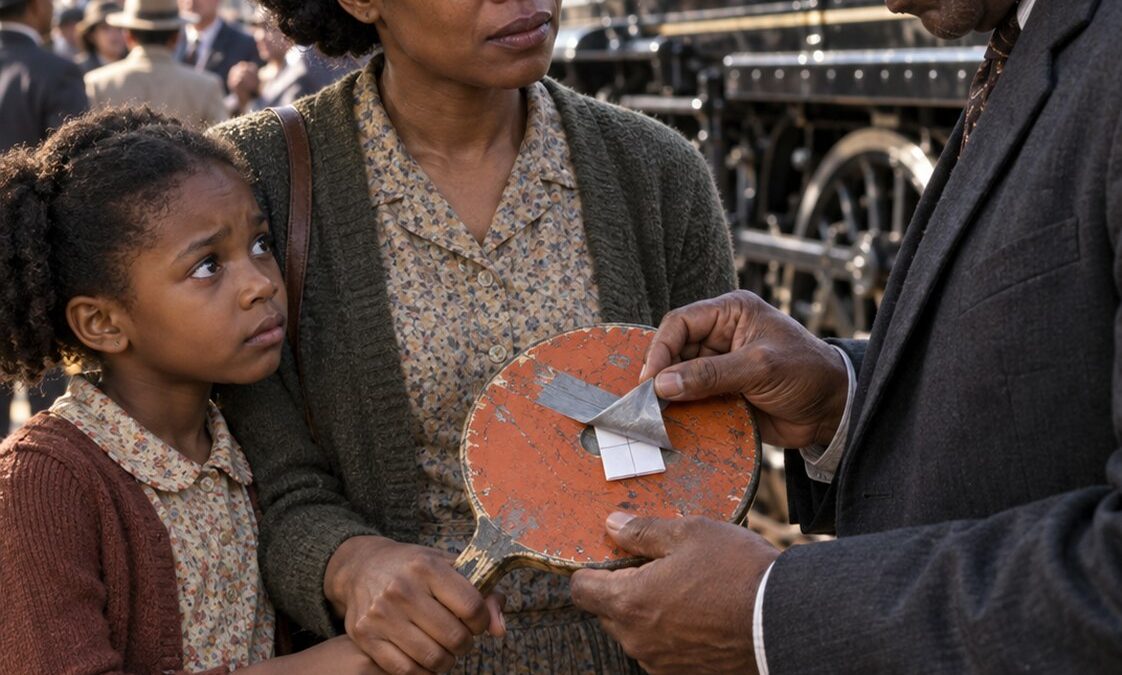
She gave him the paddle.
He lifted the edge of the tape with a letter opener, moving slowly around the crack Ellis had repaired.
The paper beneath it was folded into a thin square.
Gideon opened it.
Two lines of Ellis’s handwriting crossed a carbon copy of a yard stop order.
HOLD ENGINE 18. BRAKE TEST FAILED. 2:14 A.M.
Below that, Ellis had written another sentence.
I handed the original to Ben.
Mara sat down.
“No,” she said.
Ben had been Ellis’s friend before he became her brother-in-law’s boss.
He had found Ellis the yard job.
He had brought Junie coloring books after the accident.
Gideon turned the paper toward her.
“Is that his writing?”
“Yes.”
“You’re sure?”
“I know how he made his fours.”
Junie leaned against Mara’s chair.
“Did Dad stop the train?”
“He tried,” Gideon said.
Mara looked at the stop order again.
The official account said Ellis had cleared the locomotive to move.
The paper in her hands said he had ordered it held.
Gideon reached for the office phone, then stopped.
“First, we make a copy in front of you.”
“Why?”
“Because your family has already lost one report.”
He called the station manager in as a witness.
Mara watched the machine feed out two copies.
Gideon wrote the time on each.
The manager signed beneath it.
Only then did Gideon return the original to Mara.
Junie touched the orange handle.
“Can Dad have his name back?”
Mara could not answer.
Gideon looked directly at the child.
“We’re going to find out who took it.”
* * *
The unveiling was canceled before noon.
Gideon told the waiting crowd there was a question about the locomotive’s history that deserved an answer before the ceremony continued.
He did not name Ellis.
He did not name Ben.
Mara appreciated both choices.
A station manager brought them sandwiches from the café.
Junie ate hers on the office floor, with her back against Mara’s legs.
Gideon called the lawyer who had handled claims from the accident.
She arrived forty minutes later carrying a notebook and a hard plastic document sleeve.
Her name was Ada Kim.
She read the paper without touching its edges.
“Where has this been?” she asked.
“Under tape on the paddle,” Mara said.
“Who kept the paddle?”
“My daughter.”
Ada looked at Junie.
“May I ask how you found the paper?”
“I didn’t,” Junie said.
“I put the sign on the train.”
“Then you helped us find it.”
Junie considered that.
“Am I in trouble for the scratch?”
“No,” Gideon said.
Ada gave him a look.
He added, “The paint can be repaired.”
That afternoon, Ada asked Mara to bring the paddle to an independent document examiner.
Mara kept it beside her on the bus.
She held the handle through Junie’s music lesson and all the way home.
Ben called at six.
Mara stared at his name on the screen.
She let it ring.
A moment later, his message appeared.
Heard about the ceremony. Is Junie okay?
Mara showed Ada the message when the lawyer came by that evening.
“Answer only what you want to answer,” Ada said.
“I want to know what he knows.”
“Then we find the records first.”
The next morning, Mara took a shift off work.
Her supervisor sounded irritated until Mara explained that it concerned Ellis’s accident.
Then she said she would save Mara’s hours for Saturday.
At the document examiner’s office, they watched the paper go under bright light.
The examiner photographed both sides.
She found a pressure mark from a stamp on the back, too faint for Mara to see.
The mark matched the number of a yard order form.
“It’s consistent with the forms used that year,” she told them.
She could not tell them who had written the words or when they had been hidden.
Mara liked that she said so.
Ada requested the archived yard records through Gideon’s company.
Gideon had sold his freight business two years earlier, but its records had been retained under the sale agreement.
He persuaded its current owner to preserve the relevant files before anyone searched them.
They found the order number in an electronic index.
The scanned image attached to it was a clearance form.
It bore Ellis’s typed name.
It recorded a passed brake test at 2:17 a.m.
Mara stared at the screen.
“His paper says failed at 2:14.”
“The clearance might be a later test,” the records clerk said.
“Ellis would have noted a second test.”
“You’re certain?”
“He came home complaining when people left dates off the milk.”
The clerk almost smiled.
Mara had worked beside Ellis at their kitchen table often enough to know his habits.
After long shifts, he made lists for the next day on the backs of grocery receipts.
He drew a small box beside every finished task.
On the paper beneath the tape, he had boxed the words BRAKE TEST FAILED.
The clearance form on the screen had no box.
That proved little.
It told Mara where to look.
“Can we see the original sheet?” she asked.
The clerk checked the archive catalog.
The original had been transferred to a storage company.
Ada requested it.
They waited three days.
Junie asked about the paddle every night.
Mara told her it was safe.
She did not promise more.
On Thursday, a courier brought a sealed records box to Ada’s office.
Inside was a thin folder holding the clearance form and a cover sheet showing who had submitted it.
The signature on the cover sheet belonged to Ben Alder.
Mara read it twice.
Then she saw the date.
Ben had submitted the clearance four days after Ellis died.
* * *
Ben came to Mara’s apartment on Friday evening.
He carried a paper bag from the bakery Junie liked.
Mara left the door chained.
“Where’s Junie?” he asked.
“At a friend’s.”
“Good.”
The word made her hand tighten around the door.
Ben had always been the person she called when she needed help lifting furniture, fixing a sink, or finding someone to watch Junie.
He had stood beside her at Ellis’s service.
He had told everyone Ellis made one mistake in a hard job.
Mara had spent eleven months trying not to hate her husband for it.
“I’ve called you six times,” Ben said.
“I know.”
“Gideon’s people have been asking about the yard.”
“They found a stop order.”
Ben’s eyes moved from her face to the gap in the door.
“What stop order?”
“One Ellis wrote.”
“That doesn’t mean he filed it.”
“He said he handed it to you.”
Ben set the bakery bag on the hallway floor.
“Ellis was badly hurt, Mara.”
“He wrote it after the accident.”
“Exactly.”
“You think he imagined handing you a report?”
“I think he wanted the night to make sense.”
Mara looked at him through the narrow opening.
The answer came too smoothly.
“Who told you about the paddle?”
Ben picked up the bag again.
“Nobody.”
“I haven’t mentioned a paddle.”
He held her gaze for a moment.
Then he turned away.
“Tell Junie I came by.”
Mara watched until the stairwell door shut.
She called Ada.
Ada asked her to write down the conversation while it was fresh.
Gideon arranged for the archived files to be copied and held by the new freight company’s lawyer.
Nobody went to Ben’s office.
Nobody demanded a confession.
On Saturday, Mara worked the breakfast floor at the hotel.
She made beds while the lawyer searched.
A guest asked for another towel.
A cart wheel squeaked.
Ordinary sounds kept interrupting the worst thoughts she had ever had about her brother.
At noon, Ada called.
She had obtained the old shift roster.
Ben had been the night supervisor.
His company held the contract for brake inspections on Engine 18.
A successful museum demonstration was due the following morning, with a payment tied to completion.
“If the engine failed its test,” Ada said, “the demonstration would be delayed.”
“How much money?”
“Enough to matter to his business.”
“That doesn’t tell us what he did.”
“No.”
Ada had also found an email from the former records clerk, who remembered an argument at the yard that night.
The clerk had been home when the accident happened.
She agreed to speak with Ada on Monday.
Mara finished her shift.
When she collected Junie from her friend’s apartment, the girl had drawn a picture of a train standing still.
She had given it a smiling face.
“Trains aren’t people,” Mara said.
“This one knows when to stop.”
Mara put the drawing on their refrigerator.
For the first time, she wished Ellis could see what Junie had made without needing to explain why.
That evening, Gideon called.
He had listened to the old dispatch recording that morning.
A man had reported Engine 18 moving.
Another had ordered the yard cleared.
In the few seconds between them, Ellis’s voice had come through.
He had said he was going to the cab to apply the hand brake.
Mara sat on the edge of her bed.
“Did he reach it?”
“We don’t know.”
She heard Gideon swallow.
“I signed the letter blaming him.”
“You believed the report.”
“I chose to believe it quickly.”
Mara had no comfort to give him.
Outside Junie’s room, she could hear the child singing to herself.
“We need to keep going,” Mara said.
“Yes,” Gideon replied.
Ada called again an hour later.
The records clerk had remembered one more thing and would not wait until Monday.
She had seen Ben take the failed test sheet from Ellis.
Then she had watched him send Engine 18 out anyway.
* * *
The former clerk’s name was Ruth Fallon.
She was seventy-two and kept the old yard calendar in a drawer beneath her kitchen phone.
She had written three words on the square for the accident date.
Ellis. Ben. Failed test.
“I was supposed to index the sheet the next morning,” she told Ada.
“Why didn’t you report what you saw?” Gideon asked.
“I did.”
Ruth brought out a copy of her email.
She had sent it to Ben’s company account after the accident.
Ben had answered that the test had been repeated and passed.
He attached the clearance form.
“I believed the second test happened while I was home,” Ruth said.
The original failed sheet had never reached her desk.
Ruth looked at Mara.
“I am sorry.”
“You didn’t see the train leave.”
“No.”
“You kept what you saw.”
Ruth nodded.
That mattered more than an apology she could not use.
Ada had a mechanic examine the maintenance logs.
His written opinion came back the following week.
A second brake test could have been performed in three minutes, but the log showed no mechanic assigned to it.
The person named on the clearance had clocked out before 2:14.
Ada sent the documents to the freight company, the state investigators who had handled the accident, and local police.
Investigators reopened the file.
Mara told Junie that people were checking whether the first report had been wrong.
“Will they ask Dad?” Junie said.
Mara’s throat tightened.
“No.”
“Then how will they know?”
“Because he wrote something down.”
Junie thought about that while she tied her shoes.
“Dad always wrote things down.”
“He did.”
The following morning, a letter arrived from Ben’s attorney.
It warned Mara against making public accusations about his business.
Ada read it.
“You haven’t made any,” she said.
“He came to my door.”
“Tell the detective.”
Mara did.
She gave him the time, the words, and the bakery bag Junie had found still sitting outside their apartment later that night.
The detective did not call the visit a threat.
He wrote it down.
Gideon wanted to pay Mara’s missed wages.
She refused.
“You can pay for Junie’s music lessons when this is over,” she said.
He looked surprised.
“She likes playing?”
“She likes being loud on purpose.”
His mouth twitched.
“That sounds fair.”
Mara did not know yet whether she would accept even that.
She wanted to choose without owing him.
At the station, a temporary sign stood beside the locomotive.
The unveiling was postponed pending a review of historical records.
Someone had painted over the scratch.
Junie noticed.
“They fixed what I did.”
“They did.”
“Can they fix what happened to Dad?”
Mara crouched beside her.
“They can tell the truth about it.”
Junie held the paddle close.
She had stopped sleeping with it beside her bed.
Now it stayed in a sleeve Ada had provided.
They visited the station because the detective wanted Junie to point out exactly where she had placed it.
Mara stayed beside her throughout.
When they finished, Gideon showed Junie the cab from the platform.
He did not invite her up.
“Your father knew every lever in there,” he said.
“Did you?”
“I thought I did.”
The answer followed Mara home.
Ben had submitted a clearance that could not have been written by the mechanic it named.
He had taken Ellis’s failed order.
He had told Ruth a second test had passed.
For eleven months, Mara had called that a terrible choice made after an accident.
Ada called that afternoon with the business records.
Ben’s contract would have been canceled after a failed demonstration.
He had sent the engine out to save it.
* * *
The hearing took place in a plain county meeting room.
There were no television cameras.
The people who needed to hear the evidence filled most of the chairs.
Mara sat with Ada.
Gideon sat across the aisle.
Ben arrived with his attorney and looked smaller than he had in her doorway.
Investigators presented their findings to the freight company’s safety board.
A state investigator sat at the end of the table.
The board could correct its company records and refer findings to the authorities.
It could not decide a criminal case.
Mara was grateful someone explained that before anyone spoke.
Ben’s attorney began with the strongest point he had.
Ellis had written on the paper after the accident.
Nobody had seen him hide it beneath the tape.
A damaged man might have remembered events incorrectly.
The form submitted by Ben had remained in the official file for eleven months.
Mara felt Gideon shift in his chair.
The lawyer went on.
Ellis had climbed aboard a moving locomotive against instructions.
That decision had contributed to his injuries.
The room stayed quiet.
Ben watched Mara.
She wondered if he expected her to break down.
She had done enough of that at home.
Ada called the document examiner.
The paper’s form number matched the archived order index.
The faint stamp showed it had been issued for that shift.
Ruth described Ellis handing Ben the failed test sheet at her desk.
The dispatch recording played.
Ellis’s voice filled the room.
Mara had not heard it since Gideon’s call.
In the recording, he sounded breathless.
He sounded like a man who knew exactly what he was doing.
Junie was at school.
Mara had chosen that.
She could tell her daughter what happened without making her listen to the last recording of her father at work.
Then the mechanic’s report came in.
The supposed second test bore the name of a man who had already clocked out.
Ben’s attorney argued that someone else might have used the mechanic’s login.
He was right.
The records did not prove who had typed the clearance.
The board chair turned to Ben.
“Did you receive the failed order from Ellis Bell?”
Ben looked at the paddle on the table.
“Yes.”
“Why was it absent from the accident file?”
“I thought a second test superseded it.”
“Who gave you that result?”
Ben named no one.
His attorney asked for a break.
They took one.
Mara walked to the hallway vending machine.
Gideon joined her there.
“I could have asked Ruth,” he said.
“Yes.”
“I could have listened to the dispatch tape.”
“Yes.”
“I didn’t.”
She pressed the button for water.
The bottle dropped with a hard crack.
“Then listen now,” she said.
When they returned, the state investigator had one more record.
It came from the freight company’s old phone system.
Ben had called the dispatcher at 2:16 a.m. and said the brake test was clear.
The system had retained the recording because of the accident.
Its index had placed it under Ben’s number, separate from the yard dispatch channel.
Nobody had requested that channel during the first inquiry.
Ben’s voice was unmistakable.
So was the time.
He had reported a passed test two minutes after Ellis wrote that it had failed.
The mechanic was already home.
Ben’s attorney asked whether the call alone proved his client knew the brakes remained faulty.
“No,” the investigator said.
“Ruth’s account and the missing failed sheet address what he knew.”
Ben stood when the recording ended.
“I kept that company alive,” he said.
Nobody stopped him.
“People had jobs because I met that deadline.”
He looked at Mara.
“Ellis understood what was at stake.”
Mara had carried that sentence through childhood in different forms.
Ben had always known what was best for their family.
Ben had always needed one more chance.
Now Ellis was being asked to give him one from the grave.
“He understood the brakes failed,” Mara said.
“He wrote it down.”
Ben’s face hardened.
“He climbed onto that engine himself.”
“To stop what you sent out.”
Mara did not raise her voice.
The board chair closed the hearing after the remaining questions.
Two weeks later, the company corrected Ellis’s personnel record and withdrew its finding that he had cleared the locomotive.
Gideon signed the correction.
He sent Mara a copy before anyone issued a public statement.
Investigators referred the altered records and false clearance to prosecutors.
Months later, Ben pleaded guilty to falsifying business records and making a false statement to investigators.
The court ordered restitution tied to the company’s losses and imposed probation.
His inspection company lost its contract.
None of it brought Ellis home.
Mara took the corrected record to the cemetery anyway.
She read it aloud, once, beside his stone.
* * *
Winter arrived without a ceremony.
Mara still woke at four-thirty.
Junie still left socks under the kitchen table.
The corrected report lived in a drawer with Ellis’s letters, where Mara could find it when she needed it.
She no longer had to find it every morning.
Gideon called before Thanksgiving.
“The restoration fund is paying for a new exhibit,” he said.
“It should explain the accident.”
“It will.”
He paused.
“I want to include Ellis’s stop order.”
“Ask Junie.”
“I’m asking you first.”
Mara sat at the kitchen table where Ellis had written his lists.
“You can show a copy,” she said.
“The original stays with us.”
“Of course.”
“And don’t call him a hero if that lets everyone forget the failed test.”
Gideon was quiet for a moment.
“We’ll say what happened.”
Junie visited the exhibit with Mara after it opened.
The board showed the timeline plainly.
The failed test.
The missing order.
The false clearance.
Ellis’s attempt to stop the engine.
Beside it hung a photograph of the orange paddle.
Its cracked corner was visible.
Junie read every word twice.
“Dad was right,” she said.
“Yes.”
“Ben knew?”
“Yes.”
She looked at the floor.
“Did Ben love us?”
Mara thought about the bakery bag and the mornings Ben had helped them after Ellis died.
“I think he did,” she said.
“He also made choices that hurt us badly.”
Junie nodded.
She did not ask to see him.
Mara did not ask her to.
Gideon met them near the exit.
He had brought a small envelope.
Inside was a letter from the freight company offering money to settle the harm caused by its mistaken finding about Ellis.
Ada had already reviewed the offer and explained Mara’s choices.
Mara had decided to accept it.
She would put most of it aside for Junie and use the rest to take fewer extra shifts.
Gideon seemed relieved when she told him.
“I can also set up a fund in Ellis’s name,” he said.
“For what?”
“Workers who need an independent review of a safety report.”
“That would be useful.”
“Would you help choose the people who run it?”
“I’ll look at the proposal.”
He smiled faintly.
“That sounds like Ada.”
“She’s taught me a few things.”
Gideon’s smile faded.
“I owe you an apology.”
“You gave one in the office.”
“That was for frightening Junie.”
Mara waited.
“I accepted Ben’s account because it was easier for the business,” he said.
“I treated Ellis’s name as a problem to close.”
Mara could see the cab reflected in the exhibit glass.
“You can’t give us those months back.”
“I know.”
“You can keep the next family from waiting eleven months.”
“I will.”
She believed he meant it.
She would watch what he did.
In January, Ben wrote from a court program that required him to account for the people affected by his actions.
His letter named the report.
It named the call.
It apologized to Mara and Junie.
Mara read it alone.
Then she placed it with Ada’s files.
She did not answer.
Junie had started playing drums.
The neighbors were remarkably patient.
On Saturdays, Mara walked her to lessons at a community center six blocks away.
Gideon paid for the classes after Mara agreed to it.
Junie sent him a drawing of drumsticks crossed over a train wheel.
He sent back a note saying the railroad had finally met something louder than Engine 18.
At the end of the term, the teacher asked whether Junie wanted to perform.
Junie said yes.
Then she asked Mara a harder question.
“Can I take Dad’s paddle?”
Mara looked at the orange face propped beside their front door.
“Where would you put it?”
“Beside my drum.”
“You can.”
Junie touched the repaired corner.
“I don’t need to hold it anymore.”
Mara thought Ellis would have understood that.
* * *
Five years later, Engine 18 stood in the station on a spring morning.
Its paint shone.
The line Junie had scratched was long gone.
Mara still knew where it had been.
Junie was fourteen and tall enough to read the exhibit without standing on her toes.
She had brought the paddle in its clear sleeve.
The station had invited her to speak at the opening of a safety workshop funded in Ellis’s name.
Gideon waited near the cab.
His hair had gone almost white.
He asked Junie whether she wanted to say anything about her father.
“I wrote something,” she said.
“You can change your mind.”
“I know.”
Mara stayed in the front row.
Junie described Ellis’s habit of making lists.
She described the box he drew beside each finished task.
Then she held up the paddle.
“He wrote STOP when it mattered,” she said.
“Other people should have listened.”
She did not speak for long.
She did not need to.
Afterward, Gideon asked if she wanted to see the cab.
This time, Junie looked at Mara first.
Mara nodded.
They climbed the narrow steps together.
Junie set the paddle beside the window for a photograph.
The orange word faced the empty platform.
No train was moving.
No one was afraid.
Below them waited the exhibit, the corrected record, and a room full of workers learning how to keep a warning from disappearing.
Junie lifted the paddle again.
“Dad said you didn’t see it,” she told Gideon.
“I see it now.”
She handed it to Mara before they climbed down.
Mara carried it home.
THE END