I Brought Home Our Baby’s First Portrait and Found My Husband and Best Friend Signing Away the Company at Our Kitchen Island
Chapter 2: The Other Account
Reid picked up his briefcase.
Tessa reached the hall.
I stayed beside the sink.
“Leave the check,” I said.
Reid stopped.
“It’s company property.”
“So am I, apparently.”
Tessa turned around.
Her face had gone pale.
“We can explain,” she said.
“Then start with the account.”
Reid looked at the briefcase.
“What account?”
“The one beneath Larkstone’s name.”
Tessa spoke before he could.
“It’s a reference number.”
“No.”
“You saw it backward.”
“I took a photograph.”
The refrigerator motor clicked on.
Reid rubbed his forehead.
“June, please sit down.”
“Put the briefcase on the island.”
He did.
Neither moved closer.
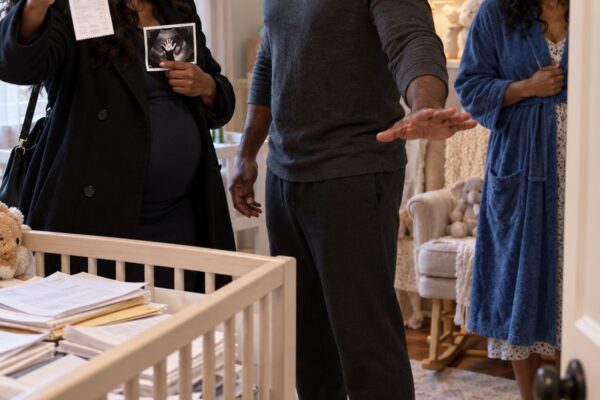
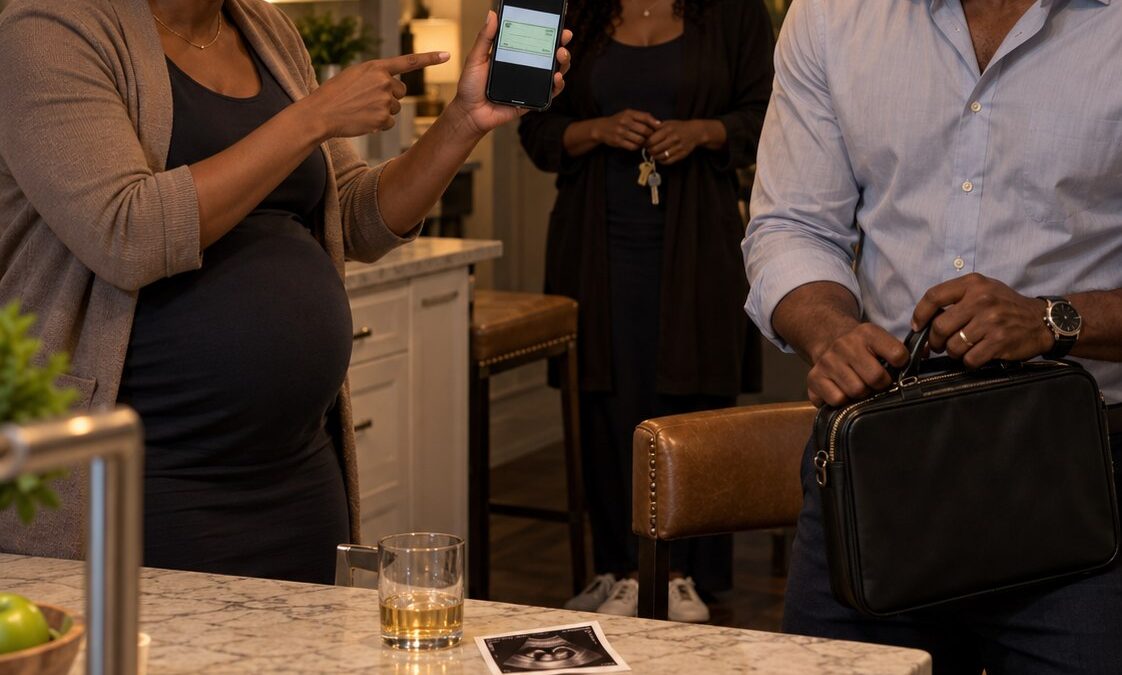
I took the ultrasound from my pocket and laid it beside my glass.
Reid looked at it again.
“She has your nose,” he said.
“That can wait.”
His hand fell.
“Tell me about the check.”
“It hasn’t gone anywhere,” he said.
“Who wrote my name?”
Tessa stared at the floor.
Reid answered.
“I did.”
His voice shook on the last word.
I looked at the signature again.
It had the uneven capital I had used since childhood.
Reid had signed our holiday cards for years.
He had practiced without telling me.
“Why?” I asked.
“To buy us time.”
“From whom?”
“From the bank.”
Tessa stepped forward.
“Reid.”
He ignored her.
“We missed a covenant,” he said.
“What covenant?”
“The credit line requires a cash balance at quarter’s end.”
I knew that agreement.
I had signed it.
We were nowhere near the limit he described.
“The balance is healthy,” I said.
“It isn’t.”
Tessa lifted her chin.
“Cash came in late.”
“From six clients?”
“More than six.”
“Then show me.”
“I can,” Reid said.
He made no move toward his phone.
I watched Tessa instead.
She was studying the ultrasound.
A small crease appeared between her eyes.
I had seen that look in conference rooms when she noticed a change to a presentation.
She wasn’t worried about the baby.
She was adjusting a plan.
“My daughter will inherit this company someday,” I said.
Reid flinched.
“Of course she will.”
I pointed at the briefcase.
“Is that why you used my mother’s carbon forms?”
Tessa’s hand closed around her keys.
Reid turned toward her.
“You told me those were blank.”
“They were.”
“Not the bottom sheets,” I said.
The paper I had seen beneath the envelope was white, not green.
My mother used white carbon sheets to leave a copy in her desk.
She numbered them in pencil.
I had done the same after she died.
Reid looked at Tessa.
“What number was on that one?”
“Does it matter?”
“It does to her.”
Tessa said nothing.
A faint ache tightened across my abdomen.
I gripped the counter until it passed.
Reid noticed.
“Are you all right?”
“I need my doctor’s number.”
He handed me my phone without being asked.
That gesture hurt more than I expected.
I called the clinic from the hall.
The nurse listened, asked a few questions, and told me when to come in if the discomfort continued.
I returned to the kitchen.
Reid had not touched the briefcase.
Tessa had.
The zipper sat an inch farther open.
“I’m going upstairs,” I said.
“June,” Reid began.
“Both of you leave.”
He looked at Tessa.
For once, she could offer him nothing.
After they went, I called the bank’s business fraud line.
I gave the check number.
The specialist confirmed it had not cleared.
She placed a stop on that number and flagged the account for review.
Then she asked me to read the number beneath the payee.
I did.
There was a pause.
“That’s an account at our bank,” she said.
“Whose?”
“I can’t give you another customer’s information over this call.”
“Is it Whitaker Design?”
“No.”
“Is Reid Whitaker on it?”
Another pause.
“Please visit the branch with identification in the morning.”
I asked whether someone could move money overnight.
The check was stopped, she said.
Other activity needed review.
I thanked her and called our outside accountant.
At eleven, she arrived with a laptop and a coat thrown over her pajamas.
Mina Patel had audited us since my mother was alive.
She took one look at the green check in my photograph.
“Who signed for you?”
“Reid says he did.”
“Did he tell you why?”
“He says we’re short of cash.”
Mina opened the read-only financial reports she had requested for Monday’s meeting.
She checked the balance.
Then the credit line.
Then the list of payments scheduled for release.
“This check is not for a contractor,” she said.
The payee field said Larkstone.
The account number belonged to a newly created holding account.
Someone had entered it as an internal transfer destination.
“Why make it look like a contractor payment?” I asked.
“So you wouldn’t ask where it went.”
Mina turned her screen toward me.
The transfer had a note attached.
BOARD RESERVE.
My mother had used those words for money held aside before a large acquisition.
We had no acquisition planned.
I looked at the date on the entry.
It had been created the morning of my scan.
Mina clicked the user history.
Tessa had entered the transfer.
Reid had approved it.
A third approval waited.
Mine.
The forged check was only one route.
They had prepared a digital request as well.
Mina scrolled farther.
A folder appeared beneath the transaction.
Its title was MONDAY.
Inside was a draft board resolution.
It proposed placing Whitaker Design into a managed sale.
The stated reason was my “temporary medical incapacity.”
I read the sentence twice.
Then I understood why Tessa had studied the ultrasound.
The check was cover.
The sale was the plan.
* * *
By morning, the pain had stopped.
I went to the clinic anyway.
The nurse checked me.
The doctor reassured me and gave me clear instructions for what to watch.
Our daughter turned away from the screen.
I almost laughed.
“She’s stubborn,” I said.
The doctor smiled.
Outside, I sat in my car for five minutes.
I called my attorney.
Then I drove to the bank.
My mother’s old desk key pressed against my palm inside my coat pocket.
The branch manager led me into a small office.
Mina joined us by video.
My attorney, Eleanor Cho, sat beside me.
The manager confirmed that the check was stopped.
She could not disclose another customer’s private account details simply because I asked.
She could review whether our company had authorized the transfer.
We had not.
Eleanor gave her the operating agreement and our current signature card.
The manager compared them with the image I had taken.
“That signature needs examination,” she said.
“Reid admitted making it,” I answered.
“Please put that in a written statement.”
I did.
Then I asked about the second account number.
The manager explained that it had been entered into our payment system as a destination for an internal reserve.
Her staff had not created that label.
Someone at our company had.
“Can you stop any pending transfers to it?” Eleanor asked.
The manager checked the account.
“Yes.”
She made the call while we sat there.
No money had left through that route.
That was good news.
It was not enough.
Mina had found four earlier payments to Larkstone.
Each was under the threshold for my signature.
Together, they totaled $184,000.
We took the statements back to Eleanor’s office.
Mina traced the entries to vendor records Tessa controlled.
The invoices described installation work at three offices.
Two offices had no installation scheduled.
The third had closed last year.
Eleanor told me to leave the original records alone.
She arranged for a forensic accountant to preserve copies with access logs.
We would not accuse anyone in a board meeting with a photograph and a feeling.
We would bring records someone else could verify.
At noon, Reid called.
I let it ring.
He sent a message.
I didn’t know about the resolution.
A second came two minutes later.
Tessa said it was only in case you needed leave.
I put the phone on Eleanor’s desk.
“Do I answer?”
“Only if you want to,” she said.
I typed one sentence.
Communicate through Eleanor about company matters.
Reid replied at once.
What about us?
I did not answer that.
Eleanor reviewed the resolution.
Our board had five seats.
I held three votes through a trust my mother had created.
The trust had transferred to me on my thirty-first birthday, two months earlier.
Reid knew my mother had given me control eventually.
He seemed to believe the trustees still voted for me.
I had not corrected him while Mina reviewed the books.
I had wanted a clean account of his decisions.
Now I had one.
“Could they pass the sale?” I asked.
“Not without your votes,” Eleanor said.
“They think they can.”
“They can embarrass you.”
“They wrote that I’m incapacitated.”
“That claim has no support.”
I touched the edge of the ultrasound in my bag.
“I went to one appointment alone.”
Eleanor’s voice softened.
“That is not evidence of incapacity.”
The forensic accountant arrived after lunch.
His name was Daniel Price.
He asked ordinary questions.
Who entered vendors?
Who approved payments?
Who could edit the board packet?
He copied the payment history and recorded where each file came from.
Mina showed him the four invoices.
Daniel found the same spelling error in each address.
“Can you tell who owns Larkstone?” I asked.
“Public records may tell us who registered it,” he said.
He searched.
The company existed.
It had an office address in a building across town.
Its registered agent was a service company.
That told us little.
I recognized the suite number.
Tessa’s brother had rented a studio there for years.
I had attended his opening party.
I gave Daniel his name.
He checked the tenant directory.
The brother had moved out eighteen months ago.
Larkstone had moved in the following week.
That connection warranted a closer look.
It did not prove who received our money.
Daniel requested the vendor onboarding file.
Tessa had approved it herself.
She had attached a tax form.
The form carried a signature that looked like the brother’s.
I called him with Eleanor beside me.
He answered on the third ring.
“Did you start a company called Larkstone?” I asked.
“No.”
“Did you sign a tax form for it?”
“No.”
He went quiet.
“Tessa said you might call,” he said.
“What did she tell you?”
“That you were having trouble at work.”
He asked me to email the form to his attorney.
Eleanor sent it.
Twenty minutes later, his attorney confirmed that he disputed the signature.
The lie had reached into Tessa’s family.
That evening, I went to my mother’s desk.
I unlocked the bottom drawer.
The carbon box sat beneath old project sketches.
The top sheet had been torn away.
The pencil number on the next sheet was 041.
So the missing sheet was 040.
I remembered signing out that key to Reid when he helped clear the office after my mother’s death.
I had never asked for it back.
The drawer also held her ledger.
On page 040, beneath a note about spare forms, she had written one line.
KEEP COPIES IF TESSA EVER ASKS.
I read it again.
My mother had been dead six years.
Tessa had been in my kitchen last night.
* * *
I took the ledger to Eleanor the next morning.
She examined the page.
My mother’s handwriting was familiar, but the note had no date.
It could mean several things.
I wanted it to mean one.
Eleanor would not let me choose.
“Who else knew she kept this ledger?” she asked.
“Her office manager.”
“Call him.”
Mr. Bell had retired to a town two hours west.
He remembered the carbon forms immediately.
My mother had ordered them when electronic approvals were still new.
They let her compare handwritten requests with the final entries.
“She watched details,” he said.
“Why did she mention Tessa?”
He hesitated.
“Tessa asked for a job before you hired her.”
I sat straighter.
“How long before?”
“About a year.”
“She never told me.”
“Your mother declined.”
“Why?”
“She caught Tessa copying a client list during the interview.”
The room seemed to tilt.
Mr. Bell continued carefully.
Your mother had asked her to leave.
She had told Mr. Bell to watch for future requests made in Tessa’s name.
After my mother died, Tessa had come to me.
She brought food when I could not make myself cook.
She stayed.
A year later, I hired her.
I had believed the choice was mine alone.
We thanked Mr. Bell.
Eleanor asked him to write down what he remembered and send any surviving records.
He found an old interview calendar and a note my mother had filed afterward.
They supported his account.
They did not prove current fraud.
Daniel kept working.
He obtained company records showing that Larkstone’s business address had been paid for with Tessa’s personal card.
The payments passed through a management service.
Reid’s name appeared nowhere.
That afternoon, someone canceled our company’s health insurance payment.
Payroll discovered it when an automatic notice arrived.
The payment had been scheduled.
Now it was marked “hold.”
Thirty-eight employees depended on that plan.
I called our payroll manager.
“Can you release it?”
“I need an authorized officer.”
“I am one.”
“Tessa removed your approval access.”
I closed my eyes.
“When?”
“Yesterday morning.”
Eleanor heard the answer.
She contacted the provider.
I signed the payment authorization directly, and the coverage remained in place.
Daniel preserved the change log.
Tessa had removed my access two hours after I found her in the kitchen.
That was a present act.
A deliberate one.
Reid called while I was signing the forms.
This time, I answered.
“The insurance payment,” I said.
“I didn’t touch it.”
“Tessa did.”
“I told her to leave the staff alone.”
“You told her?”
“She isn’t listening to me.”
That was the first honest thing he had said.
“Come to Eleanor’s office,” I said.
“Will you be there?”
“Yes.”
“Will she?”
“No.”
He arrived with dark circles under his eyes.
He looked at my stomach before he looked at me.
I pulled out a chair.
“Tell me how this started.”
“She showed me a margin report,” he said.
“She said we were losing money.”
“Were we?”
“Not like she said.”
He had approved the first false invoice because Tessa promised to reverse it before year’s end.
Then there was another.
After that, she had copies of his approvals.
He said she threatened to show me everything.
“That isn’t an excuse,” he added.
“No.”
“I signed the checks.”
“Yes.”
“I knew the invoices were false.”
Eleanor took notes.
Reid watched her write.
“She said your mother ruined her father,” he said.
I looked up.
Tessa’s father had once owned a small design firm.
It failed when she was seventeen.
I knew that much.
“Did she say how?”
“She said your mother took his biggest client.”
My mother had competed hard.
She had also kept every rejected proposal.
I could check that history.
“Why the sale?” I asked.
“She has a buyer.”
“Who?”
“Larkstone’s backer.”
He looked at Eleanor.
“I never met them.”
“What would you get?” I asked.
“A position.”
“And Tessa?”
“Enough money to buy the company’s residential division.”
I considered the office where my mother had worked until the night before she died.
The staff whose insurance Tessa had tried to interrupt.
Our daughter’s image, tucked inside my bag.
Reid leaned forward.
“She planned the timing,” he said.
“She knew you’d be at the scan.”
My hands stayed still.
“Why tell me now?”
“Because she told me to say you’d been confused for months.”
He had refused that part, he said.
I wanted to believe him.
I believed only that he was frightened.
Daniel called before Reid left.
He had found the buyer.
A private investment group had submitted a letter of interest.
The contact name was Tessa’s father.
The offer was contingent on a distressed sale.
Tessa had built the distress herself.
* * *
Monday’s board meeting began at nine.
I arrived with Eleanor, Mina, and Daniel.
Reid sat at the far end of the table.
Tessa sat beside him.
Her presentation was already on the screen.
A photograph of our headquarters filled the first slide.
It made the building look tired.
She had cropped out the courtyard my mother planted.
I took my usual seat.
Tessa greeted the board.
Her voice was steady.
She gave them the cash report she had prepared.
It showed a company near failure.
She described unpaid vendors.
She described weak controls.
She described a founder’s daughter struggling to manage both pregnancy and a complex business.
I let her finish.
One board member, Mrs. Vale, asked whether I wanted to respond.
“Yes.”
Tessa raised a hand.
“I think June deserves privacy.”
I looked at her.
“Then stop discussing my health.”
Reid stared at the table.
Tessa pressed on.
She said the sale would protect employees.
She said Larkstone’s investor could move fast.
She said delay would cost jobs.
Two directors looked uneasy.
Her numbers were convincing.
Mina opened her own report.
Every figure Tessa had used came from the same ledger.
Mina showed the board what had been left out.
Client deposits due that week.
A renewed contract signed Friday.
Four payments to a vendor with no completed work.
Then the held health insurance payment.
Tessa folded her arms.
“Accounting disagreements happen.”
“Not usually in vendor addresses,” Daniel said.
He placed copies of the invoices on the table.
Each listed a different work site.
Each used the same incorrect suite number for Larkstone.
Tessa leaned forward.
“You brought in a stranger to accuse me?”
“I brought in an accountant,” I said.
“He has a report.”
Daniel explained his methods.
He had preserved copies, checked access logs, and compared them with bank records.
He did not claim to know what Tessa thought.
He showed what her account had done.
She had created Larkstone as a vendor.
She had approved the invoices.
She had entered the new reserve account.
She had removed my payment access.
Tessa turned to Reid.
“Say something.”
He lifted his head.
“I signed the false approvals.”
The boardroom went still.
“I knew they weren’t real,” he said.
Tessa gave a sharp laugh.
“He’ll say anything to save his marriage.”
I did not correct her.
The marriage could wait.
The company could not.
Eleanor passed out the bank’s written confirmation.
The green check had been stopped before deposit.
The reserve transfer had not gone through.
The four earlier vendor payments had cleared.
The bank had opened its own fraud review.
Tessa examined the letter.
“It proves a check was stopped,” she said.
“Nothing more.”
“Look at the attachment,” I said.
The bank had supplied the image of the check presented for processing.
My forged signature sat beneath Reid’s.
The white carbon sheet was still attached along one edge.
Its pencil number showed through.
040.
I put my mother’s ledger beside it.
Tessa’s face changed.
Only briefly.
Mrs. Vale noticed.
“What is that?” she asked.
“My mother kept numbered copies.”
Tessa recovered.
“A number doesn’t show I touched it.”
“No,” I said.
I had learned from Eleanor.
I would state what the record proved.
“The paper came from her locked desk.”
Reid spoke.
“I gave Tessa the key.”
Tessa turned toward him.
“You handed me a drawer key.”
“I saw you take the form.”
“Then why didn’t you stop me?”
He had no answer.
Mr. Bell joined by video.
He identified the ledger and explained the old carbon system.
He also described Tessa’s earlier attempt to copy a client list.
Tessa objected that a decades-old interview had nothing to do with today.
On that point, she was right.
The directors needed today’s evidence.
Daniel gave it to them.
He showed the account log for the canceled insurance payment.
He showed the Larkstone onboarding file.
Then Eleanor read a statement from Tessa’s brother.
He disputed the signature on its tax form.
Tessa said he was mistaken.
She offered to bring him in.
Eleanor said his attorney was available to speak with investigators.
Tessa looked around the table.
“You’re letting June turn a family crisis into a trial.”
Mrs. Vale met her eyes.
“You put her family in the board packet.”
Tessa pulled her presentation from the screen.
“Fine,” she said.
“Reject the offer.”
“Then watch your employees pay for it.”
I stood.
“They already nearly did.”
I asked the board to remove Tessa’s access immediately, place Reid on leave, and refer the records to counsel and the authorities.
The two directors outside my voting trust agreed.
The vote was unanimous.
A company security officer waited at the door.
He asked for Tessa’s badge.
She set it on the table.
As she passed me, she stopped.
“Your mother took everything from my father.”
I kept my voice level.
“Then you should have brought me the records.”
She had none.
Weeks later, we found my mother’s file.
Tessa’s father had lost a major client after his firm billed for work it had not completed.
The client had asked my mother’s firm to review the project.
She documented what she found.
She had not caused the missing work.
Investigators took over the fraud case.
Reid and Tessa hired attorneys.
The bank pursued the cleared payments.
The company sued for recovery.
None of it happened in one dramatic afternoon.
There were interviews.
Copies of records.
Long waits.
Reid eventually admitted his role and agreed to repay what he could.
Tessa disputed the charges for months before entering a plea to financial fraud.
Their sentences and restitution orders came the following year.
By then, our board packet showed something she had never expected.
Whitaker Design was solvent.
* * *
I moved out of the house in June.
The baby came in August.
We named her Wren.
She had Reid’s dark hair and my mother’s serious expression.
For the first month, I watched her sleep whenever I should have slept myself.
My sister brought meals.
Mrs. Vale brought tiny socks.
Mina arrived with a spreadsheet of volunteer shifts.
I told her the columns were excessive.
She added a column for my objections.
It was the first time I laughed in weeks.
Reid met Wren at the hospital.
I had agreed to that before she was born.
He held her for twenty minutes.
He asked whether he could come again.
“Yes,” I said.
“We’ll arrange it.”
He nodded.
He had learned not to treat a yes as ownership of the next one.
Our divorce took time.
So did the custody agreement.
We set visits that fit Wren’s needs and his legal obligations.
I wanted her to know her father honestly.
I would not teach her that love erased what he had done.
One afternoon, while she slept in her stroller, Reid met me at a café near the office.
“I’m sorry,” he said.
He had apologized before.
This time, he did not attach a reason.
“I believed I could fix it before you found out.”
“That was part of it,” I said.
“I know.”
He watched the stroller.
“I’m sorry I used your mother’s name.”
“And mine.”
“And yours.”
I thanked him for saying it.
I told him we could discuss Wren’s schedule through the arrangement we had made.
He did not ask for more.
At work, I changed our approval system.
Two people still reviewed large payments.
Their authority came from separate teams.
Vendor details were checked before a first payment.
Mina trained the staff.
Daniel helped us close the gaps he had found.
I did not enjoy reading his final invoice.
He did not pretend I would.
We recovered some money.
Insurance covered part of the loss after review.
The rest came slowly through restitution and a civil settlement.
The company survived because its actual clients had stayed.
A few asked hard questions.
I answered them.
One offered a contract extension before I finished.
Our employees kept their coverage.
No one missed a paycheck.
In November, the board offered me a larger bonus for guiding the company through the crisis.
I asked them to fund paid family leave for every employee instead.
Mrs. Vale checked the numbers.
We could afford both.
I took the standard bonus.
We adopted the leave policy.
That choice would have delighted my mother.
It also made practical sense.
People did better work when they could care for their families.
On a cold Friday, I returned to the house to collect the last box from my office.
Reid had already moved out.
The kitchen island was bare.
I stood where I had stood with the ultrasound in my hand.
The floorboard near the sink still creaked.
I had forgotten that sound.
Eleanor arrived to help carry files.
She found me looking at the counter.
“You can keep the house,” she said.
“I know.”
“Do you want to?”
I looked through the window.
The yard held a maple my mother had planted when I bought the place.
Wren would have room to play.
“Yes.”
“Then keep it.”
She picked up a box.
Inside was the old carbon ledger.
I had been carrying it between offices for months.
Eleanor asked whether I wanted it stored with the case records.
“After we make a proper copy,” I said.
She nodded.
The original went into a safe at work.
I kept a copy of page 040.
I wanted Wren to have my mother’s sketches someday.
I did not need to hand her every wound with them.
That winter, Reid asked whether he could attend Wren’s first birthday.
It was months away.
He asked early because he knew the answer was mine to give.
“Yes,” I said.
“As her father.”
He understood the boundary.
For the first time, I believed he would respect it.
* * *
Five years later, Wren spread paper across the kitchen island.
She was drawing a building for ducks.
It had a lobby.
It had a pond.
It had a very large elevator.
I asked why ducks needed an elevator.
“For their groceries,” she said.
I accepted the answer.
The old green check lay beneath a sheet of glass in my office downtown.
It belonged to the case archive now.
Nobody used carbon forms at Whitaker Design.
Our staff knew the story in pieces.
They knew why approvals were checked.
They knew why employees could take leave when a child was sick.
They did not need to know what my husband had said beside that island.
Wren would learn the truth when she was old enough to ask for it.
Reid saw her every week.
He came on time.
He listened when she spoke.
Our marriage had ended.
Their relationship had not.
Tessa paid restitution under the court’s order.
I had seen her once after sentencing, across a courthouse hall.
She did not speak to me.
I did not need her to.
The maple outside the kitchen window had grown taller than the roof.
Wren held up her drawing.
“Will they build it?”
“The ducks?”
“The people you work with.”
“Maybe if you give them a budget.”
She frowned.
“How much?”
I looked at the improbable elevator.
“More than you think.”
She fetched another sheet of paper.
I opened the drawer for a pencil.
Inside lay her first ultrasound.
The paper had faded.
Her hand was still visible against her cheek.
For years, I had remembered bringing it home and finding the check.
Now I remembered something else.
I had brought home our daughter’s first portrait.
Reid had reached for it.
I had kept it safe.
Wren climbed onto the stool beside me.
“Can I see?”
I placed the picture in her hands.
She studied it with great care.
“That’s me?”
“That’s you.”
“I was tiny.”
“You were.”
She set it beside her drawing.
Two pictures on the island.
One child, still becoming herself.
Outside, the maple leaves moved in the afternoon light.
Wren picked up her pencil.
“Tell me about the ducks,” I said.
She did.
THE END