The Little Girl Saw Her Missing Brother on Her Aunt’s Security Screen… Then Someone Opened the Door Behind Him
Chapter 2: The Traveling Sky
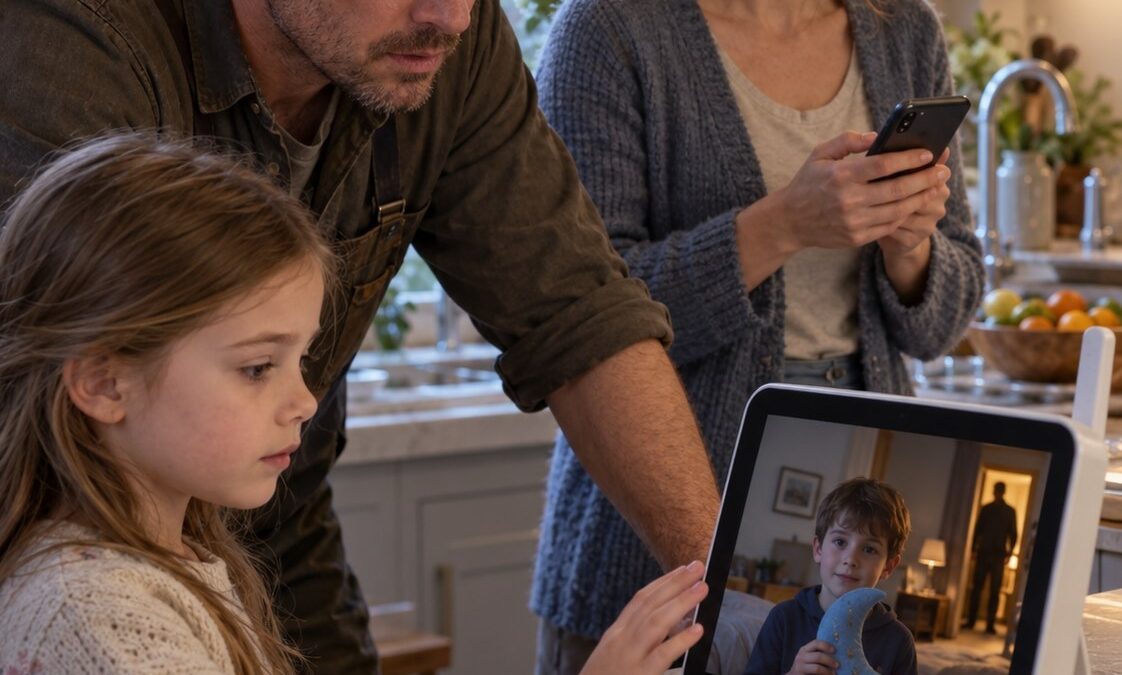
Miles struck the microphone button.
“Benji!”
The figure on the screen did not turn.
A broad shoulder filled the view.
Then a hand covered the camera.
The picture went blue.
Iris made a small sound.
Tessa caught her before she reached the counter.
Miles took out his phone.
He dialed 911.
Tessa held out her own phone.
“Use mine, too.”
He did not take it.
The dispatcher answered.
Miles gave his name.
He gave Tessa’s address.
“My missing son is on a live security feed,” he said.
“I can see him.”
The dispatcher asked whether the child was in the house.
“We’re finding that out.”
Tessa enlarged a line of text beneath the blue screen.
UNIT 6.
HOLLOWAY SERVICE ROAD.
She read the address aloud.
The dispatcher repeated it back.
“Officers are being sent to both locations,” she said.
“Stay on the line.”
Miles knew Holloway Service Road.
It ran behind the old county hospital.
The laundry building there had closed in spring.
He had maintained its freight elevator until the contract ended.
He remembered its dented steel gate.
He remembered standing there with Benji once, waiting for a ride home.
“Unit Six is across town,” he told the dispatcher.
Tessa gripped the counter.
“I didn’t know.”
Miles looked at her.
“What did you know?”
“That a camera had appeared on our system.”
“When?”
“Wednesday morning.”
“Today is Friday.”
“I thought it was an old recording.”
“You told me you found it two days ago.”
“I did.”
The dispatcher asked Miles to keep the screen visible.
A second camera tile appeared.
It showed a corridor.
Its ceiling lights were on.
Someone had opened a door at the far end.
Tessa moved closer.
“Graham manages a storage company,” she said.
“He bought the hospital’s old service buildings last year.”
Miles felt the floor seem to shift under him.
Graham had helped search for Benji.
He had paid for the flyers.
He had stood beside Miles at a press conference.
Miles remembered the weight of Graham’s hand on his shoulder.
He remembered believing it meant they were looking in the same direction.
“Give the dispatcher his name.”
Tessa did.
Then she called Graham.
He answered on the second ring.
“Where are you?” she asked.
Miles could hear his voice.
“In the car.”
“Don’t hang up.”
“What happened?”
“The camera from Holloway is on our kitchen screen.”
A pause followed.
Miles watched the blue square.
Graham said, “I’m coming home.”
The call ended.
Tessa stared at her phone.
“He sounded afraid.”
“So is Benji.”
Miles took his coat from a chair.
The dispatcher heard him.
“Mr. Kellan, officers are close to the service road.”
“I know that building.”
“Tell me what you know.”
He described the two entrances.
The main loading gate had a motor lock.
The old laundry ramp had a manual release.
Its lever sat inside a gray cabinet near the door.
He had repaired it twice.
“Please give that to the officers,” he said.
The dispatcher asked him to stay at the house.
Miles looked at the blue screen.
There was no picture.
His son might still be beside that cot.
He might already be somewhere else.
Iris slipped her hand into his.
“Dad, they know the door now.”
He knelt.
Her fingers were cold.
“I’m staying until the officers get here.”
Tessa pulled a blanket from the breakfast nook.
She wrapped it around Iris’s shoulders.
Iris looked up at her aunt.
“You should have told us.”
“I should have.”
No one softened the words.
A patrol car turned through the front gate.
Two officers came up the path while Miles was still on the phone.
He opened the kitchen door before they knocked.
“Is the feed live?” one asked.
“It was.”
Miles showed them the address.
The other officer spoke into his radio.
He repeated Miles’s instructions about the ramp.
Then he asked Tessa for the security account’s login.
She wrote it on a grocery receipt.
Her hand shook enough to tear the paper.
The officer took it gently.
At the same time, the corridor camera flickered back.
A person crossed it carrying a small bundle.
Miles stepped close enough to see the blue moon hanging over one hand.
Then the person came into focus.
It was a woman in a hospital jacket.
She held Benji against her shoulder.
He was awake.
His eyes followed the camera.
Miles touched the screen.
The woman looked up.
A radio sounded near her collar.
An officer had found him.
“Can you ask if he’s hurt?” Miles said.
The dispatcher passed the question along.
They waited while the woman disappeared from the corridor view.
A voice answered over the officer’s radio.
The boy was speaking.
He was walking with help.
They were taking him for medical care.
Iris began to cry.
Miles put both arms around her.
For the first time in forty-seven days, he let himself say it aloud.
“Your brother is coming home.”
* * *
They brought Benji to the emergency department where Miles worked.
A doctor examined him behind a curtain.
Miles waited outside while the doctor asked Benji a few questions alone.
It was the longest ten minutes of the night.
When the curtain opened, Benji held a paper cup of water.
He was tired and hungry.
He had a cough that needed watching.
The doctor said he could stay overnight for observation.
Miles sat where Benji could see him.
Iris occupied the chair beside the bed.
She had brought her blanket from Tessa’s kitchen.
Every few minutes, she touched Benji’s sleeve.
He never pulled away.
A nurse brought crackers and a second cup of water.
Benji broke one cracker in half.
He handed the larger piece to Iris.
She gave it back.
“You eat it.”
“You always take the big one.”
“Today you can.”
Miles looked away while Benji ate.
He had imagined feeding his son for weeks.
He had never imagined how hard a packet of crackers would be to watch.
Tessa waited outside with a detective named Maren Cho.
Maren had led the missing-person investigation since the first week.
She entered only after Benji agreed.
“Would you like me to come back tomorrow?” she asked.
Benji considered it.
“Can I tell Dad first?”
“Of course.”
Maren stepped out.
Miles waited.
Benji studied the felt moon in his lap.
“I took it off my backpack,” he said.
“I saw.”
“I thought you would know it.”
“I did.”
Benji ran his thumb over the loose stitching.
“The woman who brought my food said somebody would come.”
“Did she hurt you?”
“No.”
Miles held his hands together.
“Did you know her name?”
“Ruth.”
“Did you know where you were?”
“There was a big door.”
Benji glanced toward the hospital hallway.
“It sounded like the elevator here.”
Miles remembered the old laundry lift.
Its gate struck the frame with a hollow ring.
He had heard that sound thousands of times.
“Who took you there?” he asked.
Benji looked at him.
“Uncle Graham.”
Iris turned in her chair.
Tessa was Graham’s wife.
Their children were grown.
For years, Graham had hosted the Kellan family every Thanksgiving.
He had taught Benji to skip stones at the lake.
Miles reached for the rail of the bed.
It was cool beneath his palm.
He held it until his fingers steadied.
Benji watched his face.
“I told him I saw the car.”
“What car?”
“The one by the lake.”
Miles thought of the soccer field.
There was a narrow road between the field and the water.
On the day Benji vanished, a delivery driver had been found injured beside that road.
The driver, Aaron Pike, had survived.
He remembered a dark vehicle but no plate.
Police had investigated a hit-and-run.
Miles had learned about it from a news report.
He had never connected it to Benji.
“Tell me what you saw,” he said.
Benji looked at the doorway.
“He said nobody would believe me.”
“Tell me anyway.”
Benji gripped the moon.
“I went back for my bottle.”
“My blue one.”
“I remember.”
“I heard tires on the road.”
A gray SUV had come around the bend.
It struck the delivery driver.
The driver fell near the ditch.
Benji had been behind the fence.
He saw Graham get out.
He saw him look toward the driver.
Then Graham saw Benji.
“I thought he was going to help,” Benji said.
Miles felt his hand tighten on the rail.
“Did he?”
“He called somebody.”
“An ambulance?”
“I don’t know.”
“He told me to get in the car.”
Benji’s voice thinned.
“He said the road wasn’t safe.”
Miles had taught him to ask for help from people he knew.
Graham was family.
Benji had gotten in.
Miles could hardly bear that part.
“You did what any kid might have done.”
Benji rubbed the felt moon.
Graham had driven him to Holloway.
A woman named Ruth brought food and books.
Graham came three times.
He told Benji that the driver was fine.
He said Miles would be blamed if Benji talked.
“Why would he say that?” Miles asked.
“He said you fixed his car.”
Miles looked up.
Three weeks before Benji vanished, Graham’s SUV had needed a lift repaired.
Miles had borrowed a shop bay after hours.
He had replaced a jammed rear hatch motor.
Graham had insisted on paying cash.
Miles had kept the receipt in his work notebook.
The repair had happened before the crash.
Graham had changed what it meant for Benji.
“I fixed a hatch,” Miles said.
“You didn’t do anything wrong,” Benji whispered.
“I know.”
Benji’s eyes stayed on him.
Miles moved his chair closer.
“You don’t have to keep his story straight anymore.”
“I couldn’t tell Ruth?”
“You can tell anyone now.”
Benji nodded once.
Then he tucked the moon into Miles’s hand.
Miles held it while his son rested.
Maren returned with a nurse.
The nurse checked Benji’s temperature.
Then Maren sat by the curtain.
She listened while Benji repeated what he could.
She stopped when he grew tired.
Before leaving, she asked about the woman in the hospital jacket.
“Ruth brought me here,” Benji said.
“She said the police were outside.”
Maren nodded.
“Her full name is Ruth Calder.”
“She came out when officers arrived.”
Benji looked relieved.
“She told me to bring the moon.”
Miles glanced toward the doorway.
Tessa stood on the other side of the glass.
She was speaking into her phone.
She looked as though she had aged during the drive.
Maren followed his gaze.
“Your sister has given us access to the security system.”
Miles nodded.
“There’s something else.”
He described Graham’s hatch repair.
He gave Maren the date.
He told her about the receipt.
She wrote it down.
“It may help establish the vehicle’s history,” she said.
“Will you find him?”
“We’re looking for him now.”
Miles looked at Benji.
His son had fallen asleep with the moon beneath his cheek.
For forty-seven days, Miles had searched for a stranger.
The person he needed to fear had helped him search.
* * *
Graham’s SUV was found at his company office before midnight.
Graham was not there.
Maren called Miles with the news.
She had no warrant to search every building Graham owned.
She did have Benji’s account.
She had Ruth Calder’s statement.
Officers were securing the laundry building.
They would ask a judge for the records and searches they needed.
Miles sat beside Benji’s bed.
He repeated the call to Tessa.
She stood near the window with Iris asleep against her.
“I gave them every code,” she said.
“Every camera account.”
“Good.”
Tessa looked at him.
“I saw that room Wednesday.”
“I know.”
“I thought it was part of Graham’s storage system.”
Miles said nothing.
“On Thursday, I saw the blue patch,” she continued.
“I told myself it could belong to anyone.”
“And today?”
“Today I asked you to bring Iris.”
Miles could not make those three days disappear.
“Why?”
“I knew she would recognize it.”
“You recognized it.”
Tessa’s eyes filled.
“Yes.”
She adjusted the sleeping child in her arms.
“I was afraid Graham would see me open the feed.”
“You could have called Maren.”
“I should have.”
Miles took Iris from her.
He laid his daughter on the empty bed beside Benji.
The children turned toward each other in their sleep.
Tessa watched them.
“I will tell the detective all of it.”
“Tell her why that camera was on your screen.”
“I intend to.”
She paused at the door.
“There’s a log of who signed in.”
“Give her that, too.”
“I already did.”
Miles nodded.
It was the first useful answer Tessa had given him without being pressed.
In the morning, Maren visited with new information.
The camera had been added to the home system through Graham’s account.
He had used the same company to install cameras at his office and at Tessa’s house.
A technician confirmed the connection from installation records.
Ruth had given officers the key to the room.
She said Graham hired her to care for Benji.
He claimed the boy’s family was in danger.
He told her a legal dispute would be settled soon.
Ruth had asked to speak to Miles.
Graham refused.
When she learned police were at the building, she opened the room and brought Benji out.
“Will she be charged?” Miles asked.
“That decision belongs to prosecutors,” Maren said.
“Her cooperation matters.”
Miles thought of the meals she had carried through a locked door.
He was grateful she had opened it.
He wished she had opened it sooner.
Maren had also reached Aaron Pike.
The injured driver remembered the gray SUV’s shape.
He remembered a bright white scrape along its rear door.
He had seen it as the vehicle stopped.
Graham’s SUV had been examined overnight.
Maren could not share the results yet.
“We need independent records,” she said.
“Traffic cameras, toll records, repair records.”
“I have my receipt.”
“That helps.”
Miles went home while Tessa stayed with the children.
The house smelled stale.
He had left a plate in the sink Friday morning.
A paper chain Iris made for Benji’s birthday hung across the living room.
His birthday had passed while he was missing.
Miles opened the notebook where he recorded repairs.
He found Graham’s receipt.
March 6.
Rear hatch motor replaced.
A sketch beside it showed the old part’s serial number.
Miles had drawn it because the replacement box carried a different number.
The shop’s camera might have recorded the SUV leaving that night.
He called the owner.
The owner still kept ninety days of video.
Miles asked him to save March 6.
Then he opened the folder of photographs police had given back.
The soccer field.
The bleachers.
Benji’s backpack in an evidence bag.
Miles stopped on the last image.
A small white scrape marked the gray metal railing behind the bag.
He zoomed in.
The scrape was low.
Fresh paint lay along its edge.
The rail stood near the path to the lakeside road.
He sent the image to Maren.
She called within minutes.
“Who took this photograph?”
“An officer at the scene.”
“The original is in our system.”
“I thought you should see the paint.”
“I’m glad you sent it.”
Miles looked at the date.
Benji vanished on March 27.
His hatch repair was three weeks earlier.
Graham had told Benji that Miles fixed the car after the crash.
The receipt would disprove that part.
Then Miles noticed a second entry on the page.
March 28.
Graham had called about a sticking side door at the office.
Miles had gone there the day after Benji vanished.
He had worked twenty minutes and left.
At the time, Graham had offered to pay for another run of missing-child flyers.
Miles remembered thanking him.
Maren called again that afternoon.
Graham had been found at a lawyer’s office.
He agreed to speak with investigators.
He claimed he knew nothing about Benji’s confinement.
He said his credentials had been used without permission.
Tessa’s name appeared on the account, too.
“Is he blaming her?” Miles asked.
“He is making that claim.”
Miles looked through his notebook again.
On March 28, he had noted the office door’s fault.
The latch plate had been bent from the inside.
Graham said delivery carts caused it.
Miles had drawn its shape.
He stared at the sketch.
He remembered Graham standing behind him while he worked.
The man had asked whether a bent plate could lock someone in.
Miles had told him the door was meant to open from either side.
At the time, it had sounded like a question about building safety.
Now Miles heard it differently.
The laundry room had once stored delivery carts.
Its doors used the same commercial hardware.
Graham had sent him to a building filled with records the day after taking his son.
Miles closed the notebook.
The trap had been set near his own hands.
* * *
Maren did not ask Miles to investigate further.
She asked him to preserve his notebook.
He handed it over after photographing every page.
The shop owner supplied the video of Graham’s SUV.
It showed the rear hatch working normally on March 6.
That was useful for the timeline.
It said nothing about March 27.
Traffic cameras filled part of the gap.
A city camera showed a gray SUV turning onto the lakeside road minutes before Aaron Pike was struck.
Another showed it leaving.
The images were too distant to read a plate.
Graham’s lawyer said many gray SUVs used that road.
He also said a frightened child could have mistaken an uncle for someone else.
Miles heard this through Maren.
He tried to stay with what could be proved.
Benji was safe in his own bedroom now.
Iris slept on a mattress beside him.
Miles slept in the hall the first night.
Both children protested.
He moved his pillow back to his room.
Then Benji asked him to leave the hallway light on.
Miles did.
The next morning, Iris set three bowls on the table.
She had put strawberries in Benji’s.
She had cut the largest one in half.
Benji examined it.
“You gave me two,” he said.
“You were gone for a birthday.”
“That means I get cake.”
“That means I get the biggest slice.”
Miles smiled before he could stop himself.
At noon, someone rang the doorbell.
A courier held out an envelope.
Inside was a letter from Graham’s lawyer.
It asked Miles to stop making public accusations.
It said false statements could harm Tessa’s foundation.
Miles had made no public statement.
He gave the letter to Maren.
He also called Tessa.
“Graham knows I have the notebook.”
“Yes.”
“He’s bringing your foundation into it.”
“I expected him to.”
“Are you prepared?”
Tessa looked at him through the video call.
“I have the board records.”
“About what?”
“Graham charged the foundation for a security installation.”
She had found the invoice after the feed appeared.
It listed cameras at Holloway as “family safety equipment.”
The foundation did not own Holloway.
Graham’s storage company did.
“I asked our accountant to preserve everything,” she said.
“Did you tell Maren?”
“This morning.”
Miles nodded.
Tessa hesitated.
“Iris wants to come here for her painting set.”
“Graham still has a key.”
“I’ve changed the locks.”
“That isn’t what I’m worried about.”
“I understand.”
He would bring Iris himself when officers no longer needed the house.
Tessa accepted that.
There was no argument.
After the call, Miles checked the front lock.
He knew Graham had not threatened to come there.
Still, he had taken Benji from a familiar place in daylight.
Miles put the lawyer’s letter beside his notebook photographs.
He wanted every claim answered by a date.
That evening, Maren called.
Forensic technicians had examined Graham’s SUV.
Paint on the rear door appeared consistent with the marked railing.
Comparison results would take more time.
A damaged trim piece also matched fragments collected from the roadside after Aaron Pike was struck.
Maren spoke carefully.
“Those results need formal review.”
Miles wrote down her words.
He had learned to keep dates.
He had learned that hope could make a person hear more than someone said.
“Has Aaron heard about Benji?” he asked.
“Yes.”
“He wants to know if the boy is all right.”
“Tell him Benji is home.”
“I will.”
Before she ended the call, Maren mentioned one more thing.
Ruth had kept a calendar at the laundry building.
She marked every visit Graham made.
She had also recorded the day he ordered her to move Benji to another room.
It was the day Tessa first opened the feed.
Graham had known someone might see it.
Miles looked toward the hallway light.
“Why didn’t he remove the camera?”
“We’re working on that.”
The answer came the next morning.
The installer had set the camera to record locally as well as stream.
Removing it would leave an outage in the system log.
Graham had asked the installer how to erase that log.
The request was in an email.
Maren read the date.
March 27.
The day Benji disappeared.
* * *
The charges came in stages.
First, Graham was charged in connection with Benji’s confinement.
Later, prosecutors filed charges connected to Aaron Pike’s injury.
The evidence went to court.
The case did not turn on one image.
It rested on Benji’s account, Ruth’s records, the security logs, traffic footage, vehicle evidence, and the statements Graham had made afterward.
Miles learned this from the prosecutor.
He attended the hearings he was allowed to attend.
He did not bring the children.
Tessa sat across the aisle at the first one.
She wore a dark coat.
She did not approach him.
Graham entered with his lawyer.
He glanced toward Miles.
Miles looked back.
For weeks, Graham had stood beside him under posters bearing Benji’s face.
Now Benji was at home.
That fact steadied Miles.
Graham’s lawyer argued that Ruth had misunderstood her instructions.
He said Graham had arranged temporary care for a child in danger.
He said Tessa controlled the house security account.
He said Benji’s memory had been shaped by frightened adults.
The prosecutor presented the account records.
Graham had approved the Holloway camera.
His phone had connected to it repeatedly.
Ruth’s calendar showed his visits.
The court heard enough to keep the case moving.
Afterward, Miles watched Tessa speak to Maren in the hallway.
She opened a folder and pointed to an invoice.
Graham’s lawyer passed them without stopping.
Tessa did not look at him.
Outside, a reporter asked Miles whether he wanted revenge.
“I want the facts heard,” he said.
“And I want my children left alone.”
He went home.
Tessa came by the following Sunday.
She stood on the porch with Iris’s painting set.
The box had a handle shaped like a rainbow.
Iris spotted it through the window.
“Can I get it?”
Miles opened the door.
Tessa knelt and held out the box.
“I cleaned your brushes.”
Iris checked them.
“You missed the green one.”
“I did.”
“It was under the couch.”
“That sounds like it.”
Iris carried the box inside.
Tessa remained on the porch.
“I resigned from the foundation board,” she said.
Miles waited.
“They’re having an outside review of every payment.”
“That’s necessary.”
“I agree.”
“I saw the patch on Thursday,” she said.
“I knew it might be Benji’s.”
Miles looked at her.
“You already told me.”
“I told the detective, too.”
“I’m glad.”
“I wish I could say I was brave.”
Miles thought of the two days between Thursday and Friday.
He thought of Benji waiting in that room.
“I need you to understand what that cost us.”
“I do.”
“Maybe someday the kids can visit again.”
“Only if they want to.”
“And I’ll be there.”
Tessa nodded.
She did not ask for a hug.
She did not offer another explanation.
That made it possible for Miles to speak again.
“Benji asked about you.”
Her face changed.
“What did he ask?”
“Whether you knew where he was.”
“What did you tell him?”
“That you saw the screen before we did.”
Tessa lowered her eyes.
“Did he want me to come in?”
“He said he’ll decide later.”
“I’ll wait.”
Miles closed the door gently.
Weeks passed.
Benji returned to school for half days.
Iris walked with him to the entrance.
She watched until he reached his classroom.
Miles met with teachers about missed work.
They cared more about Benji eating lunch with his friends.
That helped.
On his first Friday back, Benji brought home a folded invitation.
A classmate wanted him at a birthday party.
Benji left it on the table all evening.
At breakfast, he asked Miles whether the party had a back door.
Miles called the classmate’s father.
They talked through the plan with Benji listening.
The father promised to meet them at the front.
Benji decided to go for an hour.
He stayed for two.
Aaron Pike sent a card.
He wrote that he was recovering and glad Benji was home.
Benji drew him a picture of the lake with a wide path around it.
He asked Miles to mail it.
Miles did.
The foundation review found that Graham had billed it for cameras, monthly service, and repairs at Holloway.
The records mattered in court.
They also mattered to Tessa.
She arranged for the foundation to repay the misused funds from her own money while the legal case continued.
Miles learned that from a board notice sent to donors.
He had never asked her to do it.
In summer, Graham pleaded guilty to charges related to Benji’s confinement and the crash.
The court imposed a prison sentence.
Aaron Pike spoke at the hearing.
He described the long recovery and the work he had missed.
Miles spoke about the forty-seven days his children had lived apart.
He kept his hands on the edge of the lectern.
He told the court about the porch light Iris would not let him turn off.
He told them about the first cracker Benji had shared with his sister.
Then he stopped.
There was nothing Graham could say to improve those nights.
Graham listened.
When it was over, Miles drove home.
Iris had made a sign for the kitchen wall.
WELCOME HOME, AGAIN.
Benji had drawn a moon beside it.
Miles taped the sign where both children could see it from the table.
* * *
By fall, ordinary arguments had returned.
Benji wanted the window seat in the truck.
Iris wanted it because she was younger.
Miles said they could alternate days.
Both children announced that this was unfair.
He considered the complaint a good sign.
He worked a regular hospital route again.
The late mortgage payment was behind him.
He still kept a flashlight by his bed.
On some nights, he checked the children’s rooms before sleeping.
Benji knew.
Once, he opened one eye and said, “Dad, I’m here.”
“I see that.”
“You checked five minutes ago.”
“I lost count.”
“That’s what Iris says when she takes my markers.”
Miles laughed quietly.
Benji smiled and rolled over.
Tessa wrote both children letters.
Miles read them first.
She did not ask for visits.
She said she was sorry.
She told Benji she should have called for help when she recognized his moon.
She told Iris she had been right to trust what she saw.
Benji placed his letter in a drawer.
Iris put hers beneath the painting set.
Neither child answered right away.
Miles told Tessa that was their choice.
In November, Iris asked whether Tessa could come to her school art show.
Benji said he did not mind.
Miles called Tessa.
She arrived after the doors opened.
She kept to the back of the room.
Iris showed her a painting of three figures under a yellow porch light.
Tessa studied it.
“Who are they?”
“Us,” Iris said.
“Benji painted the moon.”
Tessa looked toward him.
“May I see?”
Benji stepped closer.
He pointed to the small blue shape in one corner.
“It’s going places again.”
Tessa pressed her lips together.
“It looks that way.”
Afterward, they stood in the school hallway.
Parents carried paper paintings and paper cups of cider.
Tessa asked Miles whether she could take the children for hot chocolate one afternoon.
Miles looked at Benji and Iris.
Iris said yes.
Benji thought longer.
“Could Dad come?”
“Of course,” Tessa said.
The first visit lasted twenty minutes.
They went again the next month.
Tessa listened more than she talked.
She did not ask Benji to reassure her.
That helped him stay.
One afternoon, Benji asked why she had waited.
They were sitting at a small café table.
Tessa set down her cup.
“I was afraid of what it meant,” she said.
“That didn’t help me,” Benji said.
“No.”
He looked at the window.
“I still like seeing you sometimes.”
“I’m glad you told me.”
He did not say anything else.
Tessa let him finish his drink.
That winter, the foundation offered Miles money for the work he had missed.
The offer came through its new director.
Miles accepted reimbursement for documented search expenses.
He asked that the remaining support go to families whose missing-child cases were still open.
The director showed him the proposed fund.
It would pay for travel, printing, and temporary childcare during searches.
Miles reviewed the details with a lawyer.
Then he signed.
He told Benji where the money would go.
“Will it help somebody find their kid?” Benji asked.
“I hope so.”
“Could they use a moon?”
Miles looked at the patch on his son’s desk.
“We can ask what they need.”
Benji considered that.
“Probably flyers.”
“Probably.”
The blue moon stayed with him.
His mother’s uneven silver stitches remained visible along one edge.
Sometimes Benji clipped it to his school bag.
Sometimes he carried it in a pocket.
He no longer needed to keep it where a camera could see.
* * *
Five years later, Tessa sold the house with the security screen.
She invited Miles and the children to visit once before the sale.
Benji was fourteen.
Iris was twelve.
They decided to go.
The kitchen had been emptied.
The screen remained in the wall, switched off.
Iris walked straight to it.
She put her palm against the glass.
Miles remembered her small hand there.
He remembered the blue square.
Benji came beside her.
“You really saw my moon from here?”
“First I saw it,” she said.
“Then I saw you.”
“You were very bossy on the speaker.”
“I was trying to save you.”
“You did.”
Iris glanced at him.
“You helped.”
Benji took the felt moon from his jacket pocket.
The silver stitching had been repaired twice.
He set it against the dark screen.
Their reflections gathered around it.
Tessa stood by the doorway.
She let the three of them have the moment.
Outside, the gates stood open for the movers.
Miles looked at his children.
At the sister who had learned to wait for their answer.
At the small blue moon in Benji’s hand.
Iris had been right that day.
Her brother was waiting for someone to see him.
They had found him.
Now they could all see one another.
THE END