The Little Girl Said Her Missing Brother Was Inside Her Uncle’s Pipe Organ… Then Someone Played a Note From Behind the Wall
Chapter 2: Behind the Pipes
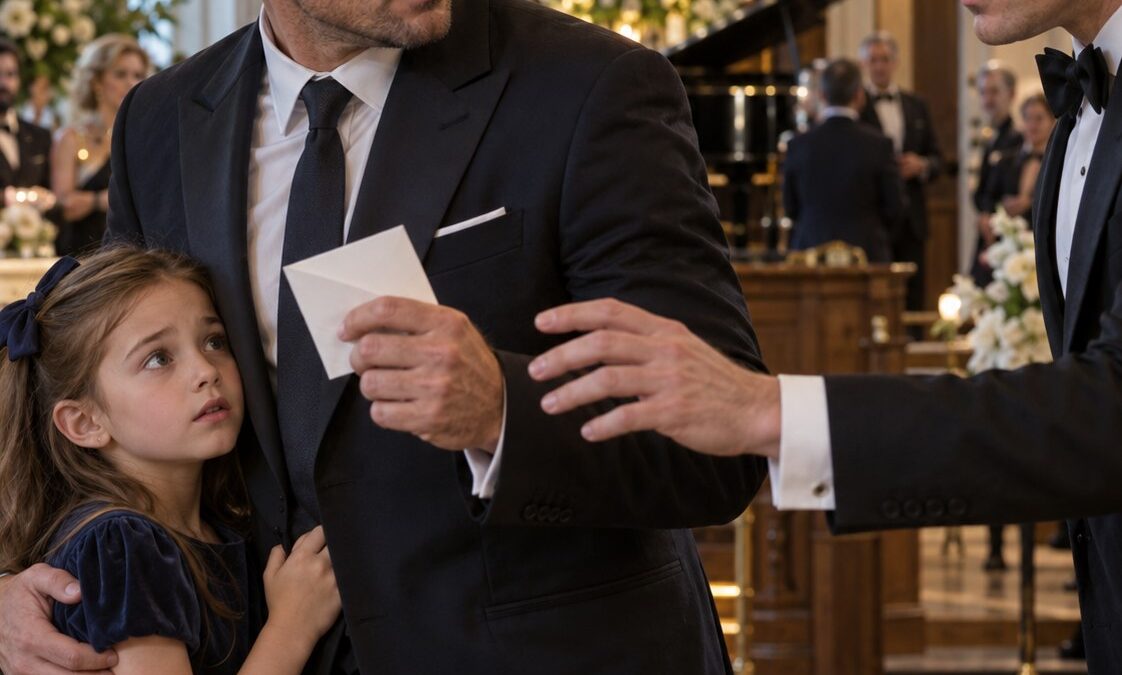
Ben read the note twice.
Adrian reached for it.
Ben held it away.
“Who has the key?”
“I don’t know.”
“You saw his handwriting.”
“Yes.”
Adrian’s phone was still connected to the dispatcher.
He told her they had found evidence of a child inside the house. He gave her the service door’s location and said someone else might be in the passage.
The dispatcher asked them to move away.
Ben wanted to tear the door from its hinges.
He took Tess by the hand instead.
They retreated behind the piano, where they could see both the service door and the entrance to the room.
A low note sounded.
The organ’s keys had not moved.
Tess tightened her grip.
“Owen?”
Another note answered, higher this time.
Ben looked at the row of pipes.
There had been three sounds before.
Owen had stopped after the third.
Ben understood why when a narrow panel beside the largest pipe shifted outward.
It opened barely an inch.
One of Owen’s eyes appeared in the gap.
Ben was moving before he knew he had stood.
“Stay where you are,” he told Tess.
Owen shook his head.
His face vanished.
From beyond the panel came a man’s voice.
“Come away from there.”
Ben stopped.
He could not see the man. He could see the panel close.
Adrian spoke into the phone.
“There’s another adult inside.”
The dispatcher told him officers were two minutes away.
Two minutes filled the room.
Ben heard a door open deeper in the passage.
Then a muffled thud.
The panel opened again.
Owen pushed his face against the gap.
“I locked him out,” he whispered.
Ben pulled at the edge of the panel. It was held by a simple catch.
He lifted it.
Owen crawled through an opening too small for Ben’s shoulders. His cheeks were hollow, and his shirt hung loosely on him, but he could stand.
Ben caught him.
For a moment, the whole room narrowed to the weight of his son.
Owen smelled of dust and the orange soap they kept at home.
Tess ran to them.
Owen put one arm around her.
Ben kept his eyes on the panel.
“Who’s in there?”
Owen shook against him.
“Mr. Pike.”
Adrian made a sharp sound.
“Gavin Pike?”
Owen nodded.
Pike was Adrian’s household manager. He arranged repairs, hired temporary staff, and knew every door in the house.
Ben had seen him that morning directing caterers across the lawn.
Adrian stepped toward the service door.
Ben stopped him.
“Stay with us.”
Outside, sirens rose past the gates.
Pike tried the bolted door.
Once.
Then again.
He went quiet when the first officer called from the hallway.
Two officers entered the music room. Ben told them where Owen had come through and pointed to the passage doors on the floor plan Adrian pulled up on his phone.
One officer stayed with the family.
The other went out to meet arriving colleagues.
A few minutes later, Ben heard a man protesting in the hall.
“I work here,” the man said.
The officer beside Ben did not move.
Owen’s fingers closed around Ben’s sleeve.
“He didn’t bring me here,” Owen whispered.
Ben looked down.
Pike’s voice faded toward the front of the house.
“Then who did?”
Owen glanced at Adrian.
His uncle’s face seemed to fold.
“Uncle Adrian found me,” Owen said.
* * *
Paramedics examined Owen in an upstairs bedroom after the officers cleared it.
Tess sat at the foot of the bed, guarding the silver whistle.
Ben had picked it up from the floor and given it to her. She held it in both hands.
Owen drank water slowly. He ate half a banana and fell asleep before he could finish it.
The paramedic told Ben he needed a hospital assessment. His condition did not appear urgent, but eleven days away from home left questions nobody should guess at.
Ben agreed.
He wanted his son somewhere he could see the door.
Adrian waited in the hall with a detective named Faye Brennan. Ben had spoken to her every day since Owen vanished.
She let him choose where they would talk.
They went into a small sitting room across from the bedroom. Ben kept the door open.
“Start at the beginning,” Brennan said.
Adrian stared at his hands.
“Four nights ago, I found a photograph under my front door.”
It showed Owen sitting on a cot.
Adrian had kept it in a locked drawer in his study.
Brennan’s expression hardened.
“You didn’t give it to us.”
“No.”
“Why?”
“There was a message on the back.”
Adrian recited it from memory.
If police see this, Ben loses both children.
Ben felt the edge of a chair against his legs.
“That was the threat?”
“There was more.”
Adrian took a breath.
The message claimed Owen would be released once Ben signed documents concerning the East Ferry Station. Adrian had not called Ben because the writer promised to make Tess disappear too.
Ben had spent his career maintaining locks on city buildings. He knew the station. His father had owned its disused east wing, which was now held in a family trust.
Adrian managed the trust.
Ben had a vote on major decisions.
Neither brother had agreed to sell the building.
Evelyn, Adrian’s wife, believed they should.
She had made that case for years.
“Why didn’t you tell Brennan?” Ben asked.
“I thought I could find him first.”
“You had four days.”
“I know.”
Adrian did not offer anything else.
Brennan asked what he had done.
Adrian had taken the photograph to a private security consultant. Together they compared the room behind Owen with spaces used by the family’s foundation. They found nothing. The cot could have been anywhere.
Then Adrian checked the security cameras at the house.
That afternoon, footage showed Pike bringing a covered equipment cart through the rear entrance. An hour later, Pike came out without it.
Adrian had called Brennan from the hallway when Tess heard the organ.
“Why was Pike still working here?” she asked.
“I hadn’t checked the footage until tonight.”
Adrian looked at Ben.
“I was going to tell you.”
“You should have told me four nights ago.”
“Yes.”
Ben’s voice was steady. He could not tell whether that was good.
Brennan asked to see the photograph and message. Adrian took her to his study.
Ben stayed where he could hear Owen breathing across the hall.
He had trusted Adrian with every part of the search that money could reach.
Adrian had given him search maps, calls from specialists, and a place to bring Tess. All the while, he had held proof that Owen was alive.
Ben could understand the threat.
He could not understand being left alone with uncertainty.
An officer brought Gavin Pike past the open doorway.
Pike wore a dark suit and a badge from the catering staff. He looked toward the bedroom.
Ben stepped into the hall.
Brennan came out of the study at once.
“Mr. Mercer, stay here.”
Pike’s expression did not change.
“I tried to get the boy out,” he said.
“You locked the passage,” Ben replied.
“He went into the organ by himself.”
Owen called from the bedroom.
“That part’s true.”
He had woken.
Ben went to him.
Owen’s eyes were fixed on the door.
“Mr. Pike came for me today,” he said.
“From where?”
“A house with blue stairs.”
Brennan entered and crouched beside the bed. She spoke softly, asking only what Owen felt able to say before the hospital.
Owen told her a woman had met him outside the library.
He had gone with her because she said Tess was hurt.
He had asked to call Ben once they reached her car.
The woman said they were almost there.
They had driven somewhere else.
Ben kept his hands open at his sides.
Owen had spent eleven days asking to come home. People brought him food and told him to wait. That afternoon Pike had moved him in the covered cart, through an enclosed passage from the garage.
At the house, Owen heard music from the organ.
He knew Tess would recognize their tune if he could reach the pipes.
“He gave me my whistle back,” Owen said.
“Who did?”
“Mr. Pike.”
“Why?”
Owen looked at the blanket.
“He said I might need it.”
Brennan asked about the woman at the library.
Owen remembered her hair, her coat, and a ring shaped like a leaf.
Evelyn wore a leaf-shaped ring.
Ben had seen it flash beside Adrian’s face at dinner after dinner, as she told him she would help bring Owen home.
* * *
Brennan did not treat a child’s memory as the end of the investigation.
She arranged for Owen to speak later with a trained interviewer. First came the hospital, rest, and a chance for the family to be together without more questions.
Ben rode with Owen in the ambulance.
Tess came with them, her hand around the whistle.
Adrian followed in his car after giving police the photograph, his phone, and the camera footage.
At the hospital, Owen had blood tests and a careful examination. He was tired and dehydrated. The doctor expected him to recover with food, sleep, and follow-up care.
Ben sat beside him through the night.
Whenever Owen woke, he checked that Ben was still there.
“I am,” Ben told him.
Owen nodded and slept again.
At dawn, Tess asked whether she could give him the whistle.
Ben looked at Owen.
“Would you like it?”
Owen held out his hand.
The dent faced upward when Tess laid it in his palm.
“I heard the organ,” she told him.
“I heard you talking.”
“I said you were there.”
“I know.”
Tess leaned against him carefully.
Ben turned toward the window. Outside, the hospital parking lot filled with people going to ordinary appointments.
He had forgotten how ordinary a morning could look.
Brennan returned after breakfast with updates.
Pike had been arrested on suspicion of taking part in Owen’s confinement. He had requested a lawyer. The house with blue stairs had been located through toll records for a foundation van and footage from a gas station along its route.
Officers found children’s books there, unopened food packets, and clothes in Owen’s size. The property had been rented by a company tied to the foundation.
Brennan had also spoken to the library.
A camera inside showed Owen leaving the children’s room at 2:17. He followed a woman out of frame. The parking lot camera that might have caught her car had been under repair.
Ben knew that camera.
His crew had fixed the lock on its electrical cabinet three months earlier.
The cabinet had a city seal. Someone had opened it again on the day Owen vanished.
He told Brennan.
“Could that have stopped the recording?” she asked.
“It could have,” Ben said. “I can give you the work order and the key log.”
She wrote it down.
Those records showed who had requested access and who could sign for a key. Ben was careful to explain what they could prove. They would show a request, not who had actually opened the cabinet.
“I’ll get a technician to examine it,” Brennan said.
She also had a question about the note Owen had pushed under the service door.
The place card was from Evelyn’s dinner.
Pike had locked Owen in the passage after Owen tried to reach the music room. Owen found the card among supplies left by an electrician. On its back, he wrote the warning with a stub of pencil from the same box.
Ben had thought the note meant Pike held another key.
Owen told Brennan he meant someone else.
“He told Mr. Pike to lock me in,” Owen said.
“Did you see him?”
“I heard him.”
“Did you know his voice?”
Owen nodded.
Ben braced himself for Adrian’s name.
“Mr. Voss,” Owen said.
Martin Voss was Evelyn’s business adviser.
He had sat across from Ben twice since Owen vanished, offering to arrange a larger reward. He had assured Tess that everyone in the room was working for her brother.
Brennan did not react.
She asked Owen what Voss had said.
“He said Uncle Adrian was getting close.”
By noon, officers had seized the foundation van, and a judge had approved searches of the blue-stair house and Pike’s office.
Voss’s name appeared on an invoice for security work at the house. Pike’s lawyer told Brennan his client wanted to give a statement.
Pike claimed Voss hired him to move Owen. He said he had believed the boy was being held during a family dispute and that he knew it was wrong. He gave investigators the address and the names of two others who had delivered food.
His account did not excuse what he had done.
It did help the police find the route between the house and Adrian’s estate.
That evening, Ben’s phone lit with a message from Evelyn.
Adrian tells me Owen is safe. Please say you’ll let me see him.
Ben showed it to Brennan.
“Don’t answer yet,” she said.
Evelyn had been at the fund-raiser throughout the search of the organ. She could say she knew nothing about Pike’s work or Voss’s plans.
The detectives needed to establish what she knew and when.
Ben understood.
He also remembered her hand on Tess’s shoulder the previous week. She had told Ben to eat something because Owen would need him strong.
At the time, he had mistaken her attention for kindness.
Brennan’s phone rang.
She listened, then asked a short question and stepped into the hall.
When she came back, she held a photograph on her screen.
It showed the woman beside Owen at the library entrance. The view came from a delivery driver’s dashboard camera, found after officers revisited the businesses across the street.
The face was clear.
The woman was Evelyn.
* * *
Adrian came to the hospital after Brennan left.
He stopped outside Owen’s room and waited until Ben saw him.
Owen was asleep.
Tess was coloring at the window.
Ben stepped into the hall.
“Brennan knows about Evelyn,” he said.
Adrian’s hand went to the wall.
He had defended his wife for eleven days while she helped direct the search.
“I gave them our accounts,” Adrian said. “Every password they asked for.”
“Good.”
“I thought Martin was pressuring her about the station.”
“Did you ask?”
“She said he was arranging a loan.”
Ben looked through the glass at his children.
The East Ferry Station had sat empty for nearly twenty years. Their father bought the east wing when the city gave up its old parcel office. He had planned to turn it into a community workshop, then died before he could.
Adrian wanted to restore it.
Ben wanted the city to use it.
Evelyn wanted it sold to a developer who planned apartments on the site.
They had argued at holidays. Nobody had imagined Owen could become part of that argument.
Brennan had asked Ben to come downtown after Owen settled. He brought the city’s key log and three work orders.
The cabinet at the library lot had been reported faulty two weeks before Owen disappeared. A company named Northline Security requested access to replace a cable. The job never appeared on the city’s maintenance schedule.
Voss owned Northline.
A technician found that the camera’s power had been disconnected inside the cabinet. The cable was sound.
That fact made Ben cold.
Someone had made room for the woman in the leaf-shaped ring.
Investigators were also tracing the foundation’s money. Adrian had authorized a legitimate feasibility study for the station. Voss submitted invoices for surveys and legal work. Some had no matching reports.
Evelyn had approved them as chair of the foundation.
Brennan explained what they knew and what they did not.
Money had left the foundation.
Owen had been taken.
Voss and Pike were connected to both.
They still needed proof of who had ordered the abduction and why.
Ben went home with Tess that night. Owen stayed for one more observation before coming home in the morning.
The house was painfully neat.
A clean cup waited beside Owen’s plate.
Ben filled it with water and left it there.
Tess stood in the hallway, holding the whistle.
“Can I sleep in your room?”
“Yes.”
“Can Owen?”
“Yes.”
She considered that.
“Can you?”
Ben managed a small smile.
“It is my room.”
“I wanted you to ask.”
He did.
They moved blankets onto the floor so Owen could choose where to sleep when he came home.
The next morning, someone placed a white envelope on Ben’s doorstep.
Inside was a copy of an old family trust document. A yellow marker highlighted his vote on any sale of the station.
There was no note.
Ben photographed the envelope where it lay and called Brennan.
He did not touch the paper again.
Tess watched him from the stairs.
“Is it from the bad people?”
“I don’t know.”
“Are they coming here?”
“Officers are checking.”
Ben closed the blinds, then stopped himself from closing every one.
Tess had spent eleven days in a house full of fear. He would keep her safe without teaching her that daylight was dangerous.
An officer collected the envelope.
Another stayed nearby until Owen was discharged.
At the hospital, Owen asked to go straight home.
Ben said they would.
Owen held his whistle but did not put it around his neck. The cord had disappeared at the blue-stair house.
“We can get you a new one,” Ben said.
“I want this one.”
“You can keep it.”
Owen studied the dent.
“I thought Tess would hear it if I got close enough.”
“She heard you.”
“She always does.”
By afternoon, Brennan called.
A delivery service had dropped the envelope. Voss’s office had ordered it. His assistant said he was out of town.
He was not.
His car had been found at a private airfield an hour away.
Officers reached him before he boarded a plane.
Brennan would not discuss his interview yet.
She did tell Ben the foundation records revealed a debt Evelyn had kept from Adrian. She had guaranteed a large loan for a failed property venture. The lender was demanding payment.
The station sale would have covered it and left enough to hide money already taken from the foundation.
Evelyn could not sell without both brothers.
Voss had proposed a forged agreement, according to documents recovered from his office.
Ben’s signature was the obstacle.
Evelyn had spent weeks trying to make him sign a broad legal waiver as part of a supposed search fund. He had refused because the document gave her lawyer authority over trust matters.
The day after he refused, Owen vanished.
Ben sat at the kitchen table with the phone against his ear.
Across from him, Owen taught Tess how to make the whistle’s lowest sound without blowing hard.
Ben watched them until Brennan asked whether he was still there.
“Yes.”
“We’re going to speak with Evelyn,” she said.
“Is she with Adrian?”
“She’s at the foundation office.”
Ben looked at Owen’s hands.
He wanted Evelyn to see exactly what she had done to them.
He stayed at home.
The detectives would go to her.
* * *
The public had learned Owen was safe.
Adrian’s staff had asked for a short statement to stop reporters from gathering outside Ben’s house. Ben let Brennan approve the wording first.
Owen was home. The family requested privacy. The investigation continued.
By the next morning, a reporter had found the foundation’s payments to Northline Security.
Adrian called Ben.
“The board has called an emergency meeting,” he said.
“Are you going?”
“I have to.”
“Then tell them what you withheld.”
“I will.”
Ben believed he meant it.
That did not repair the four days.
Brennan called shortly afterward. Evelyn had agreed to meet with investigators and brought a lawyer. She denied knowing Owen was at the blue-stair house. She said the library photograph showed her speaking to him, then leaving him with someone she believed Ben had sent.
Ben asked who that person was.
“She hasn’t named anyone,” Brennan said.
Evelyn also claimed Voss had managed the security invoices without her knowledge.
The board meeting mattered because it would preserve records and remove her access to accounts. Adrian asked Ben to attend as a trustee and witness.
Brennan said he could. She asked him not to question Evelyn about the case.
Ben brought the whistle in his coat pocket.
He did not plan to show it to anyone. He needed something his son had touched.
The meeting took place in a glass room above the foundation’s public gallery. Six board members sat around a table. Adrian sat at one end.
Evelyn sat at the other with her lawyer.
Her leaf-shaped ring lay against a closed folder.
Ben took a seat beside the door.
Adrian began with the photograph he had withheld and the threats written on its back. He told the board when he received it, what he had done, and what he had failed to do.
His voice broke once.
He continued.
Evelyn listened without changing expression.
When Adrian finished, she opened her folder.
“My husband acted from fear,” she said. “I understand why.”
She acknowledged meeting Owen at the library. She said she had promised to help him find Ben after he received a message on his tablet.
“There was no message,” Ben said.
Her lawyer turned.
Ben looked at Adrian.
“I’m sorry,” he said. “I’ll let her finish.”
Evelyn set one page on the table. It was a screenshot from Owen’s tablet, showing a message from a number saved as Dad.
Come outside. Tess is hurt.
For one sick second, Ben stared at it.
He had not sent it.
The number beneath the saved name was different from his.
Brennan had already found the device at the blue-stair house. The message had come from a prepaid phone bought by Voss’s assistant.
Evelyn knew the board might not know that.
She explained how easily a child could misunderstand an adult’s help. She said her meeting with Owen had been brief. She said Voss had exploited the family’s panic and used her name to gain access.
One board member asked why she had not told police she had seen Owen.
“I was advised to let investigators work,” she said.
Her lawyer looked down.
It was a careful answer. It might have satisfied people who wanted the meeting to end.
Then Adrian placed the foundation’s bank records on the table.
Evelyn had personally approved Northline’s first payment three days before Owen disappeared. She had approved its last payment the morning Pike brought him to the estate.
She said the approvals were routine.
Another board member asked about the missing survey reports.
Evelyn said Voss had them.
She argued well. She named procedures, committees, and signatures. She reminded the board that suspicion could ruin innocent people.
Ben could hear the effort it took Adrian to stay seated.
A knock came at the door.
Brennan entered with another detective. She had arranged to speak with the board after its counsel preserved the records.
The board chair asked Evelyn to remain.
Evelyn’s lawyer rose.
Brennan did not announce an arrest.
She asked for access to the foundation’s server backups and gave counsel an order authorizing a search of specified accounts.
The foundation’s own accountant, seated beside the chair, handed her a sealed drive.
The accountant had been asked the previous night to preserve data. She had found a version history on a shared folder Evelyn believed Voss controlled alone.
It showed who created the station waiver.
It showed who edited it after Ben refused to sign.
And it contained an audio file attached to a draft email.
The file was not played at the meeting. Brennan summarized what investigators had verified: it recorded Evelyn giving Voss instructions to keep Owen somewhere Ben could not find him until Ben signed.
Evelyn reached for her water glass.
Her hand missed.
“That file is incomplete,” she said.
“Your lawyer can address that,” Brennan replied.
The accountant added one more fact.
Voss’s invoices were marked approved from Evelyn’s own account. The server saved the device information for each approval. On the morning Owen vanished, the approval came from Evelyn’s office computer while a staff member saw her sitting at it.
Evelyn looked at Ben.
“You know what the station could have done for this family.”
Ben had spent eleven days searching alleys, calling hospitals, and sleeping beside an empty room.
He thought of all the ways the station could have helped.
“It could have waited,” he said.
Evelyn was arrested later that day after a prosecutor reviewed the evidence from Voss, Pike, the records, and Owen’s account. Voss faced charges too. Pike’s cooperation would be weighed in his own case.
The proceedings took months.
Ben gave a statement. Adrian testified about the photograph and accepted the consequences of withholding it. His failure made the investigation harder, and he said so under oath.
Evelyn’s lawyer challenged the recording and the payments. The court heard the full file, its source, and the server records that showed it had not been changed. The delivery driver testified about his dashboard camera. Owen’s recorded interview was handled through the process the court allowed for a child.
Ben listened only to the parts he had to.
He did not make Owen sit through more than the law required.
Evelyn and Voss were convicted for their roles in taking and confining him, along with financial offenses tied to the foundation. Pike pleaded guilty and was sentenced separately.
When Evelyn was led away, she looked back at Ben.
“You still have to decide what happens to the station,” she said.
“Yes,” he answered.
His children were waiting at home.
He went to them.
* * *
Spring came slowly that year.
Owen refused to go near organs. He also insisted on returning to the library.
Ben went with him on a Tuesday when the parking lot was quiet. Tess brought a stack of books she had already read and wanted to return herself.
Inside, Owen chose a book about bridges.
He carried it to the desk and checked it out.
Ben made no speech about courage.
On the way home, they stopped for ice cream. Tess ordered a flavor she disliked because its color looked interesting. Owen traded with her after three bites.
She thanked him as though she had planned it.
At home, the whistle hung from a new cord on Owen’s bedpost.
He used it once when Ben was downstairs fixing a sticking drawer. Ben came up at once.
Owen grinned.
“I wanted to see if it worked.”
“It works.”
“Even with the dent?”
“Especially with the dent.”
Some nights remained hard.
Owen woke and needed the hall light.
Tess checked his room before she went to sleep.
Ben learned to ask what each child wanted on a difficult day. Sometimes they wanted to talk. Sometimes they wanted pancakes and a movie that had nothing to do with being brave.
Adrian called every week.
At first, Ben answered only to tell him how Owen was doing.
Later, he let Adrian speak to the children when they asked.
Adrian apologized to Owen without explaining away the photograph.
“I should have told your dad,” he said.
Owen considered him carefully.
“Were you scared?”
“Yes.”
“I was too.”
Adrian closed his eyes.
Ben did not tell Owen to forgive him.
He told Adrian that visits would be arranged in advance and that no decisions about the children would be made without him. Adrian agreed.
Months later, Adrian came to Ben’s house for dinner.
He brought a pie. The bottom had burned.
Tess ate the filling and asked whether he had made it that way on purpose.
“No,” Adrian said.
“Good,” she replied. “Then you can learn.”
It was the first time Ben had heard all three of them laugh in the same room.
The foundation changed its board and recovered what money it could. Adrian stepped back from daily management.
Then he brought Ben an offer.
A developer still wanted the East Ferry Station. The price was high enough to restore Adrian’s finances after the legal costs and give Ben a sum that would change the way he worked and lived.
Ben read the offer at his kitchen table.
Owen built a paper bridge nearby.
“What do you think?” Adrian asked.
“I think Dad would hate the apartments.”
“He would.”
Ben ran one finger down the proposed sale terms.
The station had been his father’s unfinished promise. Ben had held on to it partly because selling felt like losing him again.
Now he could see another reason.
The east wing had a broad ground floor, strong old beams, and doors that opened straight onto a public sidewalk. It could hold the workshop their father wanted.
It could also give young people a place to learn practical work.
Ben said no to the sale.
He and Adrian took a different proposal to the city: a long lease at a low rate for training programs, repairs, and a public room. They could afford the renovation by selling a smaller parcel beside the station and using grants the city already offered for old buildings.
The city asked for inspections, insurance, and a budget.
Ben did the work.
Adrian paid for an independent lawyer so both brothers understood the trust’s obligations. Ben chose his own lawyer.
They signed only after the numbers made sense.
The first class taught teenagers how to repair bicycles.
Ben helped on Saturdays. He showed one girl how to test a lock without forcing it and one boy how to ask for help before a screw stripped.
Owen watched from the doorway.
“Can I join when I’m older?”
“You can help sort parts now.”
“That sounds boring.”
“It is,” Ben said.
Owen stayed and sorted them anyway.
Evelyn wrote Adrian several letters from prison. Adrian told Ben when one mentioned the children.
Ben asked him not to pass those parts along.
If Owen wanted to know more when he was older, Ben would answer honestly. He would not let Evelyn reach him through adults who felt obligated to be polite.
Adrian accepted the boundary.
One evening, Owen came to the workshop with the whistle around his neck.
He found Ben testing the front door.
“Will this one lock?” Owen asked.
“Yes.”
“Can people get out?”
“Always.”
Owen watched him check the handle from the inside.
Then he asked if he could try.
Ben stepped aside.
* * *
Five years later, the pipes were silent.
Adrian had donated the old organ to a conservatory after selling the house. Before it was moved, the service passage was inspected, repaired, and closed in a way that let workers reach it safely.
The music room became a public space for small concerts.
Tess returned there at twelve with her school choir.
Ben sat beside Owen in the last row.
Owen was fourteen now, tall enough that his knees reached the seat ahead. The silver whistle lay in his pocket. Its cord had frayed years ago, and he had never replaced it.
Tess walked past the place where the organ bench had stood.
She paused.
Ben saw her glance at the wall.
Then she crossed the room and joined her friends.
She sang clearly.
Afterward, Adrian met them near the door. He asked whether Tess wanted a photograph with the choir.
“Only if you all get in it,” she said.
They stood beneath the empty space where the pipes had risen.
Adrian put an arm around Owen’s shoulders after Owen nodded.
Ben held the camera while Tess directed everyone into the light.
“Listen first,” she told them.
They stopped moving.
From the lawn came children calling to one another. A door clicked gently shut. Somewhere inside, a piano sounded its first uncertain note.
Tess smiled.
“That’s better.”
The photograph caught all four of them looking toward her.
Later, Ben kept it beside an older picture of the East Ferry Station on its opening day.
The station had classrooms now.
A working front door.
Young people coming and going.
At home, Owen set the whistle on a shelf above his desk. The dent still made it unmistakably his.
Tess sometimes played their old tune on the piano. She always changed the last note.
Ben asked why.
“Because he comes home,” she said.
That evening, Owen played the new ending back to her.
Ben heard it from the kitchen, where dinner was nearly ready and every cup had someone to fill it.
THE END