I Came Home From My Baby’s Scan and Found My Husband and Best Friend Using the Crib to Hide a Forged Sale
Chapter 2: The Name on the Receipt
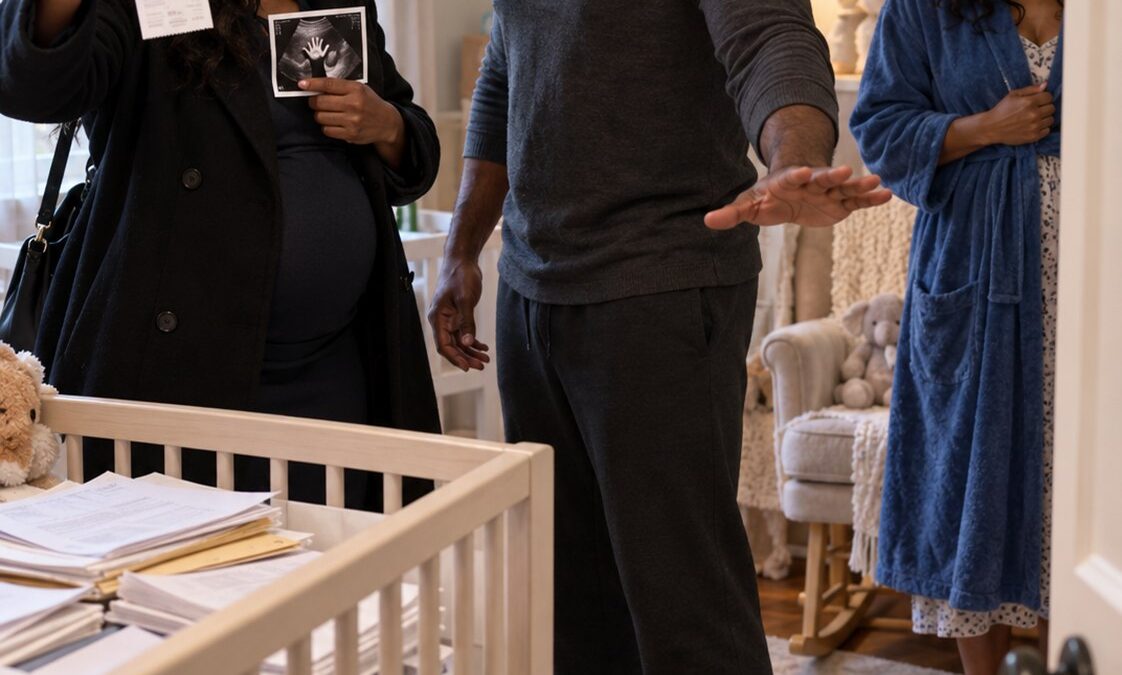
Julian stood between the crib and the door.
I held the ultrasound against my coat.
“Let me see the contract,” I said.
“You already did.”
“The original.”
Brenna folded her arms.
“There isn’t one.”
I looked at the wet blue ink beside my name.
She followed my eyes.
“Rowan,” Julian said, “please sit down.”
“I’m calling the title company.”
“That would make this worse.”
“For whom?”
He had no answer.
My phone rang again.
The same number appeared.
I answered and put it on speaker.
“Ms. Vale?” a woman asked.
“Yes.”
“This is Denise Park at Northline Title.”
“I saw your call.”
“We have an authorization bearing your signature.”
“I didn’t sign it.”
Denise paused.
“Are you somewhere private?”
I looked at Brenna in my robe.
“I’m at home.”
“I need to secure the file,” Denise said.
“Please email that statement to me.”
“I will.”
Julian held out a hand.
“Denise, this is Julian Vale.”
“I know who you are,” she said.
He lowered his hand.
“We’re reviewing a family transaction.”
“Your wife says she didn’t sign.”
“The document isn’t final.”
“Then I can hold it without inconveniencing you.”
Brenna looked at the window.
I looked at the crib.
Our daughter’s mattress had arrived that morning.
Julian had promised to put it in place before dinner.
“Who delivered the packet?” I asked.
Denise checked her screen.
“It was uploaded from your office account.”
“Which account?”
She gave Brenna’s name.
Brenna’s jaw tightened.
“I sent a draft,” she said.
Denise heard her.
“A signed authorization is not a draft.”
“I can send you the source file,” Brenna said.
“Please send nothing further tonight,” Denise replied.
She gave me a case number.
I repeated it aloud and wrote it on the back of my clinic parking slip.
Then I asked her to preserve the uploaded file and its history.
“I’ve already requested that,” she said.
When the call ended, Julian sank into the rocking chair.
It was the chair my mother had bought.
She had died before she could see the nursery painted.
Brenna remained standing.
“Did you know she uploaded it?” I asked Julian.
“I knew she was preparing it.”
“Did you know she signed my name?”
“I didn’t see her do it.”
“That isn’t what I asked.”
He rubbed his forehead.
“Mercer costs us money.”
“Mercer has tenants.”
“The upper floors are empty.”
“They won’t be after the repairs.”
Brenna spoke quietly.
“You’ve said that for two years.”
I looked at her.
She knew why the repairs had taken two years.
One contractor had disappeared with an advance.
My mother’s illness had consumed the spring after that.
Brenna had sat beside me at both meetings with the bank.
“Take your shoes,” I told her.
Julian stood.
“Don’t throw her out.”
“She can leave through the front door.”
Brenna collected her shoes.
At the threshold, she turned.
“I was here for you last year.”
“I remember.”
Her eyes flicked to the ultrasound.
Then she left.
Julian waited until the front door closed.
“We made a mistake,” he said.
“You both made several.”
“I’m still your husband.”
“I’m aware.”
I laid the ultrasound on the dresser, away from the papers.
Our daughter’s face was a pale curve on the print.
Julian saw it.
His expression changed.
“How is she?”
“The doctor said she’s growing well.”
He nodded and sat down again.
For one second, I saw the man who had built the nursery shelves.
Then my phone vibrated.
Denise had emailed the case number and the name of the person who requested the closing.
The request had been opened three weeks before my scan.
Three weeks before Julian first mentioned selling Mercer.
Brenna had opened it.
* * *
I slept in the guest room with the door locked.
Julian did not knock.
At seven, I called my attorney, Adele Knox.
She had written the operating agreement for Vale House when I inherited my mother’s share.
She had also watched me buy out the remaining investors over six years.
“Bring every page you photographed,” she said.
“And the receipt.”
“Should I bring Julian?”
“No.”
I left the house before he woke.
The crib was empty when I passed it.
The mattress leaned against the wall.
He had moved the papers, but I had the title company’s case number.
Adele met me at her office with a legal pad and a box of tissues.
I took the pad.
She left the tissues where they were.
I told her about the robe, the contract, and the message on Brenna’s phone.
I showed her the photographs.
She enlarged my signature.
“Did you sign any sale authorization?”
“No.”
“Did you give either of them permission to negotiate?”
“Julian asked about the building.”
“What did you say?”
“I said we would review repairs in November.”
Adele wrote that down.
She called Denise with me present.
Denise confirmed that Northline had stopped work on the file.
The buyer had not sent funds.
No deed had been recorded.
An unsigned closing appointment sat on the calendar for the following Friday.
Adele asked Northline to preserve its communications and advised them in writing that I disputed the authorization.
Then she called the office.
My assistant, Hester, answered.
“Please restrict Brenna’s access to company files,” I said.
Hester hesitated.
“She’s in the conference room.”
“With whom?”
“Julian.”
“Tell them access is being reviewed.”
Adele held out her hand for the phone.
She gave Hester the name of an outside computer specialist we used for contract disputes.
He would preserve account activity before anyone touched the devices.
I wanted to call Brenna myself.
Adele saw it.
“Wait until we know what she can still reach.”
I set the phone down.
That was a choice I could make.
Mercer stood eleven blocks from my office.
Its marquee still carried the faint outline of letters from a movie theater that closed before I was born.
My father had taken me there once, when the lobby housed a temporary market.
He showed me how the carved plaster had been repaired.
He died before I bought it.
I had never told Julian that part of the purchase mattered more to me than the numbers.
He knew the numbers.
That should have been enough to keep him honest.
By noon, the specialist had copied Brenna’s work account and secured her company laptop.
Hester brought me the access log.
Brenna had entered the property folder forty-eight times in a month.
She had downloaded the appraisal, the repair budget, and a list of tenants.
Julian had approved her access as a consultant.
“Who hired her?” Adele asked.
“Julian.”
“Who paid her?”
“Vale House.”
I felt heat climb my neck.
Brenna had told me she was helping Julian organize donor prospects for a community arts fund.
Instead, I had paid her to study my building.
The copier receipt gave us another lead.
Hester matched its machine number to the copier outside Julian’s office.
The time was 9:14 that morning.
My appointment had been at nine.
I had told Brenna when I would be gone.
Denise sent the uploaded authorization and its earlier versions to Adele.
One version carried a note from an account with Brenna’s initials.
Need owner signature before prenatal appointment ends.
I read it twice.
Adele did not take the page away.
“We can establish who sent it,” she said.
“I want to know who wrote that note.”
“So do I.”
There was one more attachment.
It was a draft email to a bank requesting proof of available funds from the buyer.
The address belonged to a company called Lantern Quay Partners.
Hester searched our vendor records.
The company had never done business with us.
Adele found its public registration.
Brenna was not listed.
Her older brother was.
* * *
Brenna’s brother, Peter, ran a small construction brokerage.
I had met him at two holiday dinners.
He was polite, forgettable, and always short of parking money.
Adele warned me that a public registration did not prove who controlled the buyer.
“We follow the money,” she said.
I returned to the office.
Julian was waiting in my conference room.
He had dressed for work.
His jacket hung on the back of a chair.
Hester stood near the door.
“Can we talk alone?” he asked.
“You can talk here.”
He glanced at Hester.
She looked at me.
I nodded for her to leave the room, and she closed the door behind her.
Julian lowered his voice.
“Brenna says her account has been frozen.”
“It has.”
“She can’t finish the arts fund proposal.”
“She didn’t start one.”
His mouth opened, then closed.
I placed a copy of the appraisal on the table.
“Mercer was valued at eight million four hundred thousand dollars.”
“I know.”
“Your contract sells it for four million one.”
“There are repairs.”
“Those costs are in the appraisal.”
“Brenna found a buyer willing to take the risk.”
“Her brother.”
Julian gripped the chair.
“He’s a broker.”
“He owns the buyer.”
“He told me he had investors.”
“Did you ask their names?”
“No.”
I waited.
Julian looked at the door.
“He said the money would clear.”
“How much were you getting?”
His eyes came back to mine.
“Nothing.”
I put the contract beside the appraisal.
The gap between the numbers sat plainly on the table.
“You signed a fee agreement,” I said.
He looked startled.
I had guessed.
Now I knew where to look.
“Brenna handled it,” he said.
“How much?”
“She said we could pay down the apartment.”
The apartment was in my name.
My mother had helped me buy it before the wedding.
Julian knew that too.
He took a breath.
“I thought we were building something together.”
“We were.”
“You make every decision.”
“I make decisions about property I own.”
“You didn’t even tell me you bought out the last investor.”
“I told you the deal closed.”
“You didn’t tell me what it meant.”
I studied him.
He had worked beside me for four years.
He knew the tenants’ names and the roof’s weak spots.
He had never asked to read the ownership records he signed each January.
“You thought you could sell Mercer,” I said.
“I thought the company could.”
“You thought I would agree once it was moving.”
He did not deny it.
My phone lit up with a message from an unknown number.
A photograph showed the outside of the clinic.
My car was visible at the curb.
The caption read: Hard to run a company from the waiting room.
Julian saw my face change.
“What happened?”
I showed him.
He frowned.
“That wasn’t me.”
“Who knew I parked there?”
“Brenna.”
He reached for my phone.
I kept it.
Adele told me to forward the message to her and save the original.
I did both.
That afternoon, she helped me notify the clinic about the photograph.
They checked their entrance cameras and agreed to preserve footage.
I asked Hester to arrange someone to walk with me between the office and my car for the next few days.
She chose herself.
At five, my younger sister, Willa, came over with soup.
She did not ask for the whole story.
She put bowls on the kitchen table and opened the ultrasound envelope.
“Oh,” she said.
Our daughter’s hand was visible in the corner.
“She looks like she’s waving.”
“She was moving.”
“Then she already takes after you.”
I ate three spoonfuls.
It was the first food I had managed since breakfast.
After Willa left, Adele called.
The bank had confirmed the buyer’s funding letter was genuine, but the account history raised questions.
Peter had received a large deposit two days earlier.
Adele could not yet see who sent it.
The specialist had found a fee agreement on Julian’s company laptop.
Julian would receive two hundred thousand dollars at closing.
Brenna would receive three hundred thousand through a consulting firm she owned.
That explained Julian’s part.
It did not explain why Brenna had pushed so hard for Mercer itself.
Adele had found a letter attached to her notes.
It was from a developer who had tried to buy the theater two years earlier.
He planned to demolish its back wall and join the land to a hotel site.
I had refused.
His project stalled.
The letter had been sent to Brenna’s private email.
It offered her a much larger payment if she acquired Mercer through Lantern Quay and transferred it to him.
The developer had asked for my decision.
Brenna had answered for me.
* * *
Adele arranged a meeting with Northline Title for Monday morning.
Denise agreed to attend with the title company’s counsel.
I invited our outside accountant and the two members of Vale House’s advisory board.
Neither had authority to sell Mercer.
Both had advised me on the repairs.
They needed to hear what had happened before Julian tried to speak for the company again.
Brenna came with a lawyer.
Julian came alone.
I sat at the end of the table with the ultrasound in my bag.
I had almost left it at home.
Then I remembered why I had driven back so quickly on Friday.
Denise opened the meeting.
“Northline has stopped the proposed sale,” she said.
“No closing is scheduled.”
Brenna’s lawyer nodded.
“My client welcomes a careful review.”
Julian stared at the table.
I gave the board a copy of the disputed authorization.
One member, Malcolm, adjusted his glasses.
“That isn’t your signature,” he said.
“It resembles it.”
“You dot your name differently.”
He had seen me sign hundreds of contracts.
Brenna leaned forward.
“Resemblance is not proof of forgery.”
Her lawyer placed a hand near her elbow.
She ignored it.
“Rowan authorized Julian to manage Mercer,” she said.
“I heard her say it.”
“You heard me authorize repairs,” I replied.
“You wanted out of the building.”
“I wanted the upper floors occupied.”
“You changed your mind whenever a sale became real.”
“That was my right.”
“You were under strain.”
I felt Julian move beside her.
“Brenna,” he said.
“She was grieving,” Brenna continued.
“She’s pregnant now.”
“She had weeks when she couldn’t face the accounts.”
My accountant looked up.
“I have every account review from that period,” he said.
“Rowan attended.”
Brenna’s face hardened.
“She signed things she forgot.”
That was the argument she had prepared.
A signature on a page.
A woman whose memory could be questioned.
I took the copier receipt from my folder.
It was creased where I had held it against the ultrasound.
“Who made this copy?” I asked.
Brenna looked at it.
“I don’t know.”
“The machine is outside Julian’s office.”
“Anyone can use it.”
“Your account sent the file to Northline.”
“My account was available to the team.”
“The note mentions my prenatal appointment.”
“I knew about it.”
“So did Julian.”
She turned to him.
He had not looked at her since arriving.
Denise’s counsel spoke.
“We have more than the uploaded page.”
Northline had retained the document history within its portal.
The version sent at 9:17 contained a typed signature image placed over the signature line.
The image came from an older agreement I had signed for a different property.
Its edges were visible when enlarged.
Brenna’s lawyer asked to see the original file.
Denise’s counsel handed him a copy.
He studied it without speaking.
“Did you upload this?” he asked Brenna.
“I uploaded what Julian gave me.”
Julian raised his head.
“I didn’t give you her signature.”
“You gave me access to the files.”
“I didn’t ask you to use it.”
There it was.
They could argue about who suggested the sale.
They could not both step away from the page.
Adele slid one more document across the table.
It was a written statement from Peter.
His lawyer had sent it that morning.
Peter said Brenna had directed the creation of Lantern Quay and supplied the deposit for its bank account.
The developer had supplied most of that money under an agreement Peter now wanted reviewed.
Peter had also given Adele the messages Brenna sent him.
One read: Rowan will never approve the hotel plan if she knows the buyer.
Brenna read the statement.
She looked at me with something I had once mistaken for concern.
“You were going to let that place ruin the company,” she said.
“The company can afford the repairs.”
“You could have had enough money to walk away.”
“I didn’t want to walk away.”
“You always get to want things.”
No one answered her.
Adele gathered the documents.
She said she would share them with the appropriate investigators and cooperate with Northline’s report.
The board voted to end Julian’s employment that day.
Our accountant began a review of payments he and Brenna had approved.
There was no dramatic arrest in the conference room.
There were people taking notes.
There were files being preserved.
There was Brenna leaving beside her lawyer, carrying the same bag she had brought to my baby shower.
Julian remained after everyone else went.
“I didn’t know about the developer’s payment,” he said.
“I believe you.”
He looked relieved.
“You knew enough.”
His relief disappeared.
“I loved this family.”
I opened my bag and showed him the ultrasound.
“She is your family,” I said.
“Being her father will depend on what you do next.”
He did not touch the picture.
Months passed before the legal cases settled.
Peter cooperated.
Brenna admitted to forging the authorization and hiding the developer’s agreement.
Julian admitted to his undisclosed fee arrangement and to helping prepare the attempted sale.
Their attorneys reached separate agreements with prosecutors.
The court imposed penalties and supervision.
My company recovered the fees it had paid for Brenna’s false consulting work.
The attempted sale never closed.
Mercer stayed ours.
At the end of the last hearing, Brenna stopped beside me.
“You still think the theater was worth all this?”
I looked at the doors behind her.
“No,” I said.
“My name was.”
* * *
My daughter was born on a rainy Tuesday in March.
We named her June.
Willa said the name sounded optimistic for a child who arrived during a thunderstorm.
June answered by sleeping through it.
Julian came to the hospital after I invited him.
He washed his hands, sat where I pointed, and held her for ten minutes.
He cried quietly.
I watched him carefully.
He did not ask me to comfort him.
Our divorce took longer than the criminal cases.
The company remained mine under its ownership records and our marital agreement.
We negotiated the rest with lawyers.
Julian moved into an apartment across town and took a job that had nothing to do with my business.
He attended the parenting classes we agreed on.
At first, visits happened with Willa present.
Later, when June was older and he had kept every appointment, we changed the arrangement.
I did not forgive him on a schedule.
I also did not want June to grow up carrying a quarrel she had never chosen.
One afternoon, he brought back a small sweater I had packed in her bag.
He had washed it.
It was half its former size.
“I read the label afterward,” he said.
“That was ambitious.”
“I bought another.”
He held up a bag.
Inside was the same sweater, two sizes larger.
June took the receipt and tried to eat it.
For a minute, the three of us dealt only with that.
Then Julian looked at me.
“I was angry you had more power,” he said.
“I used the work you trusted me with to take some.”
I took the receipt from June.
“Yes.”
“I’m sorry.”
“I hear you.”
He waited.
“That doesn’t change the rules,” I said.
“I know.”
He asked before he picked June up.
I said yes.
That became the shape of things.
A question.
An answer.
A choice each of us could live with.
Mercer’s repairs resumed in the summer.
The developer withdrew his hotel proposal and paid to resolve claims connected to his arrangement with Brenna.
After expenses and legal fees, Vale House had money left.
Malcolm suggested using it to finish the upstairs offices.
I agreed to part of that.
The rest funded low-cost rehearsal rooms on the ground floor.
My father had learned woodworking in a borrowed workshop.
I knew what a room someone could afford might change.
On opening day, teenagers carried music stands through the old lobby.
A woman in her seventies asked if the theater still had its original ticket booth.
It did.
She told June, who understood none of it, about the first movie she had seen there.
June held the woman’s finger.
Hester photographed them.
Later, my mother’s old rocking chair arrived from storage.
I had moved it out of the nursery after the sale attempt.
For months, I could not look at it without seeing Brenna.
I asked Willa to help carry it back upstairs.
“Are you sure?” she asked.
“Yes.”
We set it by June’s window.
I sat in it that evening while June slept against me.
The chair creaked.
The room was warm.
Nothing in it belonged to Friday anymore.
* * *
Five years later, June asked why there was a photograph of her in the Mercer lobby.
We stood beneath the repaired plaster ceiling.
She wore yellow rain boots and carried a paper crown from her school play.
“That’s you before you were born,” I said.
She studied the ultrasound in its frame.
“I looked like a bean.”
“You had a very good hand.”
She raised hers against the glass.
It nearly covered the pale shape in the picture.
A dance class was finishing upstairs.
Children came down the steps in uneven lines while their parents waited below.
June wanted to watch.
We sat on the bench beside the old ticket booth.
I had once driven home from a scan believing I knew what I would find there.
For a while afterward, I thought of that day whenever I saw the picture.
Now June leaned against my arm, humming a tune she had learned at school.
The picture had held the first glimpse of her.
It still did.
“What happens next?” she asked.
The dance teacher opened the lobby doors.
Sunlight crossed the floor.
“You can ask her,” I said.
June jumped down, straightened her crown, and went to join the children.
THE END